11 Six-Pack Abs Myths That Are Killing Your Results (And What to Do Instead)

Woman in a kitchen holding a donut beside healthier foods, illustrating six-pack-abs myths about diet choices and visible abs.

If you’ve ever felt like you’re doing everything “right” for your abs but still not seeing results, you’re not alone.

The problem usually isn’t your effort.
It’s the myths you’ve been told.

From “doing 200 crunches a day” to “never eat carbs again” to “you just don’t have the genetics”, six-pack abs advice online is full of half-truths and outright lies.

This guide breaks down 11 of the biggest six-pack myths and shows you what actually works instead, so you can stop wasting time and start moving toward visible, strong abs the smart way.

Understanding common six-pack-abs myths can help you focus on what really works.

Quick Answer: The Truth About Six-Pack Abs and Six-Pack-Abs Myths

If you don’t read anything else, remember this:

  • You can’t spot-reduce belly fat with ab exercises.

  • A visible six-pack comes from lower body fat + some ab muscle, not just crunches.

  • You don’t need extreme diets, detoxes, or “fat burner” pills.

  • Genetics matter, but they’re not everything, your habits matter more.

  • Consistency beats “hardcore for 2 weeks then quit” every single time.

Keep those truths in mind as you read each myth. Many bad ideas about abs fall apart once you understand these basics.

Why There Are So Many Six-Pack Abs Myths

Before we smash specific myths, it helps to understand why there’s so much bad info:

  • Social media loves extremes. Quick transformations and “one weird trick” videos get clicks. Boring habits that actually work? Not as viral.

  • We want shortcuts. “Do this one exercise every day for shredded abs” sounds more fun than “eat in a small calorie deficit for months.”

  • Marketing sells magic. Detox teas, fat burners, waist trainers—they make money by convincing you the basics aren’t enough.

  • Everyone’s different. People with naturally lean midsections share advice that might not fit someone with a different starting point, age, or lifestyle.

With that in mind, let’s tackle the big myths one by one.

11 Six-Pack Abs Myths

Myth #1: “Crunches Burn Belly Fat”

The myth:

If you just do enough crunches (or sit-ups, or leg raises), the fat around your stomach will burn off and reveal a six-pack.

The reality:

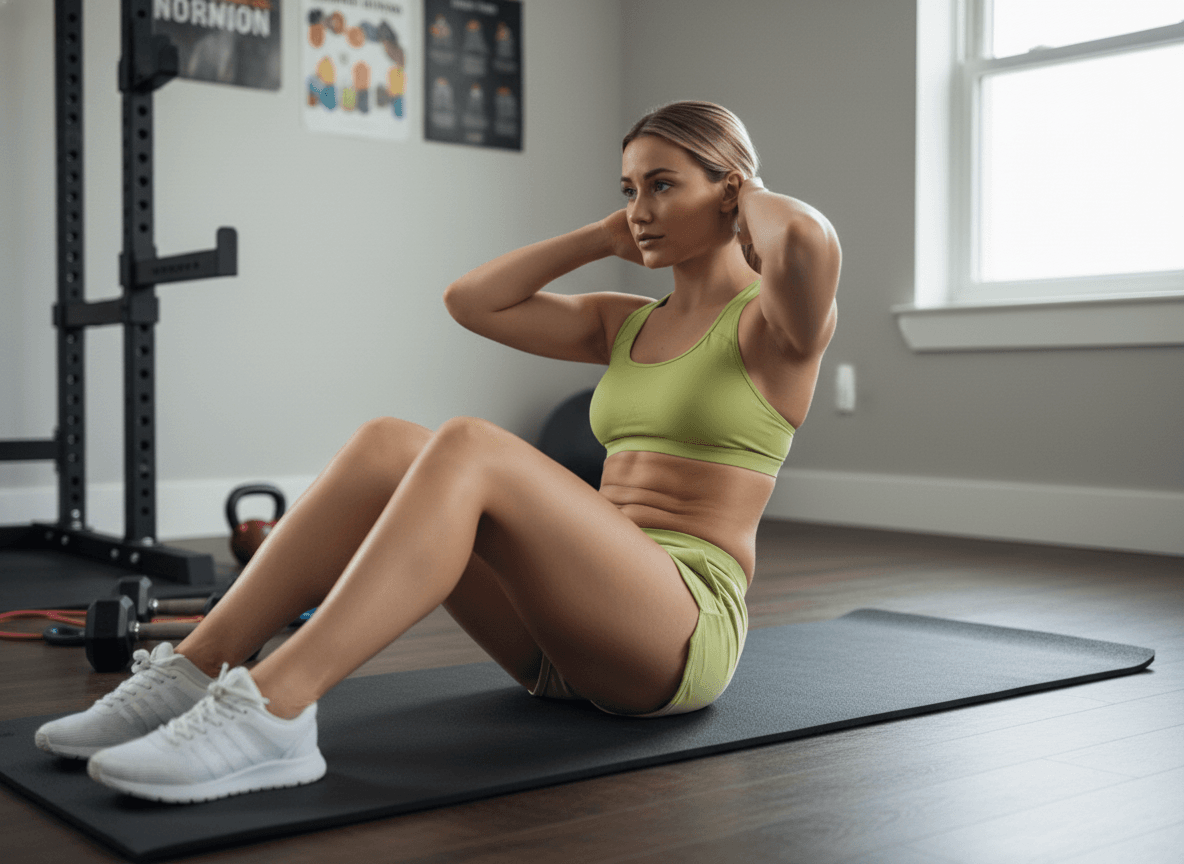
Woman performing crunches on a mat in a home gym, illustrating the “crunches burn belly fat” idea from six pack abs myths.Crunches work the muscles under the fat. They do not tell your body where to burn fat from.

Your body decides where fat comes off based on hormones, genetics, and overall fat levels—not based on which muscle you’re training.

What crunches can do:

  • Strengthen your rectus abdominis (the six-pack muscle).

  • Improve core endurance.

What crunches can’t do:

  • Melt belly fat directly.

What to do instead:

  • Use ab exercises (including crunch variations) to build stronger muscles.

  • Combine them with a real fat-loss plan: calorie deficit, enough protein, and consistent movement.

Myth #2: “You Can Spot-Reduce Fat From Your Stomach”

The myth:

Targeted exercises or special creams will remove fat only from your midsection.

The reality:

Woman in workout clothes holding her stomach in a kitchen, illustrating the spot-reduction belief discussed in six pack abs myths.Spot reduction is basically a fantasy. Fat loss happens all over your body, not in one exact place you choose.

You might notice some areas lean out sooner (like your face or arms) and others later (like lower belly or hips) – that’s genetics.

What to do instead:

  • Focus on overall fat loss with:

    1. A small, sustainable calorie deficit.

    2. Regular strength training (full body, not just abs).

    3. Daily movement (steps, walks, light activity).

  • Be patient. The last few “stubborn” spots usually lean out last, not first.

Myth #3: “You Need to Train Abs Every Day”

The myth:

If your abs aren’t sore 24/7, you’re not doing enough.

The reality:

Your abs are muscles. Just like any other muscle, they need work + recovery to grow and get stronger.

Training hard every day can lead to:

  • Fatigue and poorer form.

  • Annoying back or hip discomfort.

  • Burnout and inconsistency.

What to do instead:

  • Aim for 2–4 focused core sessions per week.

  • Each session can be 10–15 minutes of quality work.

  • Focus on form, control, and progression—not just a daily “burn.”

You can still use your core in other exercises (squats, deadlifts, carries) on non-ab days.

Myth #4: “Heavy Lifting or Ab Training Will Make Your Waist ‘Thick’ and Bulky”

The myth:

Doing weighted ab exercises or lifting heavy makes your waist huge and ruins your V-taper, especially for women.

The reality:

  • Building some muscle around your core actually makes 

  • your midsection look tighter and more athletic, not “blocky,” for 

  • most people.

  • A “thick” waist look usually comes from higher body fat, not from doing planks or cable crunches.

What to do instead:

  • Don’t be afraid of moderate load on your core (when you’re ready).

  • Focus on:

    1. Good form

    2. Controlled range of motion

    3. Maintaining a reasonable body fat level through nutrition

A strong core supports your spine, improves posture, and helps every other lift you do.

Myth #5: “Carbs Are the Enemy of Six-Pack Abs”

The myth:

You must eliminate carbs completely to see your abs.

The reality:

Woman eating a balanced meal with protein, vegetables, and carbs at a dining table, illustrating six pack abs myths about avoiding carbs.You can absolutely eat carbs and still get lean, as long as:

  • Your calorie intake is in a deficit (for fat loss).

  • You get enough protein.

  • Most of your carbs come from minimally processed sources.

Cutting carbs aggressively can make you:

  • Tired and irritable.

  • Struggle in your workouts.

  • Crave binges on sugary foods.

What to do instead:

  • Keep carbs from:

    • Rice, oats, potatoes, fruits, whole grains, beans.

  • Limit:

    • Sugary drinks, desserts, ultra-processed snacks.

  • Adjust carb amounts based on your total calorie target, not fear.

Myth #6: “Fat Burners, Detoxes, or Teas Will Reveal Your Abs Fast”

The myth:

There’s a pill, tea, or quick detox that will burn belly fat and show your abs in a few weeks.

The reality:

Most of these products do little or nothing beyond:

  • Making you lose some water weight.

  • Suppressing appetite temporarily.

  • Emptying your wallet.

They don’t replace:

  • Calorie control.

  • Balanced nutrition.

  • Movement and training.

What to do instead:

  • Treat supplements as optional extras, not the foundation.

  • Build your results on:

    • A realistic eating plan.

    • Consistent training.

    • Sleep and stress management.

Then, if you choose to use supplements, they’re just minor support—not magic.

Myth #7: “You Have to Eat 100% Clean With Zero ‘Fun’ Foods”

The myth:

One cookie, one slice of pizza, or one drink will “ruin” your abs.

The reality:

Woman smiling in a kitchen eating a bowl of dessert while a donut sits on a food scale, illustrating six pack abs myths about strict clean eating.Your body responds to your overall pattern of eating, not a single food.

You can absolutely have:

  • A weekly treat meal.

  • Occasional dessert.

  • Social events.

And still make progress, if your weekly average stays close to your calorie and protein goals.

What to do instead:

  • Base 80–90% of your diet on:

    • Protein

    • Vegetables

    • Whole carbs

    • Healthy fats

  • Use the remaining 10–20% flexibly:

    • Treats, meals out, social eating.

  • Avoid all-or-nothing thinking (perfect or “I blew it”).

Myth #8: “You Can Out-Train a Bad Diet”

The myth:

If you just train hard enough, you can eat whatever you want and still get abs.

The reality:

Exercise burns calories, but not as many as people think—especially compared to how fast eating adds them back.

Example reality checks:

  • 60 minutes of hard training might burn a few hundred calories.

  • One big fast-food meal can easily double or triple that.

You simply can’t make up for wild eating with “grind harder” in the gym.

What to do instead:

  • Use training to:

    • Build muscle and strength.

    • Improve fitness and health.

  • Use nutrition to:

    • Create your calorie deficit.

    • Control hunger and energy.

They work together, not as replacements for each other.

Myth #9: “My Genetics Are Bad, So It’s Pointless to Try”

The myth:

If you don’t naturally have a flat stomach or don’t see abs quickly, there’s no point in working on your body.

The reality:

  • Genetics influence:

    • Where you store fat.

    • How quickly you lose it.

    • How your abs look when lean.

  • Genetics do not control:

    • Whether you improve at all.

    • Your habits, consistency, and effort.

Some people might see abs at a higher body fat percentage. Others may have to get leaner. But almost everyone can:

  • Get stronger.

  • Lean out compared to where they started.

  • Look and feel significantly better over time.

What to do instead:

  • Stop comparing your progress to someone else’s “week 4 transformation.”

  • Compare yourself to your own starting point.

  • Focus on realistic, steady improvements in strength, habits, and body composition.

Myth #10: “If It Doesn’t Hurt, It’s Not Working”

The myth:

Your abs must be on fire and you should feel intense pain or you’re wasting your time.

The reality:

  • A moderate burn or fatigue is normal.

  • Sharp pain, especially in your lower back or hips, is a warning sign, not a badge of honor.

Chasing pain or extreme soreness can:

  • Wreck your form.

  • Make you dread your workouts.

  • Increase injury risk.

What to do instead:

  • Focus on:

    • Controlled movement.

    • Stable spine and good posture.

    • Smooth breathing.

  • If you feel sharp pain, skip or modify that exercise and choose a safer variation.

Myth #11: “Visible Abs Automatically Mean You’re Healthy”

The myth:

If someone has a six-pack, they must be healthy, strong, and fit.

The reality:

  • You can have visible abs and still:

    • Sleep poorly.

    • Eat in an unsustainable way.

    • Feel tired, injured, or stressed.

  • You can improve your health significantly even if your abs aren’t perfectly carved.

Visible abs are mainly a sign of low body fat + some muscle—not a full health report.

What to do instead:

  • Treat visible abs as one possible goal, not the only one.

  • Also track:

    1. Strength.

    2. Energy.

    3. Mood.

    4. Sleep.

    5. Overall health markers (as advised by your doctor).

So What Actually Works for Six-Pack Abs?

Now that we’ve knocked down the myths, here’s what consistently works in the real world.Woman standing in workout clothes in a home gym, representing realistic progress beyond six pack abs myths and quick-fix promises.

 

Tip 1 - Eat for Fat Loss, Not Just “Clean Eating”

  • Set a small calorie deficit (not starvation).

  • Prioritize protein in every meal.

  • Fill your plate mostly with:

    • Lean protein

    • Vegetables and fruit

    • Whole carbs and healthy fats

Tip 2 - Lift and Move Your Whole Body

  • Use full-body strength training 2–4 times per week.

  • Add focused core work 2–3 times per week (like your beginner ab routines).

  • Move more during the day: walks, steps, light activity.

Tip 3 - Progress Your Ab Training Over Time

  • Start with beginner-friendly exercises you can perform well.

  • Increase:

    • Reps

    • Time under tension

    • Difficulty (harder variations)

  • Keep your lower back safe and your form tight.

Tip 4 - Be Patient and Consistent

  • Visible abs take weeks or months, not days.

  • Tiny daily improvements (better food choices, scheduled sessions, sleep) compound over time.

How to Use This Guide With Your Current Routine

Here’s a simple way to apply what you just read:

  1. Pick 2–3 myths you’ve been guilty of (most people will recognize at least a few).

  2. Replace each myth with the “What to do instead” habit in this article.

  3. Stick with those new habits for at least 4–6 weeks.

  4. Then refine again: adjust calories, improve exercise choices, and tighten up weekends.

Instead of searching for another “secret,” squeeze more consistency out of the basics you already know now.

FAQs

No. For some people, a moderate level of leanness is enough to see some definition. Others may need to go leaner. You don’t have to chase an extreme, stage-level physique to have a strong, visible core.

Yes, if:

  • You manage your nutrition well.
  • You use progressive ab and full-body exercises (harder variations, more reps, more control).
  • You stay consistent for long enough.

Equipment can help, but it’s not required.

It depends on:

  • Your starting body fat.
  • How consistent you are with food and training.
  • Your genetics.

For many people, visible changes can appear over a few months of consistent effort. Extreme “two-week ab transformation” promises are usually hype.

Yes. The principles are the same:

  • Smart nutrition.
  • Progressive ab and full-body training.
  • Patience.

Training abs will not make women “bulky.” It helps create a tighter, stronger midsection.

Not if you:

  • Use good form.
  • Choose the right level of difficulty.
  • Avoid exercises that cause sharp pain.

If you have back issues, talk to a professional and focus on safer, controlled core work (like dead bugs, bird dogs, and glute bridges).

Final Checklist: Are These Abs Myths Still Tripping You Up?

Quick self-check:

I’ve stopped relying on crunches to burn belly fat

I know I can’t spot-reduce and accept that fat loss is full-body

I’m not trying to out-train a bad diet

I don’t fear all carbs or think one “bad” food ruins everything

I’m training abs 2–4 times per week, not randomly doing 100 reps once in a while

I’m patient with my genetics and focused on sustainable progress

I understand that visible abs = low body fat + muscle + consistency

If you’re checking most of these boxes, you’re ahead of the majority of people still stuck in myth-land.

Keep training smart, eat in a way that supports your goals (and your life), and let time and consistency do the rest.

Related Articles:

Scroll to Top