
V-sit Hold Tutorial
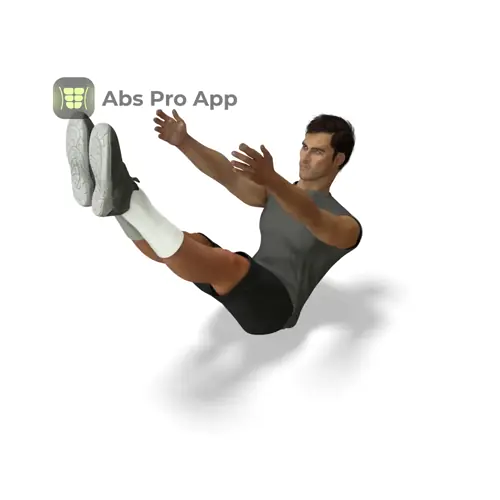
The V-sit hold is a classic bodyweight core exercise where you balance on your sit-bones with your legs lifted at about a 45-degree angle and your arms reaching forward. This isometric hold challenges your abs to stay tight without movement, making it a great way to build deep core strength, balance, and posture.
It is ideal for beginners who want a clear guide on how to train their abs without equipment. Focus on steady breathing, a tall chest, and keeping tension through your entire midsection.
Benefits
- Builds deep abdominal strength
- Improves balance and body control
- Teaches proper core bracing
- Enhances posture awareness
- Requires no equipment or space
- Low impact on joints
- Easy to scale up or down
Setup & Starting Position
Start by sitting on the floor with your legs extended straight in front of you. Place your hands lightly on the floor beside your hips for balance as you find your sit-bones, the bony points under your pelvis. Sit tall with your chest lifted and spine long.
Lean your torso back slightly while keeping your back neutral, not rounded. Lift both legs together until they are about a 45-degree angle from the floor. Your knees stay straight but relaxed, not locked. Once balanced, lift your arms off the floor and extend them forward at a slight upward angle from your shoulders, palms facing each other.
Before starting the hold, gently draw your ribs down and tighten your abs as if preparing for a light cough. Quick setup tip: If you feel pressure in your lower back, sit a bit taller and reduce the leg height slightly.
How To Do V-sit hold (Step-by-step)
- Sit on the floor with legs straight and chest tall
- Find balance on your sit-bones
- Lean back slightly with a neutral spine
- Lift both legs to roughly 45 degrees
- Extend arms forward and slightly upward
- Brace your core without holding your breath
- Hold the position with steady tension
- Breathe slowly and stay balanced
- Lower feet and arms with control to finish
Form Cues
- Chest proud, shoulders relaxed
- Ribs down, abs tight
- Long spine, no slouching
- Legs together and steady
- Arms reaching, not shrugging
- Balance on sit-bones
Breathing & Bracing
Proper breathing makes the V-sit hold much more effective and comfortable. Before lifting your legs, take a slow inhale through your nose to lengthen your spine. As you raise your legs and arms, gently exhale and tighten your abs, as if zipping up snug jeans.
During the hold, avoid holding your breath. Use a steady rhythm like inhaling for three seconds and exhaling for three seconds. Each exhale should reinforce your core brace while keeping your ribs from flaring upward.
Think about creating tension around your waist in all directions, not just squeezing the front of your abs. Your hips and ribs should stay stacked, and your breathing should feel controlled, not strained. If breathing becomes shallow or shaky, lower your legs slightly and reset.
Common Mistakes
- Rounding the lower back, fix by sitting taller and lowering leg height
- Holding the breath, fix by using slow counted breaths
- Lifting legs too high, fix by keeping them near 45 degrees
- Shrugging shoulders, fix by relaxing the neck and reaching forward
- Locking the knees hard, fix by keeping them straight but soft
- Rocking side to side, fix by tightening the core evenly
How It Should Feel
Quick Self-Check: The V-sit hold should create a steady, controlled burn across your abs and hip flexors. You should feel balanced and strong rather than shaky or tense in the neck.
Good signs:
- Abs feel engaged across the front and sides
- Breathing stays smooth and controlled
- Lower back feels supported, not strained
Warning signs:
- Sharp pain in the lower back, stop immediately
- Neck or shoulder tension taking over
If you feel it mostly in your neck, relax your shoulders and lower your arms slightly. If your lower back feels stressed, sit taller or bend the knees briefly to reset before continuing.
Alternative Names
Boat pose hold
Variations
Easier
- Bent-knee V-sit hold, keep knees bent while holding the same torso and arm position
- Heel-supported V-sit, lightly touch heels to the floor for balance
- Short hold V-sit, hold for 10 to 15 seconds with perfect form
Harder
- Extended V-sit hold, lower legs closer to the floor while keeping the same torso angle
- Overhead arm V-sit, raise arms overhead to increase core demand
- Pulsing V-sit hold, make small controlled leg lifts while staying balanced
Sample Workout
Core Focus Workout:
- V-sit hold, 3 sets of 20 to 30 seconds
- Dead bug, 3 sets of 8 reps per side
- Glute bridge, 3 sets of 12 reps
- Forearm plank, 2 sets of 20 seconds
Rest 30 to 45 seconds between sets. Use the V-sit hold early in the workout when your core is fresh, and focus on clean technique over long hold times.
Progression Plan
Week 1: Practice the basic V-sit hold for 3 to 4 sets of 15 to 20 seconds. Focus on balance, breathing, and posture. Rest 30 to 45 seconds between sets.
Week 2: Increase hold time to 20 to 30 seconds per set. Aim for smoother breathing and less shaking. If form breaks early, stop and repeat the set rather than pushing through.
Week 3: Extend holds to 30 to 40 seconds or add one extra set. You can also slow your breathing rhythm to increase control.
Week 4: Try an advanced variation like lowering the legs slightly or raising the arms overhead. Only progress if you can hold the basic version with perfect form for at least 30 seconds.
Repeat a week if balance or lower back comfort is not consistent. Progress by time first, then by difficulty.
FAQ
Should my legs be straight or bent?
In the standard V-sit hold, legs stay straight with soft knees. Bent knees make it an easier variation.
How long should I hold the V-sit?
Beginners usually start with 15 to 30 seconds and build up gradually.
Why do my hip flexors burn so much?
Hip flexors assist in holding the legs up. Strong abs and proper posture help balance the effort.
Can I do this every day?
Yes, as long as volume is moderate and there is no lingering soreness.
What if I keep tipping backward?
Sit taller, lower your legs slightly, and tighten your abs before lifting.
Summary
The V-sit hold is a simple but powerful way to strengthen your core using only your bodyweight. By focusing on balance, controlled breathing, and steady tension, you build strength that carries over to many other exercises.
Start with short, high-quality holds and progress gradually. Stay mindful of your posture and listen to your body. With consistent practice, this hold can become a strong foundation for more advanced core training.
Get Defined Abs in 30 Days
This exercise is part of our complete 30-day ab program. Download the app for structured daily workouts and track your progress.