
Unilateral Bicycle Crunch Tutorial
Unilateral bicycle crunch is a controlled abs exercise where you hold a crunch position and twist your upper body toward one bent knee while the opposite leg stays extended. Unlike fast bicycle crunches, this version emphasizes slow control, rotation, and time under tension.
It is excellent for building the obliques and deep core muscles, improving coordination, and learning how to brace your abs while moving your legs. This move works well for anyone following an abs workout, core stability routine, or rehab focused plan. Focus on keeping your shoulders lifted, ribs down, and moving with intention rather than speed.
Benefits
- Builds strong and defined obliques
- Improves rotational core control
- Increases time under tension for abs
- Teaches proper crunch bracing
- Enhances mind muscle connection
- Low impact and joint friendly
- Balances left and right side strength
Setup & Starting Position
Start by lying flat on your back on a comfortable mat. Bend both knees with feet flat on the floor. Place your hands lightly behind your head, fingertips touching the skull, with elbows open and wide. Avoid interlocking your fingers or pulling on your neck.
Before the movement begins, gently tuck your chin and lift your head and shoulders off the floor into a small crunch. Your shoulder blades should hover just above the mat. Keep your lower back pressed lightly into the floor by tightening your abs.
From here, bring one knee toward your chest while extending the opposite leg straight out, hovering a few inches above the ground. The extended leg stays relaxed but controlled.
Setup tip: Think about shortening the distance between your ribs and hips before you twist. This helps lock in core tension before the rotation.
How To Do Unilateral bicycle crunch (Step-by-step)
- Lie on your back with knees bent and hands supporting your head
- Lift shoulders into a crunch and brace your abs
- Extend your right leg straight out, hovering above the floor
- Pull your left knee toward your chest
- Twist your upper body so your chest rotates toward the left knee
- Hold the crunch and twist for the desired time or reps
- Keep elbows wide and neck relaxed
- Slowly rotate back to center without dropping shoulders
- Switch legs and twist toward the opposite knee
- Continue alternating sides with controlled tempo
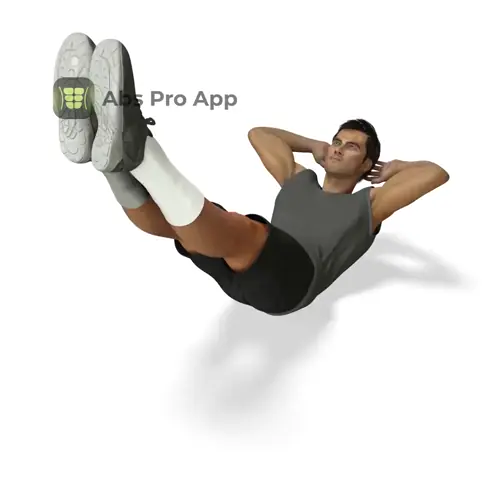
Form Cues
- Shoulders stay lifted the whole time
- Twist from ribs, not elbows
- Lower back stays pressed down
- Neck long and relaxed
- Move slow and controlled
- Legs stay active, not loose
Breathing & Bracing
Proper breathing is key for getting the most out of the unilateral bicycle crunch. Before lifting into the crunch, take a calm inhale through your nose. As you raise your shoulders and bring one knee in, gently exhale through your mouth.
During the twist, continue exhaling slowly as if fogging a mirror. This helps engage the deep abs and keeps your ribs pulled down. Do not hold your breath. Instead, think of tightening your core like you are preparing for a light cough.
When switching sides, take a small inhale as you rotate back to center, then exhale again as you twist toward the other knee. A simple rhythm to follow is exhale on twist, inhale on reset.
Your brace should feel firm but breathable. Imagine your abs wrapping around your waist evenly, keeping hips and ribs stacked and controlled.
Common Mistakes
- Pulling on the neck, fix by using hands only for support
- Dropping shoulders between reps, keep them lifted
- Twisting elbows instead of chest, rotate from ribs
- Rushing the movement, slow down and hold the crunch
- Arching the lower back, press it gently into the floor
- Letting the extended leg drop, keep it hovering
How It Should Feel
Quick self check: You should feel steady tension across your abs, especially along the sides of your waist. The working side oblique should feel warm and slightly fatigued during the hold.
Good signs:
- Abs stay tight the entire set
- Neck feels relaxed and supported
- Movement feels controlled, not rushed
Warning signs:
- Sharp pain in neck or back, stop immediately
- Hip flexors doing all the work
If you feel it mostly in your neck, lighten your hand pressure and lift less high. If your lower back feels strained, bend the extended leg slightly or bring it higher.
Alternative Names
isometric bicycle crunch, slow bicycle crunch
Variations
Easier
- Bent leg unilateral crunch: Keep both knees bent and twist toward one knee
- Short range bicycle crunch: Extend leg higher to reduce leverage
Harder
- Extended hold unilateral bicycle crunch: Hold each side for 10 to 20 seconds
- Tempo unilateral bicycle crunch: Use a 3 second twist and 3 second return
Sample Workout
Core focused workout:
- Dead bug, 10 reps per side
- Unilateral bicycle crunch, 8 to 12 reps per side
- Side plank, 20 to 30 seconds per side
- Glute bridge, 15 reps
Rest 30 to 45 seconds between exercises. Complete 2 to 3 rounds. Focus on slow, clean reps rather than speed.
Progression Plan
Week 1: Perform 2 to 3 sets of 6 to 8 reps per side. Keep the extended leg higher and hold each twist for 1 to 2 seconds. Rest 45 seconds between sets.
Week 2: Increase to 8 to 12 reps per side or extend the hold to 3 to 5 seconds. Lower the extended leg closer to the floor for more leverage.
Week 3: Add tempo control. Use 3 seconds to twist and 3 seconds to return. Keep rest under 30 seconds.
Week 4: Move to advanced variations with longer holds or combine with other rotational core exercises.
Repeat a week if you lose form, feel neck strain, or cannot keep shoulders lifted. Progress only when control stays solid.
FAQ
How many reps should I do?
Start with 6 to 10 controlled reps per side or 15 to 30 seconds per side.
Is this better than regular bicycle crunches?
It is better for control and core tension, while fast bicycle crunches are more dynamic.
Can beginners do this exercise?
Yes, with bent legs and smaller twists.
Should my elbows touch my knee?
No, focus on rotating the chest toward the knee instead.
Summary
The unilateral bicycle crunch is a powerful abs exercise when done with patience and precision. By holding the crunch and rotating slowly, you teach your core to stay engaged under movement.
Focus on quality reps, steady breathing, and strong bracing. Whether used as part of a core workout or as a finisher, this move builds strength that carries over to better posture and daily movement.
Slow it down, stay controlled, and let your abs do the work.
Get Defined Abs in 30 Days
This exercise is part of our complete 30-day ab program. Download the app for structured daily workouts and track your progress.