
Sprawl Tutorial
The sprawl is a fast, athletic bodyweight move where you jump from standing into a high plank on your hands, then return to standing. It is often used as a conditioning drill, but it is also a powerful core exercise because your abs must brace hard to control the landing and transition.
This exercise is great for people who want to build core stability, coordination, and full-body control without equipment. It fits well into abs workouts, fat loss circuits, or sports training. Focus on a tight midsection, soft landings, and smooth movement rather than rushing the reps.
Benefits
- Builds strong core bracing under movement
- Improves coordination and body awareness
- Trains fast transitions from standing to plank
- Elevates heart rate for conditioning
- Strengthens shoulders in a stable position
- Reinforces good plank alignment
- Requires no equipment or space
Setup & Starting Position
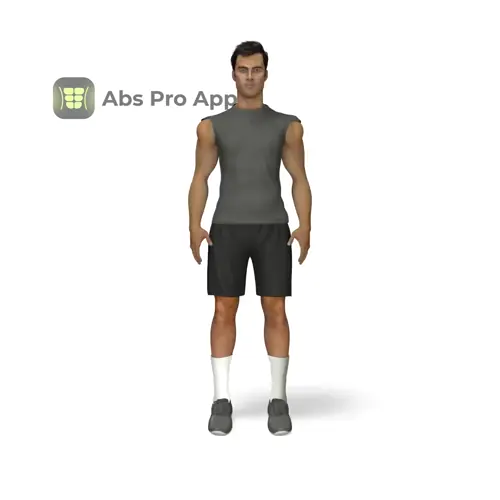
Begin standing upright on a flat surface with feet about hip-width apart. Your arms should be relaxed by your sides, shoulders down and back, and chest tall. Look straight ahead and take a moment to lightly engage your abs as if preparing to cough.
Your weight should be evenly distributed through the middle of your feet, not just the toes or heels. This balanced stance will help you move quickly and safely into the plank.
Before the first rep, practice hinging slightly at the hips and bending your knees so your body is ready to jump back. Mentally prepare to land on your hands with elbows straight but not locked, hands placed directly under your shoulders.
Quick setup tip: Think tall posture first, tight core second, speed last. Good control always beats rushing.
How To Do Sprawl (Step-by-step)
- Stand tall with feet hip-width and core lightly braced.
- Bend your knees and hips slightly to load the jump.
- Place your hands on the floor under your shoulders.
- Jump both feet back at the same time.
- Land in a high plank on your hands.
- Keep head, ribs, and hips in one straight line.
- Brace your abs and squeeze your glutes.
- Without pausing long, jump both feet forward.
- Feet land under or just behind your hips.
- Lift your hands and stand up tall.
- Reset posture before starting the next rep.
Form Cues
- Hands under shoulders
- Strong plank line
- Abs tight on landing
- Soft knees and feet
- Move fast but controlled
- Stand tall at the top
Breathing & Bracing
Breathing correctly during the sprawl helps protect your lower back and keeps your movement powerful. Start each rep with a small inhale while standing. As you jump your feet back and land in the plank, exhale gently through the mouth and tighten your abs.
Think of bracing as pulling your ribs down toward your hips, not sucking your stomach in. Your abs should feel firm, like a tightened belt, while you continue to breathe.
When you jump your feet back toward your hands, take another short exhale to maintain control. As you stand up, you can inhale again to reset for the next repetition.
Simple breathing rhythm: inhale standing, exhale to plank, exhale as feet come forward, reset breath at the top. Avoid holding your breath, especially during fast sets.
Common Mistakes
- Letting hips sag in the plank, fix by tightening abs and glutes.
- Hands landing too far forward, place them under shoulders.
- Rounding the lower back, slow down and brace harder.
- Feet landing wide, jump feet back and forward together.
- Rushing sloppy reps, reduce speed and regain control.
- Locking elbows hard, keep arms straight but soft.
How It Should Feel
Quick Self-Check: A good sprawl should feel dynamic but controlled. Your abs should engage strongly each time you land in the plank, and your shoulders should feel stable, not strained.
Good signs:
- Strong tension in the abs during the plank
- Smooth transitions without collapsing
- Even weight through hands and feet
Warning signs:
- Sharp pain in wrists, shoulders, or lower back, stop immediately
- Lower back compression or pinching
If you feel it mostly in your neck or lower back, slow the movement down and focus on keeping your ribs pulled down and glutes lightly squeezed. Shorten the range by stepping instead of jumping until control improves.
Alternative Names
Sprawl drill, Burpee sprawl
Variations
Easier
- Step-Back Sprawl, step one foot back at a time into a high plank, then step forward to stand.
- Slow Sprawl, jump back and forward slowly with a brief pause in the plank.
- Hands-Elevated Sprawl, place hands on a low surface to reduce load.
Harder
- Fast Sprawl, perform reps explosively while keeping perfect plank form.
- Sprawl Hold, pause 3 to 5 seconds in the plank each rep.
- Sprawl to Jump, add a small vertical jump when you stand up.
Sample Workout
Core and Conditioning Circuit
- Sprawl, 10 to 15 reps
- Bodyweight Squats, 15 reps
- High Plank Hold, 30 seconds
- Mountain Climbers, 20 reps
Rest 60 seconds and repeat for 3 to 4 rounds. Focus on quality movement and controlled breathing during the sprawl.
Progression Plan
Week 1: Learn the movement. Perform 3 sets of 6 to 8 slow, controlled sprawls. Rest 60 to 90 seconds. Focus on landing in a perfect high plank every rep.
Week 2: Increase volume. Perform 3 to 4 sets of 10 to 12 reps. Begin to move a bit faster while maintaining form. Rest 60 seconds.
Week 3: Add intensity. Use fast sprawls or add a 2 second plank hold each rep. Aim for 12 to 15 reps per set.
Week 4: Advance or repeat. If form stays solid, progress to advanced variations. If control breaks down, repeat the previous week and slow the tempo.
Progress by improving control first, then speed, then volume. Never sacrifice plank alignment for more reps.
FAQ
Is the sprawl the same as a burpee?
No. This version does not include a push-up or a mandatory jump at the top.
Is this an ab exercise or cardio?
It is both. The abs work hard to stabilize, and the fast movement raises heart rate.
How fast should I go?
Move quickly but only as fast as you can maintain a strong plank position.
Can beginners do sprawls?
Yes, especially with step-back or slow variations.
Summary
The sprawl is a simple but demanding bodyweight move that builds real-world core strength. By jumping into a high plank and returning to standing with control, you teach your abs to stabilize your body during fast transitions.
Focus on clean technique, strong bracing, and smooth breathing. Start with beginner options if needed and progress only when your plank position stays solid. When performed with intention, the sprawl becomes a powerful addition to any abs or conditioning routine.
Get Defined Abs in 30 Days
This exercise is part of our complete 30-day ab program. Download the app for structured daily workouts and track your progress.