
Spider Plank Tutorial
Spider plank is a challenging bodyweight core exercise that blends a wide high plank with controlled transitions down to a low plank and back up. It targets the abs, shoulders, and deep core while demanding balance and coordination.
This move is best suited for advanced trainees or anyone ready to push plank strength beyond basic holds. Focus on slow, deliberate arm changes, a wide base with straight legs, and keeping your hips steady as your support points change.
Benefits
- Builds strong anti-rotation core control
- Improves shoulder stability under load
- Trains smooth transitions between plank levels
- Challenges balance with a wide base
- Strengthens arms without equipment
- Enhances full-body tension and coordination
Setup & Starting Position
Begin on the floor in a wide high plank. Place your hands on the ground slightly wider than shoulder-width and angled diagonally outward for a stable base. Your arms are straight and elbows locked out but not hyperextended.
Step your feet wider than hip-width so your legs are straight and spread apart. Toes stay tucked under, heels pushing back. Your body should form a straight line from head to heels, with no sagging or piking at the hips.
Before starting the movement, tighten your abs, squeeze your glutes lightly, and press the floor away with your hands. Set your gaze slightly ahead of your hands to keep your neck neutral.
Quick setup tip: If your hips shift before the first arm lowers, widen your feet a bit more for better balance.
How To Do Spider plank (Step-by-step)
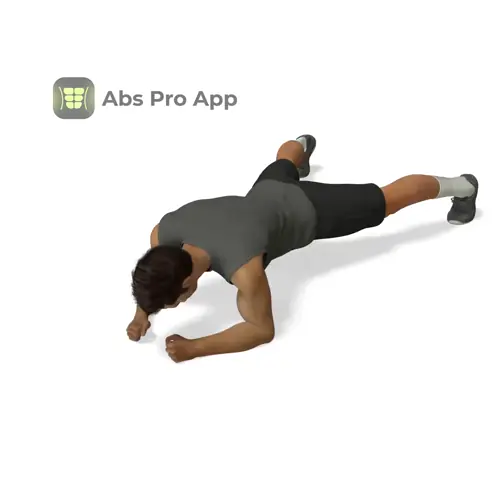
- Start in a wide high plank with arms straight and legs wide.
- Brace your core and shift weight slightly to one side.
- Lower one arm down to the forearm, keeping hips level.
- Lower the other arm to reach a wide low plank.
- Press one hand back to the floor, returning to a half-high plank.
- Press the second hand up to return to a wide high plank.
- That is one rep, alternate which arm leads on the next rep.
- Move slowly and with control for the full set.
Form Cues
- Keep hips square to the floor
- Press the ground away
- Move one arm at a time
- Legs stay wide and straight
- Neck long and neutral
- No rushing the transitions
Breathing & Bracing
Proper breathing is key to staying strong and controlled during the spider plank. Before the first rep, take a calm inhale through your nose and gently tighten your abs as if preparing for a cough.
As you lower an arm to the forearm, exhale slowly through your mouth. Keep breathing shallow but steady while you are in the low plank position. When pressing back up to the high plank, exhale again to help maintain core tension.
A simple rhythm to follow is: inhale at the top, exhale as you lower, brief inhale in low plank, exhale as you press up. Avoid holding your breath. Your ribs should stay pulled down and stacked over your hips the entire time.
Common Mistakes
- Letting hips sway side to side, widen your feet and slow down.
- Dropping the hips low, tighten abs and squeeze glutes.
- Rushing the arm transitions, move one arm at a time.
- Bending the legs, keep knees straight and active.
- Shrugging shoulders to ears, press the floor away.
- Holding breath, use steady exhales with each change.
How It Should Feel
Quick Self-Check: You should feel strong tension across your abs and obliques, with shoulders working hard to stabilize your body. Your chest and arms will feel loaded, but controlled. Breathing should feel challenging but manageable.
Good signs: steady hips, smooth arm changes, and even pressure through both hands and forearms. You feel your core working more than your lower back.
Warning signs: sharp shoulder pain, pinching in the lower back, or collapsing onto the floor. Stop if you feel sharp pain.
If you feel it mostly in your neck, lower your gaze and lengthen the back of your neck. If it hits your lower back, slow down and brace harder, or switch to an easier version.
Alternative Names
wide plank up-down, plank to forearm wide
Variations
Easier
- Wide Knee Spider Plank, perform the same arm transitions but keep knees on the floor.
- Wide High Plank Hold, hold the wide high plank without lowering to forearms.
- Slow Plank Up-Down, narrow the stance slightly and move very slowly.
Harder
- Tempo Spider Plank, add a 3 second lower and 3 second press up for each arm.
- Paused Low Spider Plank, pause for 2 to 3 seconds in the low plank before pressing up.
Sample Workout
Core and Shoulder Stability Workout
- Spider Plank, 3 sets of 6 to 10 reps
- Side Plank Hold, 3 sets of 20 to 40 seconds per side
- Dead Bug, 3 sets of 10 reps total
- Glute Bridge Hold, 3 sets of 30 seconds
Rest 60 to 90 seconds between sets. Place spider plank early in the workout when your shoulders and core are fresh.
Progression Plan
Week 1: Practice control. Perform 3 sets of 5 to 6 reps with perfect form. Rest up to 90 seconds. Focus on keeping hips steady and alternating lead arms.
Week 2: Increase volume. Perform 3 to 4 sets of 7 to 8 reps. Slightly slow down the lowering phase to build more tension.
Week 3: Add difficulty by extending time under tension. Use a 2 second pause in the low plank position for each rep.
Week 4: Progress to advanced variations like tempo spider plank. Reduce rest to 60 seconds if form stays solid.
If your hips shift or form breaks down, repeat the previous week until control improves.
FAQ
Should my feet stay wide the entire time?
Yes, the wide stance is essential for balance and to match the intended spider plank technique.
Is one rep both arms or just one arm?
One rep includes lowering to the forearms and pressing back up to the high plank.
Can I do this on my elbows only?
No, this exercise requires transitions between hands and forearms.
Why do my hips twist during the movement?
This usually means the movement is too fast or your core brace is not strong enough.
How slow should the reps be?
Each full rep should take about 4 to 6 seconds for best control.
Summary
Spider plank is a powerful way to level up your plank training using only bodyweight. The wide stance and arm transitions force your core and shoulders to work together under constant tension.
Take your time with each rep, prioritize control over speed, and use regressions when needed. When performed with focus and consistency, this exercise can build impressive core stability and upper body strength without any equipment.
Get Defined Abs in 30 Days
This exercise is part of our complete 30-day ab program. Download the app for structured daily workouts and track your progress.