
Single Leg Sit-up Tutorial
The single leg sit-up is a challenging abs exercise that builds core strength, coordination, and control. It is a variation of the classic sit-up where one leg stays bent and grounded while the other remains straight on the floor, which increases the demand on your abdominal muscles and helps limit momentum.
This move is best suited for intermediate exercisers who already have basic core control. Focus on slow, controlled movement, keeping your arms reaching upward and your spine moving smoothly one vertebra at a time.
Benefits
- Builds strong, visible abdominal muscles
- Improves core control without equipment
- Reduces reliance on momentum during sit-ups
- Helps correct left to right strength imbalances
- Improves spinal flexion control
- Challenges coordination and body awareness
- Easy to include in home workouts
Setup & Starting Position
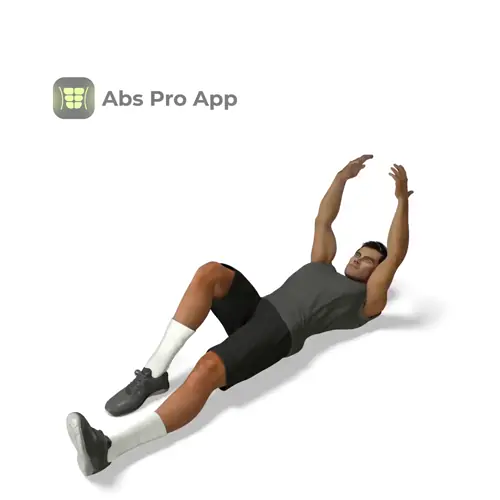
Start by lying flat on your back on a mat or comfortable floor surface. Bend one knee so that the foot is flat on the floor about hip-width from your body. The other leg stays fully straight, relaxed on the floor, with toes pointing upward.
Extend both arms straight up toward the ceiling so they are perpendicular to your torso. Your palms can face each other or forward, whichever feels more natural. Keep your head resting on the floor with your neck long and relaxed.
Before starting the first rep, gently brace your core by tightening your abs as if preparing for a light cough. Press the bent-leg foot lightly into the floor to create stability. Make sure your lower back is in a neutral, comfortable position, not forcefully flattened.
Setup tip: Choose which leg is bent first, complete all reps on that side, then switch legs.
How To Do Single leg sit-up (Step-by-step)
- Lie on your back with one knee bent, one leg straight, arms reaching straight up.
- Inhale to prepare and lightly brace your core.
- Begin the sit-up by lifting your head and shoulders off the floor.
- Continue curling your spine, reaching your arms upward as your torso rises.
- Press through the bent foot to help with balance, not momentum.
- Sit up until your torso is upright and arms are still reaching upward.
- Pause briefly at the top while staying tall.
- Exhale and slowly lower your spine back down to the floor.
- Lower one vertebra at a time until your shoulders and head rest down.
- Reset your brace and repeat for the next rep.
Form Cues
- Reach up, not forward
- Move slow and controlled
- Keep the straight leg relaxed
- Exhale as you sit up
- Do not yank the neck
- Use abs, not momentum
Breathing & Bracing
Proper breathing is key for performing the single leg sit-up with good technique. Start each rep with a calm inhale through your nose while lying on the floor. As you begin to lift your torso, gently tighten your abdominal muscles as if you were zipping up tight jeans.
Exhale slowly through your mouth as you rise into the sit-up. This helps your abs engage more strongly and reduces strain on your neck and lower back. Avoid holding your breath, which can create unnecessary tension.
At the top position, stay tall and keep breathing normally for a brief moment. As you lower back down, inhale again and maintain light tension in your core so you do not collapse onto the floor.
A simple rhythm to repeat is inhale down, exhale up while keeping your ribs stacked over your hips.
Common Mistakes
- Pulling the head with the arms, fix it by keeping arms vertical and neck relaxed.
- Using momentum to swing up, fix it by slowing down the lifting phase.
- Lifting the straight leg off the floor, fix it by keeping it relaxed and grounded.
- Arching the lower back at the top, fix it by keeping ribs down.
- Rushing the lowering phase, fix it by controlling the descent.
- Holding the breath, fix it by exhaling during the sit-up.
How It Should Feel
This exercise should feel like a strong, controlled contraction in your abdominal muscles, especially in the upper and middle abs. You may also feel some work in the hip flexors and stabilizing muscles on the side of the bent leg.
Good signs: steady breathing, smooth movement, and even effort on both sides when you switch legs. Mild muscle fatigue in the abs by the last few reps is expected.
Warning signs: sharp pain in the lower back, pinching in the hips, or neck pain. Stop immediately if you feel sharp pain.
If you feel it mostly in your neck, lower your range of motion and slow down. If your lower back feels strained, focus on bracing harder and reducing speed.
Alternative Names
single leg sit up, staggered leg sit-up
Variations
Easier
- Assisted Single Leg Sit-Up: Lightly hold the back of your thigh on the bent leg to help initiate the movement.
- Partial Range Single Leg Sit-Up: Sit up only halfway, then lower back down with control.
Harder
- Slow Tempo Single Leg Sit-Up: Take 3 to 5 seconds to sit up and 5 seconds to lower down.
- Single Leg Sit-Up with Pause: Hold the top upright position for 3 seconds before lowering.
Sample Workout
Core Focused Bodyweight Workout
- Single Leg Sit-Up: 3 sets of 8 to 12 reps per side
- Dead Bug: 3 sets of 10 reps per side
- High Plank: 3 sets of 30 to 45 seconds
- Glute Bridge Hold: 3 sets of 30 seconds
Rest 45 to 60 seconds between sets. Perform all reps on one side of the sit-up before switching.
Progression Plan
Week 1: Perform 3 sets of 6 to 8 reps per side. Focus on learning the movement, slow control, and smooth breathing. Rest as needed and repeat this week if you cannot maintain form.
Week 2: Increase to 3 sets of 10 to 12 reps per side. Begin slowing the lowering phase to about 3 seconds.
Week 3: Add a 2 second pause at the top of each rep. Keep reps at 8 to 10 per side with perfect control.
Week 4: Progress to a slow tempo version, taking 4 to 5 seconds up and down. Reduce rest between sets.
Move to advanced variations once you can complete all reps without momentum or strain. Repeat a week if form breaks down.
FAQ
How many reps should I do per side?
Most people do 8 to 12 controlled reps on one side, then switch legs.
Should both arms stay straight the entire time?
Yes, keeping the arms extended upward helps reduce neck pulling and encourages core control.
Why is one leg bent and the other straight?
This setup limits momentum and increases abdominal engagement while adding asymmetrical control.
Can I switch legs every rep?
It is better to complete all reps on one side first to build balanced strength.
Is this safe for the lower back?
It can be safe if done slowly with good bracing, but stop if you feel pain.
Summary
The single leg sit-up is a powerful bodyweight exercise for building strong, controlled abs without equipment. By using one bent leg and one straight leg, you reduce momentum and challenge your core in a more focused way.
Prioritize slow movement, steady breathing, and quality reps over speed. As your strength improves, use tempo and pauses to keep progressing. Stay consistent, train both sides evenly, and this exercise can become a reliable part of your abs workout routine.
Get Defined Abs in 30 Days
This exercise is part of our complete 30-day ab program. Download the app for structured daily workouts and track your progress.