
Single Leg Good Morning Tutorial
The single leg good morning is a challenging bodyweight hinge exercise that builds strong abs, glutes, and hamstrings while seriously testing balance and control. Performed standing on one leg with your hands behind your head, it teaches you how to hinge at the hips without rounding your spine.
This exercise is best for intermediate level trainees who want better core stability, improved posture, and stronger hip control. Focus on slow, controlled movement, keeping your chest proud, and staying balanced from start to finish.
Benefits
- Builds deep core stability
- Strengthens glutes and hamstrings
- Improves balance and coordination
- Teaches proper hip hinge technique
- Supports better posture
- Reduces left to right strength imbalances
- Enhances body awareness
Setup & Starting Position
Stand upright with your feet hip-width apart and your weight evenly distributed. Shift your weight onto one leg, this will be your working leg. The knee of the standing leg should be softly bent, not locked.
Place your fingertips lightly on the back of your head, with your elbows opened wide to the sides. This arm position increases the challenge on your core and helps prevent rounding.
Lift the non-working leg slightly behind you so your toes hover off the floor. Your torso should be tall, ribs stacked over hips, and your gaze slightly forward and down.
Setup tip: Imagine a straight line from the top of your head through your spine and out through the lifted heel before starting the first rep.
How To Do Single leg good morning (Step-by-step)
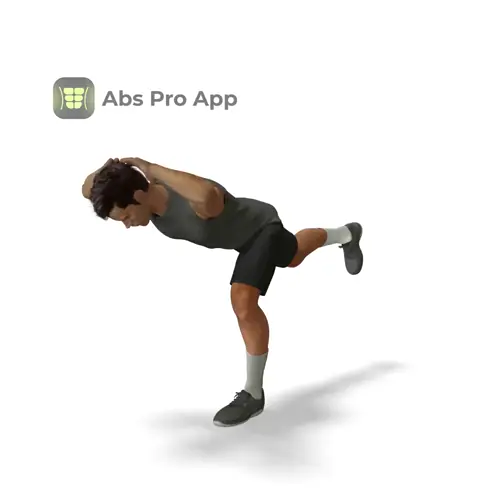
- Stand balanced on one leg with hands behind your head.
- Brace your abs gently, as if preparing for a cough.
- Begin hinging forward at the hips.
- Extend the free leg straight back as your torso lowers.
- Keep your back flat and elbows wide.
- Lower until your torso is near parallel to the floor.
- Pause briefly while staying balanced.
- Press through the standing heel.
- Return to upright by driving the hips forward.
- Finish tall without locking the knee.
Form Cues
- Hinge, do not squat
- Back stays long and flat
- Elbows wide the whole time
- Hips move back first
- Balance over mid-foot
- Move slow and controlled
Breathing & Bracing
Start each rep by taking a calm breath in through your nose while standing tall. As you hinge forward, maintain gentle abdominal tension, thinking about tightening your abs without squeezing or holding your breath.
Exhale slowly as you return to standing, letting the ribs stay down and the pelvis stay neutral. Avoid forceful breathing that causes your chest to flare.
A simple rhythm to follow is inhale at the top, hinge while holding light tension, exhale as you stand back up. Your core should feel active throughout the entire rep, helping you stay balanced and protecting your lower back.
Common Mistakes
- Rounding the back, fix it by keeping your chest open and spine long.
- Bending the standing knee too much, fix it by focusing on hip hinge.
- Twisting the hips, fix it by keeping both hips facing the floor.
- Dropping the elbows forward, fix it by pushing them wide.
- Moving too fast, fix it by slowing down each rep.
- Losing balance, fix it by shortening the range of motion.
How It Should Feel
Quick Self-Check:
You should feel strong engagement in your abs as they work to keep your torso stable. The glutes and hamstrings of the standing leg should feel loaded, especially near the bottom of the movement.
Good signs: steady balance, flat back, smooth control, and tension in the core. You may feel light fatigue in the foot and ankle from stabilizing.
Warning signs: sharp pain, loss of balance, or strong discomfort in the lower back. If this happens, stop the set.
If you feel neck tension, relax your grip behind the head and keep your chin slightly tucked. If you feel lower back strain, reduce range of motion and focus more on bracing.
Alternative Names
single-leg good morning, single leg hip hinge
Variations
Easier
- Supported Single Leg Good Morning: Lightly touch a wall or chair with one hand for balance.
- Kickstand Good Morning: Keep the back toes on the floor for extra support.
Harder
- Tempo Single Leg Good Morning: Lower for 5 seconds and pause briefly at the bottom.
- Eyes-Closed Single Leg Good Morning: Perform with eyes closed to increase balance demand.
Sample Workout
Lower Body and Core Balance Workout
- Single Leg Good Morning, 3 sets of 6 to 8 reps per side
- Bodyweight Squats, 3 sets of 12 reps
- Glute Bridge Hold, 3 sets of 30 seconds
- Dead Bug, 3 sets of 8 reps per side
Rest 45 to 75 seconds between sets. Perform one full rep per side, meaning left and right both count.
Progression Plan
Week 1: Practice control and balance. Perform 3 sets of 5 to 6 reps per side. Focus on slow movement and staying stable. Rest as needed.
Week 2: Increase reps to 6 to 8 per side and reduce rest slightly. Try pausing for one second at the bottom while maintaining balance.
Week 3: Add tempo by lowering for 4 to 5 seconds on each rep. Keep the same rep range.
Week 4: Progress to an advanced variation such as tempo reps or eyes-closed reps. If balance breaks down, repeat the previous week.
Progress only when every rep feels controlled and pain-free.
FAQ
How many reps should I do per side?
Most people do 6 to 10 controlled reps per side, where one rep is one full hinge on one leg.
Can I bend the lifted leg?
The lifted leg should stay mostly straight and extend back to help counterbalance.
Is this exercise safe for the lower back?
Yes, when done with a flat back and proper bracing, it strengthens the muscles that support the spine.
Why are my elbows important?
Keeping elbows wide increases upper body leverage and makes core control harder.
Summary
The single leg good morning is a powerful bodyweight exercise for building real-world core strength and balance. It challenges your abs to stabilize while your hips and legs do the work.
Stay patient, move slowly, and prioritize control over depth. When done consistently, this exercise can greatly improve posture, coordination, and overall athletic ability.
Master the basics, then progress thoughtfully to get the most out of every rep.
Get Defined Abs in 30 Days
This exercise is part of our complete 30-day ab program. Download the app for structured daily workouts and track your progress.