
Seated Jacks Tutorial
Seated jacks are a bodyweight core exercise performed on the floor where you lean back, lift both legs, and move them together and apart like a jumping jack motion. This move targets the abs with a strong emphasis on the lower core and hip flexors while also challenging balance and coordination.
It is best suited for intermediate trainees who already have basic core control and want a tougher seated abs exercise. Focus on slow, controlled leg movement, a steady torso, and constant core tension to get the most benefit.
Benefits
- Builds lower ab strength without equipment
- Improves core control in a seated position
- Challenges balance and coordination
- Helps develop hip flexor endurance
- Easy to add to ab circuits or finishers
- Minimal space required
Setup & Starting Position
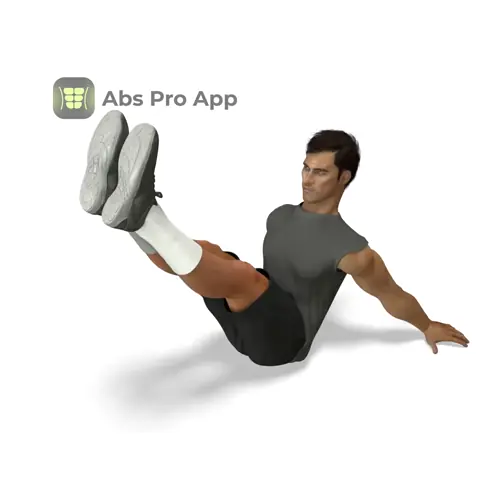
Start by sitting on the floor with your legs extended straight out in front of you. Place your hands on the floor slightly behind your hips with your fingers pointing forward or slightly outward. Your palms should press firmly into the ground to help with balance.
Lean your torso back just enough so you feel your abs engage, but keep your chest open and your spine long. Avoid rounding your lower back. From this position, lift both legs off the floor until they are roughly at a 45 degree angle. Your knees stay straight and your toes point forward.
Setup tip: If you feel unstable, scoot your hands a little wider, but do not lean back so far that your shoulders take over.
How To Do Seated jacks (Step-by-step)
- Sit on the floor with legs straight and hands placed behind you.
- Lean back slightly and brace your core.
- Lift both legs together to about a 45 degree angle.
- Keep legs straight and feet off the ground.
- Slowly open your legs out to the sides.
- Pause briefly while keeping your torso still.
- Bring your legs back together under control.
- Continue opening and closing the legs for reps.
- Finish by lowering your feet to the floor with control.
Form Cues
- Chest open, shoulders relaxed
- Core tight the whole time
- Legs stay straight
- No swinging or bouncing
- Move slow and controlled
- Keep feet off the floor
Breathing & Bracing
Proper breathing helps you stay stable and keeps tension in your abs during seated jacks. Before you lift your legs, take a small inhale through your nose and gently tighten your core as if preparing for a cough. This creates a solid brace without holding your breath.
As you open your legs apart, exhale slowly through your mouth. Think about pulling your ribs down and keeping your waist tight. When you bring your legs back together, take another controlled inhale. Continue this rhythm for each repetition.
A simple pattern to repeat is inhale as legs come together, exhale as legs move apart. Keep breathing smooth and steady. If you notice yourself holding your breath or losing posture, pause, reset your brace, and continue.
Common Mistakes
- Rounding the lower back, fix by sitting taller and reducing lean.
- Using momentum to swing the legs, fix by slowing the tempo.
- Bending the knees, fix by focusing on long straight legs.
- Leaning too far back onto the shoulders, fix by bringing torso more upright.
- Letting feet touch the floor, fix by lowering the range slightly.
- Tensing the neck, fix by relaxing shoulders and gaze forward.
How It Should Feel
Quick self-check: Seated jacks should create a strong burning sensation in the abs, especially the lower portion. You should also feel steady tension in the hip flexors as they help keep the legs lifted.
Good signs: your torso stays mostly still, legs move smoothly in and out, and you can maintain controlled breathing. Your hands feel supportive but not overloaded.
Warning signs: sharp pain in the lower back, hip pinching, or loss of control mean you should stop. If you feel it mostly in your neck or back, sit taller and reduce how far you lean back. Lower the leg height slightly if your lower back feels strained.
Alternative Names
Seated leg jacks
Variations
Easier
- Bent-knee seated jacks: Keep knees bent to shorten the lever and reduce difficulty.
- Feet-tap seated jacks: Lightly tap heels on the floor between reps for more support.
Harder
- Extended-hold seated jacks: Pause for 2 to 3 seconds with legs open on every rep.
- Hands-off seated jacks: Lift hands slightly off the floor to increase core demand.
Sample Workout
Core-focused circuit:
- Seated jacks, 12 to 20 reps
- Dead bug, 10 reps per side
- High plank, 30 to 45 seconds
- Bicycle crunch, 12 reps per side
Rest 60 seconds and repeat for 2 to 3 rounds. Place seated jacks early in the workout when your core is fresh, or use them as a finisher for a strong ab burn.
Progression Plan
Week 1: Perform seated jacks for 2 to 3 sets of 10 to 12 reps. Focus on perfect form, straight legs, and smooth breathing. Rest 60 to 90 seconds between sets.
Week 2: Increase to 12 to 16 reps per set or add a slow 2 second open and close tempo. Keep rest the same.
Week 3: Add a brief pause when legs are open or increase total sets to 3 to 4. Maintain control throughout.
Week 4: Progress to an advanced variation like extended-hold seated jacks. If form breaks down, repeat the previous week until control improves.
FAQ
How many reps should I do?
Most people do well with 10 to 20 controlled reps per set.
Is this exercise bad for my lower back?
Not if done correctly. Keep a neutral spine and stop if you feel pain.
Can I do seated jacks every day?
Yes, as long as volume is reasonable and your core recovers well.
Should my legs be straight or bent?
The standard version uses straight legs. Bent knees are for easier variations.
Summary
Seated jacks are a simple but demanding abs exercise that fits well into any bodyweight core routine. By keeping your legs lifted, your torso steady, and your movements controlled, you can challenge your core without any equipment.
Stay consistent, focus on quality reps, and progress gradually. When done with good technique, seated jacks can help you build stronger, more controlled abs and better overall core stability.
Get Defined Abs in 30 Days
This exercise is part of our complete 30-day ab program. Download the app for structured daily workouts and track your progress.