
Rope Climb Crunch Tutorial
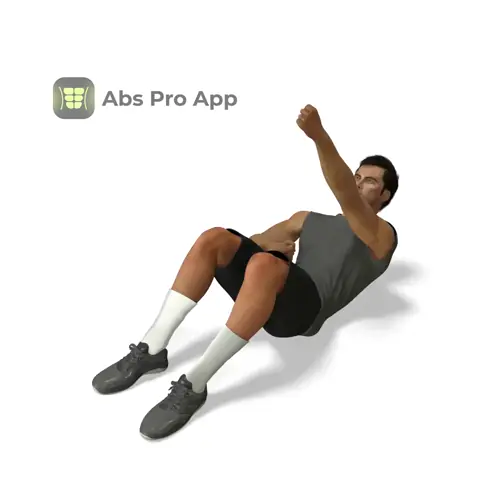
Rope Climb Crunch is a dynamic bodyweight abs exercise that combines a classic crunch with alternating arm reaches, as if you are climbing a rope. With your feet planted and knees bent at 90 degrees, this move targets the rectus abdominis while also challenging coordination and core control.
It is best suited for intermediate trainees who already understand basic crunch technique and want a more engaging variation. Focus on controlled spinal flexion, steady breathing, and keeping tension in your abs rather than pulling with your arms.
Benefits
- Builds stronger and more defined abs
- Adds coordination to traditional crunches
- Improves mind muscle connection in the core
- Trains controlled spinal flexion
- Increases time under tension for abs
- Requires no equipment and little space
Setup & Starting Position
Start by lying flat on your back on a comfortable floor or mat. Bend your knees so they form roughly a 90 degree angle, and plant your feet firmly on the ground, about hip width apart. Your toes should point forward and stay relaxed.
Extend your arms straight above your chest, hands open, palms facing each other. Gently press your lower back into the floor to set a neutral pelvis and engage your abs before you move. Keep your chin slightly tucked so your neck stays long.
Before the first rep, take a calm breath in through your nose and lightly brace your core as if preparing to cough.
Quick setup tip: If your feet lift or shift during the movement, move them slightly closer to your hips for better stability.
How To Do Rope climb crunch (Step-by-step)
- Lie on your back with feet flat and knees bent at 90 degrees.
- Arms are extended upward, shoulders relaxed.
- Inhale to prepare and brace your core gently.
- Exhale and crunch your shoulders off the floor.
- Reach up with your right hand as if grabbing a rope.
- Immediately reach up with your left hand, staying in the crunch.
- After both reaches, pause briefly at the top.
- Lower your upper back to the floor with control.
- Fully reset your shoulders, keeping abs engaged.
- That is one rep, repeat for the desired number of reps.
Form Cues
- Crunch up, not forward
- Feet stay planted
- Knees stay at 90 degrees
- Reach tall with the arms
- Neck stays relaxed
- Slow and controlled tempo
Breathing & Bracing
Proper breathing makes the rope climb crunch far more effective and safer for your spine. Start each rep with a calm inhale through your nose while lying on the floor. As you begin the crunch, exhale slowly through your mouth and feel your ribs move down toward your hips.
Brace your core by tightening your abs as if you are about to laugh or cough, not by sucking in your stomach. This light brace should stay active during both arm reaches. Avoid holding your breath, as that often leads to neck tension.
A simple breathing rhythm you can repeat is inhale at the bottom, exhale during the crunch and both reaches, then inhale again once you return to the floor. This pattern helps keep your movement controlled and your core fully engaged.
Common Mistakes
- Pulling the neck forward, fix by keeping eyes on the ceiling.
- Feet lifting off the floor, fix by planting them closer to the hips.
- Using arm momentum instead of abs, fix by slowing the reaches.
- Arching the lower back, fix by pressing it gently into the floor.
- Rushing reps, fix by counting each rep only after both reaches.
How It Should Feel
Quick Self Check: You should feel a strong, controlled burn in the front of your abs that builds with each rep. Your shoulders lift off the floor, but your lower back stays in contact with the ground. Breathing should feel challenging but manageable.
Good signs: steady tension in the abs, smooth arm coordination, and no shifting of the feet. Warning signs: sharp pain in the neck, lower back discomfort, or loss of control. Stop immediately if you feel sharp pain.
If you feel it mostly in your neck, relax your head and focus on curling your ribs toward your hips. If you feel it in your lower back, reduce the range of motion and reset your brace before each rep.
Alternative Names
rope pull crunch, climbing crunch
Variations
Easier
- Alternating Reach Crunch: Perform a regular crunch and reach with only one arm per rep.
- Short Range Rope Crunch: Lift shoulders only slightly off the floor while mimicking the rope climb.
Harder
- Extended Hold Rope Climb Crunch: Pause for 3 to 5 seconds at the top after both reaches.
- Slow Tempo Rope Climb Crunch: Take 3 seconds up and 3 seconds down for each rep.
Sample Workout
Core Focused Bodyweight Workout
- Rope Climb Crunch, 3 sets of 10 to 15 reps
- Dead Bug, 3 sets of 8 reps per side
- High Plank, 3 sets of 30 to 45 seconds
- Glute Bridge, 3 sets of 12 to 15 reps
Rest 45 to 60 seconds between sets. Perform the rope climb crunch early in the workout when your abs are fresh.
Progression Plan
Week 1: Perform 3 sets of 8 to 10 controlled reps. Focus on clean technique, steady breathing, and keeping feet planted. Rest up to 60 seconds between sets.
Week 2: Increase to 3 sets of 12 to 15 reps. Keep the same form and reduce rest to about 45 seconds. Add a brief pause after both reaches.
Week 3: Slow the tempo to 3 seconds up and 3 seconds down for 10 to 12 reps. This increases core control.
Progress to advanced variations once you can maintain perfect form without neck or lower back strain. Repeat a week if control or breathing breaks down.
FAQ
How many reps should I do?
Most people do well with 10 to 15 reps per set, where one rep includes both arm reaches.
Should my shoulders fully relax on the floor?
Yes, briefly resetting your shoulders helps maintain good form and breathing.
Can I slow it down to make it harder?
Yes, slower tempo increases time under tension and makes it more challenging.
Why do my feet keep lifting?
This usually means your core is losing tension, move feet closer or reduce range.
Summary
The rope climb crunch is a smart way to level up your abs training without adding equipment. By combining controlled crunching with alternating reaches, it challenges strength, coordination, and focus.
Prioritize form over speed, breathe with intention, and count each rep carefully. With consistent practice and gradual progression, this exercise can become a reliable staple in your core workouts.
Get Defined Abs in 30 Days
This exercise is part of our complete 30-day ab program. Download the app for structured daily workouts and track your progress.