
Reverse Plank Tutorial
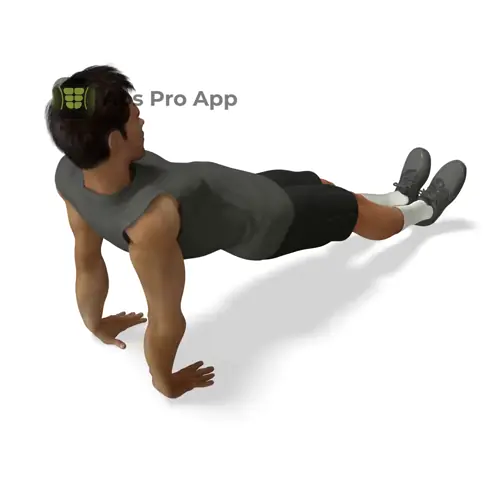
The reverse plank is a challenging bodyweight core exercise where your body faces upward and you support yourself on your hands and heels. It is a powerful way to train the abs, glutes, and the entire back side of the body while also improving shoulder stability. This exercise is best suited for intermediate trainees who already have basic core control and shoulder strength.
In this guide and tutorial, you will learn how to do a reverse plank with proper technique, what muscles it targets, and how to progress safely. Focus on keeping your body in a straight line, squeezing the glutes, and actively pushing through the hands to stay strong and stable.
Benefits
- Builds strong abs with isometric tension
- Strengthens glutes and hamstrings
- Improves shoulder stability and endurance
- Balances front and back core strength
- Enhances posture awareness
- Challenges full body coordination
- No equipment needed
Setup & Starting Position
Start seated on the floor with your legs fully straight in front of you and your heels resting on the ground. Place your hands on the floor slightly behind your hips, directly under your shoulders. Your arms are straight, elbows locked but not hyperextended. Turn your fingers so they point toward your feet, which helps align the shoulders and wrists.
Before lifting, straighten your spine and pull your shoulders slightly back and down. Your chest should feel open, not collapsed. Brace your core gently as if preparing for a plank. Keep your neck long and your gaze either toward the ceiling or slightly behind you.
Quick setup tip: Think about pushing the floor away with your hands before you even lift your hips, this helps activate the shoulders and upper back.
How To Do Reverse plank (Step-by-step)
- Sit tall with legs straight and hands under shoulders
- Point fingers toward the feet and lock arms straight
- Brace your abs and squeeze your glutes
- Press through hands and heels to lift your hips
- Raise hips until body forms a straight line
- Keep shoulders stacked over hands
- Hold the position with steady breathing
- Lower hips back to the floor under control
Form Cues
- Body in one straight line
- Squeeze glutes hard
- Push through the hands
- Ribs down, abs tight
- Neck long and relaxed
- Heels pressed into floor
Breathing & Bracing
Proper breathing is key to holding a strong reverse plank. Before lifting your hips, take a calm inhale through your nose. As you lift into the plank, gently exhale through your mouth and tighten your abs as if you are zipping them up. This creates core tension without holding your breath.
Once in the hold, keep breathing slowly and evenly. A simple rhythm is to inhale for three seconds and exhale for three seconds while maintaining the position. Your ribs should stay down and your hips should not tilt or sag as you breathe.
Avoid breath holding, which can increase pressure and cause you to lose form. Think of bracing as tightening a wide belt around your waist while still being able to breathe naturally.
Common Mistakes
- Letting hips sag, fix by squeezing glutes harder
- Bending the arms, fix by locking elbows straight
- Hands too far from shoulders, fix by stacking joints
- Neck dropping back, fix by keeping a neutral head
- Feet sliding apart, fix by keeping legs tight together
- Holding breath, fix by using slow steady breathing
How It Should Feel
Quick Self-Check: The reverse plank should feel demanding but controlled. You should feel strong tension through your abs, glutes, and shoulders.
Good signs:
- Abs feel tight and engaged
- Glutes are working to keep hips high
- Shoulders feel stable, not strained
Warning signs:
- Sharp pain in shoulders or wrists, stop immediately
- Lower back compression, reset and squeeze glutes more
If you feel it mostly in your neck, lower your gaze and lengthen the back of your neck. If the lower back takes over, focus on posteriorly tilting the hips and bracing the abs before lifting again.
Alternative Names
upward plank, back plank
Variations
Easier
- Bent-Knee Reverse Plank: Bend knees and keep feet flat to reduce load
- Short Hold Reverse Plank: Hold for 10 to 15 seconds with perfect form
Harder
- Single-Leg Reverse Plank: Lift one leg while keeping hips level
- Reverse Plank with Leg Raises: Alternate lifting legs while holding plank
Sample Workout
Core and Posterior Chain Workout
- Reverse Plank, 3 sets of 20 to 40 second holds
- Glute Bridge, 3 sets of 12 reps
- Dead Bug, 3 sets of 8 reps per side
- Side Plank, 2 sets of 20 seconds per side
Rest 45 to 60 seconds between sets. Focus on control and quality over time.
Progression Plan
Week 1: Practice the standard reverse plank with short holds. Aim for 3 sets of 15 to 20 seconds. Rest well between sets and focus on perfect alignment and breathing.
Week 2: Increase hold time to 25 to 35 seconds per set. Keep shoulders stacked and hips fully extended. If form breaks, shorten the hold.
Week 3: Work up to 40 to 45 second holds or add a slow controlled tempo by lifting into the plank over 3 seconds and lowering over 3 seconds.
Week 4: Introduce advanced variations like single-leg reverse plank. Start with 10 to 15 seconds per side. Repeat a week if you cannot maintain a straight body line.
Progress by increasing time, improving control, and reducing rest. Only move to harder variations once you can hold the standard version without hip sag or shoulder strain.
FAQ
Is reverse plank good for abs?
Yes, it trains the abs isometrically and challenges deep core muscles.
Why do my wrists hurt during reverse plank?
Wrist discomfort often comes from poor hand placement or lack of mobility, try adjusting hand angle or warming up wrists.
How long should I hold a reverse plank?
Most people benefit from 20 to 45 second holds with perfect form.
Can I do reverse plank every day?
You can perform it frequently if recovery feels good, but allow rest if shoulders or wrists feel sore.
Summary
The reverse plank is a powerful way to build strong abs and a balanced core using only your bodyweight. By following this guide and focusing on clean technique, you can safely add it to your routine and see long-term strength gains.
Stay patient, breathe with control, and progress gradually. With consistent practice, the reverse plank can become a key tool in your abs exercise library and overall core training plan.
Get Defined Abs in 30 Days
This exercise is part of our complete 30-day ab program. Download the app for structured daily workouts and track your progress.