
Plank To Bear Plank Tutorial
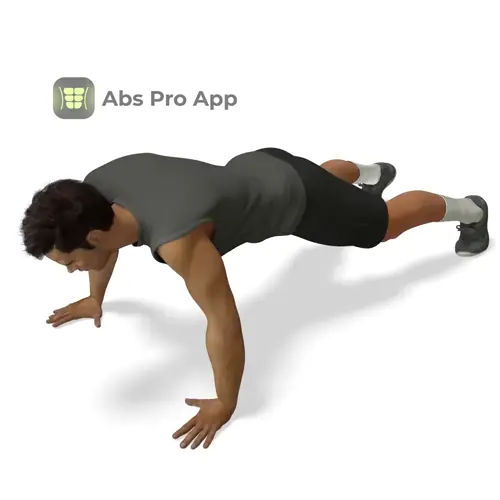
The plank to bear plank is a dynamic core exercise that transitions between a high plank and a bear plank with the knees hovering just above the floor. It builds strong abs, shoulders, and hips while teaching full body tension and control.
This move is best for intermediate trainees who already know how to hold a solid plank and want a tougher, more engaging core challenge. Focus on steady movement, quiet knees, and keeping your spine neutral throughout.
Benefits
- Improves core strength and endurance
- Builds shoulder stability under load
- Trains hip control and coordination
- Teaches bracing during movement
- Enhances plank technique
- Challenges full body tension
Setup & Starting Position
Begin on the floor in a high plank position. Place your hands directly under your shoulders with fingers spread wide for stability. Your arms should be straight but not locked, and your shoulders should feel stacked over your wrists.
Extend your legs straight back with your toes tucked into the floor. Feet should be about hip width apart to help with balance. Create a straight line from your head through your hips to your heels. Gently tuck your chin so your neck stays neutral and your gaze is slightly ahead of your hands.
Before starting the first rep, tighten your abs as if preparing for a cough and lightly squeeze your glutes. This setup ensures your lower back stays protected during the knee hover.
Setup tip: Press the floor away with your hands to activate your shoulders before you move.
How To Do Plank to bear plank (Step-by-step)
- Start in a strong high plank with arms straight.
- Brace your core and keep your spine neutral.
- Bend both knees at the same time, lowering them toward the floor.
- Stop when knees hover a few inches above the ground.
- Keep shoulders over wrists and hips level.
- Pause briefly while maintaining tension.
- Extend your legs back to a full high plank.
- Move slowly and under control.
- Repeat for the desired number of reps.
Form Cues
- Push the floor away
- Knees hover, do not rest
- Spine stays long
- Ribs down, abs tight
- Hips level side to side
- Quiet, controlled movement
Breathing & Bracing
Proper breathing makes this exercise much more effective and safer. Start each rep by lightly inhaling through your nose while in the high plank. As you bend your knees into the bear plank, exhale slowly and tighten your abs.
Think about wrapping your core around your spine rather than sucking your stomach in. Your ribs should stay down and connected to your hips. This helps prevent arching in the lower back.
A simple rhythm is to inhale in the plank, exhale as the knees hover, then inhale again as you return to plank. Keep the breath smooth and steady, not forced. Avoid holding your breath, especially during the knee hover, since that is where the most tension is required.
Common Mistakes
- Letting the hips sag, fix by bracing your abs harder.
- Rushing the movement, fix by slowing down each rep.
- Bending the arms, fix by keeping elbows straight.
- Knees touching the floor, fix by stopping higher.
- Shoulders drifting behind wrists, fix by leaning slightly forward.
- Neck craning up, fix by keeping a neutral gaze.
How It Should Feel
Quick Self-Check:
You should feel strong tension in your abs and shoulders throughout the set. The movement should feel controlled, not shaky or rushed. Your hips should stay level, and your lower back should feel supported by your core.
Good signs: abs working hard, shoulders stable, smooth knee hover, steady breathing.
Warning signs: sharp pain in the lower back or shoulders, pinching in the wrists, or loss of balance. Stop immediately if you feel sharp pain.
If you feel it mostly in your neck, relax your shoulders and push the floor away. If you feel it in your lower back, shorten the range and tighten your abs before moving.
Alternative Names
Plank to bear
Variations
Easier
- Plank knee taps: From high plank, gently tap knees to the floor instead of hovering.
- Bear plank hold: Hold the bear position without moving back to plank.
Harder
- Slow plank to bear plank: Take 3 to 5 seconds to lower and return while keeping full tension.
- Plank to bear plank with shoulder taps: Add a shoulder tap in the bear position for extra challenge.
Sample Workout
Core Stability Workout
- Plank to Bear Plank, 3 sets of 8 to 12 reps
- Dead Bug, 3 sets of 10 reps per side
- Side Plank, 3 sets of 30 seconds per side
- Glute Bridge, 3 sets of 15 reps
Rest 45 to 60 seconds between sets. Focus on quality reps and controlled breathing.
Progression Plan
Week 1: Practice 3 sets of 6 to 8 reps. Move slowly and focus on perfect form. Rest up to 60 seconds between sets.
Week 2: Increase to 8 to 12 reps per set. Keep the knee hover steady and quiet. Reduce rest to 45 seconds.
Week 3: Slow the tempo, taking 2 seconds down and 2 seconds up. Add a brief pause during the knee hover.
Week 4: Try an advanced variation like the slow plank to bear plank. If form breaks down, repeat the previous week.
Progress only when you can keep your hips level and breathing controlled on every rep.
FAQ
How many reps should I do?
Most people do well with 8 to 12 controlled reps per set.
Is one rep both directions?
Yes, one rep is bending the knees to hover and returning to high plank.
Can I do this every day?
You can, but allow at least one easier day if your shoulders feel fatigued.
Why do my wrists get tired?
This is normal at first, focus on spreading your fingers and pressing evenly through the hands.
Summary
The plank to bear plank is a powerful way to upgrade your core training without equipment. By moving between two demanding positions, you build strength, control, and awareness that carries over to many other exercises.
Stay patient with the progression, focus on clean reps, and breathe with intention. With consistent practice, this exercise can become a cornerstone of your abs and stability routine.
Get Defined Abs in 30 Days
This exercise is part of our complete 30-day ab program. Download the app for structured daily workouts and track your progress.