
Plank Ins Tutorial
Plank ins are a dynamic core exercise performed from a high plank on your hands, where you jump your feet toward your hands and back out again. This move blends core strength, shoulder stability, and light cardio into one efficient drill. It is popular in ab workouts because it trains your abs to stay tight while your legs move quickly.
This exercise is best for intermediate trainees who already have a solid plank technique and want to increase core control and conditioning. Focus on keeping your hands under your shoulders, your arms straight, and your torso stable as your feet jump in and out.
Benefits
- Builds dynamic core strength
- Improves plank stability on hands
- Trains abs to resist lower back arching
- Elevates heart rate for conditioning
- Improves coordination between upper and lower body
- Strengthens shoulders and arms isometrically
- Requires no equipment and little space
Setup & Starting Position
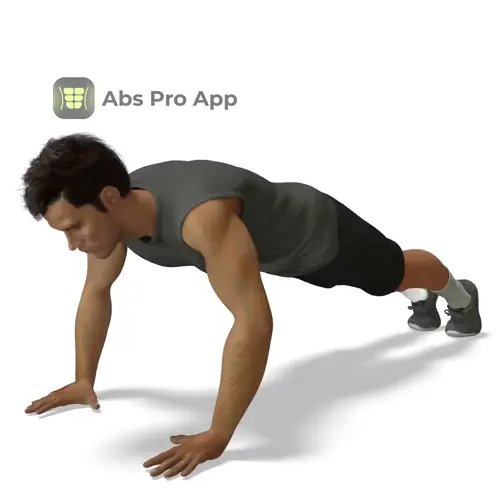
Begin on the floor in a high plank position. Place your hands flat on the ground directly under your shoulders, fingers spread wide for stability. Your arms should be straight but not locked, with elbows facing slightly back.
Extend both legs straight behind you so your weight is balanced between your hands and the balls of your feet. Your feet should start about hip-width apart, giving you a stable base for the jumps. Engage your glutes lightly and tighten your abs so your body forms a straight line from head to heels.
Keep your neck neutral by looking slightly ahead of your hands, not straight up or tucked in. Before starting the first rep, take a controlled breath and brace your core as if preparing for a light punch.
Quick setup tip: If your shoulders feel unstable, press the floor away with your hands to activate your upper back before moving.
How To Do Plank ins (Step-by-step)
- Set up in a strong high plank with hands under shoulders.
- Brace your core and squeeze your glutes.
- Bend your knees slightly to prepare for the jump.
- Jump both feet forward toward your hands at the same time.
- Land softly on the balls of your feet with knees bent.
- Keep your shoulders stacked over your hands.
- Immediately jump both feet back to the starting plank.
- Stabilize your core before the next rep.
- Continue jumping in and out with a steady rhythm.
- Finish by holding the plank briefly before resting.
Form Cues
- Hands stay under shoulders
- Abs tight the whole time
- Jump both feet together
- Soft, quiet landings
- Flat back, no sagging hips
- Push the floor away
Breathing & Bracing
Breathing correctly during plank ins helps you stay controlled and protects your lower back. Start by taking a calm inhale through your nose in the plank position. As you jump your feet toward your hands, gently exhale through your mouth while keeping your abs tight.
Think about tightening your core as a cylinder around your waist, not sucking your stomach in. Your ribs should stay stacked over your hips, and your lower back should not arch or round excessively.
A simple breathing rhythm is to exhale on the jump in and inhale as you jump back. Keep the breaths short and controlled rather than holding your breath. If you notice your breathing becoming chaotic, slow the tempo of the exercise until you regain control.
Common Mistakes
- Letting hips sag, fix by tightening abs before each jump.
- Hands too far forward, reset hands under shoulders.
- Landing flat-footed, aim to land softly on the balls of your feet.
- Jumping feet unevenly, focus on moving both legs together.
- Rounding the upper back, push the floor away with your hands.
- Holding breath, use a steady exhale on each jump.
How It Should Feel
Quick Self-Check: When done correctly, plank ins should create a strong burning sensation in your abs and hip flexors, with steady tension in your shoulders and arms. Your core should feel active and supportive, not loose.
Good signs: You feel your abs bracing hard, your shoulders feel stable, and your breathing stays controlled even as your heart rate rises.
Warning signs: Sharp pain in the lower back, wrists, or shoulders means you should stop. If your hips slam down during the jump, the core is losing control.
Adjustments: If you feel strain in your neck, look slightly forward instead of tucking your chin. If your lower back feels overloaded, slow the movement and reduce the jump distance.
Alternative Names
Plank jump ins, In and out plank
Variations
Easier
- Step-In Plank, step one foot at a time toward the hands instead of jumping.
- Short Range Plank Ins, jump feet in only halfway to reduce load.
Harder
- Plank Ins to Push-Up, add a push-up each time feet jump back.
- Fast Tempo Plank Ins, increase speed while keeping strict form.
Sample Workout
Core Conditioning Workout
- High Plank Hold, 30 seconds
- Plank Ins, 20 to 30 seconds
- Dead Bug, 10 reps per side
- Mountain Climbers, 30 seconds
Rest 60 seconds and repeat for 3 to 4 total rounds. Focus on clean technique rather than maximum speed.
Progression Plan
Week 1: Perform plank ins for 3 sets of 15 seconds with 45 to 60 seconds rest. Focus on slow, controlled jumps and perfect plank alignment. If form breaks down, shorten the set.
Week 2: Increase to 3 to 4 sets of 20 to 30 seconds. Begin to slightly increase tempo while maintaining quiet landings and strong core bracing.
Week 3: Reduce rest to 30 to 45 seconds and aim for smoother transitions between jumps. If you can complete all sets without losing form, you are ready to progress.
Advancing: Move to advanced variations once you can maintain a flat back and steady breathing for 30 seconds. Repeat a week if your hips drop or your shoulders fatigue too quickly.
FAQ
How many plank ins should I do?
Most people start with 15 to 30 seconds per set, focusing on quality reps.
Are plank ins good for abs?
Yes, they strongly challenge the abs by forcing them to stabilize while the legs move.
Can I do plank ins every day?
They can be done often, but allow rest if your core or shoulders feel overly fatigued.
Why do my hips drop during plank ins?
This usually means your core is not braced enough or you are moving too fast.
Summary
Plank ins are a powerful way to upgrade a standard plank into a dynamic core challenge. By jumping your feet in and out while holding a strong high plank, you train your abs to stay engaged under movement and fatigue.
Stay focused on hand placement, core bracing, and controlled breathing. With consistent practice and gradual progression, plank ins can become a reliable tool for building stronger abs, better shoulder stability, and improved overall body control.
Get Defined Abs in 30 Days
This exercise is part of our complete 30-day ab program. Download the app for structured daily workouts and track your progress.