
Oblique In-and-out Tutorial
Oblique in-and-outs are a dynamic side-focused core exercise that combine a side crunch hold with a controlled leg tuck and extension.
This move trains the obliques to stabilize while the legs move, which is key for rotation control, athletic core strength, and visible side abs. It fits best for intermediate level workouts and is commonly used in abs circuits or finishers.
Focus on keeping the shoulders lifted, legs off the floor, and the movement slow and deliberate. This is not about speed, but about control, tension, and clean technique.
Benefits
- Builds strength in the side abs
- Improves core stability during leg movement
- Trains control and coordination
- Challenges the abs without equipment
- Helps develop visible oblique definition
- Strengthens hip flexors in a controlled way
- Great addition to abs circuits and finishers
Setup & Starting Position
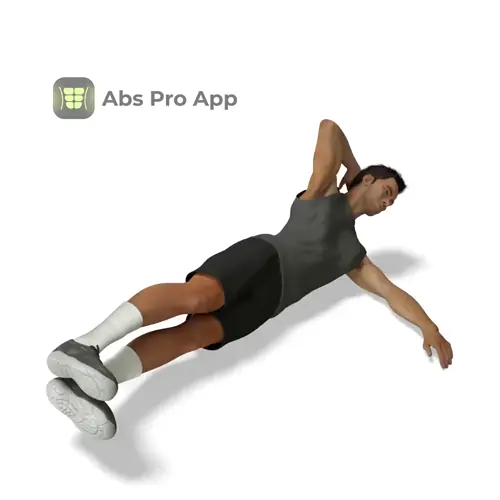
Lie on your side on a mat or flat floor. Stack your legs on top of each other and fully extend them so they form a straight line with your body.
Lift your shoulders and upper back slightly off the floor into a side crunch position. Your torso should be angled toward your hips, creating tension in the side of your waist. Keep your chest open and neck long.
Your arms can be lightly supporting your head or placed in front of your torso for balance, but avoid pulling on the neck or pushing off the floor.
Both legs should be lifted off the floor, hovering slightly, and fully straight. This is your starting position.
Setup tip: Before starting the first rep, brace your core and imagine shortening the distance between your ribs and hips on the working side.
How To Do Oblique in-and-out (Step-by-step)
- Lie on your side with legs extended and stacked.
- Lift your shoulders into a side crunch and brace your core.
- Hover both straight legs slightly off the floor.
- Bend both knees in toward your torso, forming a tucked position.
- Keep shoulders lifted and avoid collapsing backward.
- Pause briefly in the tucked crunch.
- Extend both legs back out to the straight position.
- Control the extension, do not let legs drop.
- Maintain tension in the obliques.
- Repeat for the desired reps, then switch sides.
Form Cues
- Shoulders stay lifted the entire set
- Move slow and controlled
- Do not let legs touch the floor
- Crunch from the waist, not the neck
- Exhale as knees come in
- Keep chest open
Breathing & Bracing
Breathing correctly during oblique in-and-outs helps maintain tension and protects your lower back.
Before starting, take a calm inhale and gently brace your core as if preparing to cough. This creates a stable base without stiffening the entire body.
As you bend your knees in toward your torso, exhale slowly. This helps deepen the crunch and increases oblique engagement. Think about pulling your ribs toward your hips on the working side.
As you extend your legs back out, inhale under control while keeping your core tight. Avoid letting your ribcage flare or your lower back arch.
A simple rhythm to repeat is: inhale to prepare, exhale as knees come in, inhale as legs extend.
Never hold your breath, and stop the set if you lose the ability to control your breathing.
Common Mistakes
- Letting the shoulders drop, keep them lifted throughout the set.
- Moving too fast, slow down and control each phase.
- Pulling on the neck, keep hands light or off the head.
- Letting legs touch the floor, keep them hovering.
- Rolling onto the back, stay stacked on your side.
- Using momentum, initiate every rep with the obliques.
How It Should Feel
Quick Self-Check:
You should feel a strong, burning contraction along the side of your waist and into the deep core. The movement should feel challenging but controlled.
Good signs:
- Deep fatigue in the obliques
- Core shaking near the end of the set
- Stable shoulders and torso
Warning signs:
- Sharp pain in the lower back or hip, stop immediately
- Neck strain, reduce range or support the head better
If you feel it mostly in your lower back, shorten the leg extension and focus on pulling the ribs down. If the neck gets tired, lower the shoulders slightly while keeping core tension.
Alternative Names
Side oblique in-and-out, Oblique crunch in-and-out
Variations
Easier
- Bent-Leg Oblique In-and-Out: Start with knees already bent and tuck them in and out with a shorter range.
- Side Crunch Hold: Hold the side crunch position without leg movement to build base strength.
Harder
- Straight-Leg Oblique In-and-Out with Pause: Add a 2 second pause when legs are fully extended off the floor.
- Slow Tempo Oblique In-and-Out: Take 3 seconds in and 3 seconds out for each rep.
Sample Workout
Core Focused Circuit:
- Oblique In-and-Out, 10 to 14 reps per side
- Dead Bug, 10 reps per side
- High Plank Shoulder Taps, 20 taps
- Glute Bridge Hold, 30 seconds
Rest 60 seconds and repeat for 2 to 3 total rounds. Perform all reps on one side before switching, where one rep equals a full tuck and extension.
Progression Plan
Week 1: Perform 2 to 3 sets of 8 to 10 reps per side. Focus on clean technique, slow movement, and maintaining shoulder lift. Rest 60 to 75 seconds between sets.
Week 2: Increase to 10 to 14 reps per side and reduce rest to 45 to 60 seconds. Start extending the legs slightly lower without touching the floor.
Week 3: Add a 1 to 2 second pause in the extended position to increase tension. Keep reps the same but slow the tempo.
Progress when: You can complete all reps without losing shoulder height or leg control.
If form breaks down, repeat the previous week and focus on control before advancing.
FAQ
How many reps should I do per side?
Most people do well with 8 to 15 controlled reps per side.
Should both legs move together?
Yes, both legs move together and one full tuck and extension counts as one rep.
Can I place my feet on the floor between reps?
No, keeping the legs hovering maintains constant tension and proper difficulty.
Is this exercise bad for the lower back?
When done with control and proper bracing, it is generally safe. Stop if you feel pain.
Summary
Oblique in-and-outs are a powerful way to train the side abs with no equipment while improving control and core coordination.
By keeping the shoulders lifted and moving the legs with intention, you place constant tension where it matters most. This makes the exercise effective even with lower rep counts.
Use this move to strengthen your obliques, challenge your core stability, and add variety to your abs workouts. Stay controlled, breathe steadily, and progress at your own pace.
Get Defined Abs in 30 Days
This exercise is part of our complete 30-day ab program. Download the app for structured daily workouts and track your progress.