
O-raises Hold Feet On Ground Tutorial
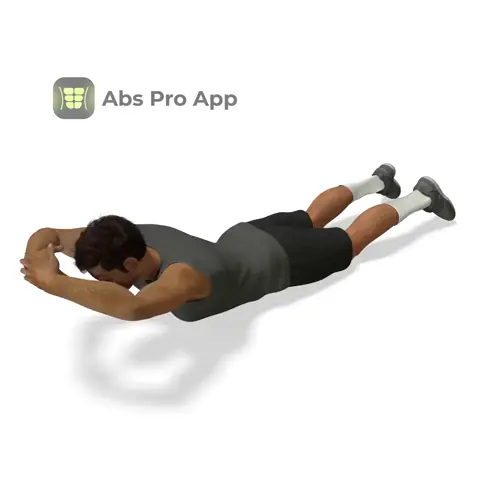
O-Raises Hold, Feet on Ground is a gentle but effective bodyweight exercise done lying face down while holding your chest lifted with your arms circled overhead. This move trains your deep core, lower back, and upper back muscles to work together, which helps improve posture and spinal stability.
It is a beginner-friendly isometric hold that fits well into abs and core workouts, especially for people learning how to control their trunk without equipment. Focus on slow breathing, keeping your feet grounded, and lifting through the chest rather than cranking the neck.
Benefits
- Improves core stability without equipment
- Strengthens lower back safely
- Supports better posture awareness
- Trains upper back endurance
- Encourages controlled breathing
- Low impact and joint friendly
- Good foundation for harder back extensions
Setup & Starting Position
Start by lying face down on a mat or comfortable floor. Extend your legs straight behind you with your feet resting on the ground, toes relaxed and pointed slightly outward. Your hips stay in contact with the floor.
Bring your arms overhead and circle them so your hands form an O shape above your head. Elbows are slightly bent and relaxed, not locked. Your forehead can rest lightly on the floor at first as you set your position.
Before lifting, gently tighten your core as if bracing your stomach. Lengthen the back of your neck so your head stays in line with your spine.
Setup tip: Think about growing longer from head to toes rather than lifting as high as possible.
How To Do O-raises hold feet on ground (Step-by-step)
- Lie face down with legs straight and feet on the floor
- Circle arms overhead into an O position
- Brace your core gently
- Lift your chest a few inches off the ground
- Keep feet, hips, and lower ribs down
- Hold the position with steady tension
- Breathe slowly while maintaining the lift
- Lower your chest back down with control
Form Cues
- Feet stay heavy on the floor
- Lift through the chest, not the chin
- Neck stays long and neutral
- Ribs stay down
- Squeeze glutes lightly
- Arms relaxed, not shrugged
Breathing & Bracing
Before lifting your chest, take a slow breath in through your nose. As you lift, gently tighten your core like you are preparing for a cough, but without holding your breath.
During the hold, breathe slowly and evenly. Inhale through your nose for about three to four seconds, then exhale through your mouth for the same length. Each exhale should help you maintain tension without collapsing.
Keep your ribs pulled down and avoid flaring them upward as you breathe. Your belly and sides should expand slightly with each inhale.
A simple rhythm to repeat is: inhale for four seconds, exhale for four seconds, while keeping the chest lifted.
Common Mistakes
- Lifting too high, fix by lowering the chest and focusing on control
- Pulling the head back, fix by keeping eyes down
- Feet lifting off the floor, fix by pressing toes gently into the ground
- Holding the breath, fix by counting breaths
- Shrugging shoulders, fix by relaxing traps
- Overarching lower back, fix by bracing core more
How It Should Feel
Quick Self-Check
Good signs:
- Steady tension in your core and lower back
- Upper back working without neck strain
- Ability to breathe calmly during the hold
Warning signs:
- Sharp pain in the lower back, stop immediately
- Pinching in the neck or shoulders
If you feel it mostly in your neck, lower the chest slightly and lengthen the neck. If you feel pressure in the lower back, reduce the lift and tighten your abs more.
Alternative Names
Prone O Hold, O Raise Isometric Hold
Variations
Easier
- Short Hold O-Raises: Hold the chest lift for 5 to 10 seconds at a time
- Arms Lowered Hold: Keep arms slightly forward instead of fully overhead
Harder
- O-Raises Hold with Arm Lift: Slightly lift arms off the floor while holding the chest up
- Long Duration Hold: Increase hold time while maintaining perfect form
Sample Workout
Core and Posture Workout
- Dead Bug, 3 sets of 8 reps per side
- Glute Bridge, 3 sets of 12 reps
- O-Raises Hold, Feet on Ground, 3 sets of 20 to 30 seconds
- Bird Dog, 3 sets of 6 reps per side
Rest 45 to 60 seconds between sets. Use this exercise near the middle or end of the workout to reinforce posture.
Progression Plan
Week 1: Perform 3 sets of 15 to 20 second holds. Focus on perfect setup, slow breathing, and keeping feet grounded. Rest 45 seconds between sets.
Week 2: Increase hold time to 25 to 30 seconds per set. Maintain the same chest height and avoid lifting higher as you fatigue.
Week 3: Add a fourth set or slightly slow your breathing rhythm to increase control. Only progress if you can hold without neck or lower back discomfort.
Week 4: Try an advanced variation like lifting the arms slightly, or extend holds to 40 seconds. If form breaks, repeat the previous week.
FAQ
How long should I hold the O-raises position?
Most beginners start with 15 to 30 seconds per hold.
Should my feet ever lift off the ground?
No, this version requires feet staying on the floor for support.
Can I do this exercise every day?
Yes, as long as there is no soreness or pain in your lower back.
Is this more for abs or back?
It works both, with emphasis on deep core and lower back support.
Summary
O-Raises Hold, Feet on Ground is a simple yet powerful way to train your core and back with control. By focusing on posture, breathing, and steady tension, you build a strong foundation for more advanced core exercises.
Use this move as part of your abs routine or posture work, progress slowly, and always prioritize quality over height. Consistency will lead to better stability and body awareness.
Get Defined Abs in 30 Days
This exercise is part of our complete 30-day ab program. Download the app for structured daily workouts and track your progress.