
Low Side Plank With Rotational Reach Tutorial
Low side plank with rotational reach is a challenging core exercise that combines a forearm side plank with controlled trunk rotation. It builds deep core strength, shoulder stability, and oblique control while improving coordination. This move is ideal for intermediate exercisers who already have a solid side plank and want to progress with rotation. Focus on slow, deliberate movement, keeping your hips lifted and your body long as the top arm reaches under and then opens back up.
Benefits
- Strengthens obliques and deep core muscles
- Improves rotational core control
- Builds shoulder and hip stability
- Enhances body awareness and balance
- Challenges anti-rotation strength
- Supports better posture
Setup & Starting Position
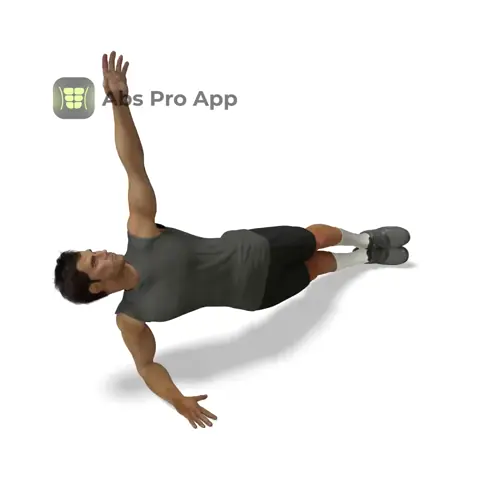
Start by lying on your side on the floor. Place your bottom forearm directly under your shoulder, elbow bent about 90 degrees, forearm pointing forward. Stack your legs straight with your feet on top of each other, pressing the outer edge of the bottom foot into the ground.
Lift your hips so your body forms a straight line from head to heels. Keep your neck neutral and your gaze forward or slightly down. Place your top hand straight up toward the ceiling with your chest open.
Before moving, tighten your core, squeeze your glutes lightly, and make sure your shoulder feels stable. Setup tip: If balance feels shaky, slightly stagger your feet heel to toe without bending the knees.
How To Do Low side plank with rotational reach (Step-by-step)
- Begin in a stable low side plank on your forearm.
- Extend your top arm straight up toward the ceiling.
- Inhale and prepare, keeping hips lifted.
- Exhale as you rotate your torso inward.
- Reach your top arm under your ribcage toward the floor behind you.
- Keep your hips stacked and lifted during the reach.
- Pause briefly at the end of the reach.
- Inhale as you reverse the motion.
- Rotate your chest back open.
- Extend your arm back up toward the ceiling.
- Maintain a steady plank position.
- Repeat for controlled repetitions.
- Lower hips only after completing the set.
Form Cues
- Elbow stacked under shoulder
- Hips lifted and steady
- Body in one long line
- Rotate through the torso
- Move slow and controlled
- Neck stays neutral
Breathing & Bracing
Breathing correctly helps you stay strong and balanced during this exercise. Start by taking a calm inhale in the starting side plank, expanding your ribs without letting your hips drop.
As you rotate and reach your arm under your body, gently exhale through your mouth. This helps your obliques engage and supports spinal control. Think about tightening your core like you are preparing for a light cough, not squeezing as hard as possible.
Inhale again as you rotate open and lift the arm back up. Keep breathing smoothly and avoid holding your breath. A simple rhythm to repeat is inhale at the top, exhale during the reach, inhale to return. Your ribs should stay stacked over your hips the entire time.
Common Mistakes
- Dropping the hips, fix by pressing harder through the forearm and feet.
- Rushing the rotation, fix by slowing each rep.
- Letting the shoulder shrug, fix by pushing the floor away.
- Bending the knees unintentionally, fix by tightening the legs.
- Over-rotating and losing balance, fix by reducing range.
- Neck strain, fix by keeping gaze neutral.
How It Should Feel
Good signs: You should feel strong engagement in the side of your abs, steady work in the shoulder of the supporting arm, and controlled tension through your hips and glutes. The movement should feel smooth, not shaky, with your torso rotating as one unit.
Warning signs: Sharp pain in the shoulder, spine, or hips is a signal to stop. If your lower back feels pinched or your neck feels strained, your form likely needs adjustment.
Quick adjustments: If you feel it in your neck, relax your head and push the floor away with your forearm. If your lower back takes over, slow the rotation and focus on keeping ribs and hips stacked.
Alternative Names
Side plank with reach through, Side plank thread the needle
Variations
Easier
- Low side plank hold, remove rotation and focus on stability.
- Low side plank with partial reach, shorten the reach range.
Harder
- Low side plank with slow tempo reach, add a 3 to 5 second reach and return.
- Low side plank with leg lift and reach, lift top leg while rotating.
Sample Workout
Core Stability Session
- Low side plank with rotational reach, 3 sets of 6 to 10 reps per side
- Dead bug, 3 sets of 8 to 12 reps
- High plank shoulder taps, 3 sets of 20 taps
- Glute bridge hold, 3 sets of 30 seconds
Rest 45 to 75 seconds between sets and focus on slow, controlled technique.
Progression Plan
Week 1: Perform 2 to 3 sets of 5 to 6 reps per side. Focus on perfect setup, steady hips, and smooth breathing. Rest as needed and stop each set before form breaks down.
Week 2: Increase to 3 sets of 8 to 10 reps per side. Slow the reach and return to improve control. Reduce rest time slightly if quality stays high.
Week 3 and beyond: Add tempo by pausing for 2 seconds under the body. Progress to advanced variations once you can complete all reps with stable hips and no shoulder discomfort. Repeat a week if balance or control feels inconsistent.
FAQ
How to do low side plank with rotational reach correctly?
Follow a step by step approach, set a strong side plank first, then rotate slowly while keeping hips lifted.
Is this exercise good for abs?
Yes, it strongly targets the obliques and deep core muscles.
How many reps should I do?
Most people do 6 to 10 controlled reps per side.
Can I do it every day?
You can include it often, but allow rest if your shoulders or core feel fatigued.
Summary
The low side plank with rotational reach is a powerful way to build resilient core strength and rotational control. By moving slowly and staying mindful of your alignment, you train your abs, shoulders, and hips to work together. Keep quality as your priority, progress gradually, and use this exercise as part of a balanced core routine. With consistent practice, your stability and confidence in side plank movements will improve.
Get Defined Abs in 30 Days
This exercise is part of our complete 30-day ab program. Download the app for structured daily workouts and track your progress.