
Low Side Plank Switching Sides Tutorial
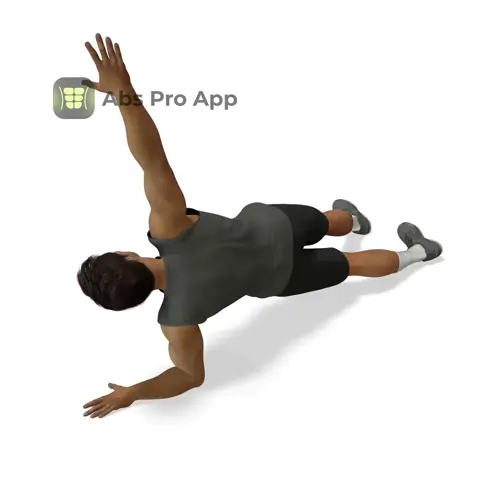
Low side plank switching sides is a dynamic core exercise performed on your forearms where you rotate from one side plank directly into the other. It challenges your obliques, deep core, shoulders, and hips while demanding full-body control.
This move is best for intermediate trainees who already understand side plank technique and want to build rotational stability and endurance. Focus on moving as one unit, elbows, hips, and heels travel together, keeping your body straight and braced the entire time.
Benefits
- Builds strong obliques and rotational control
- Improves core stability under movement
- Strengthens shoulders and hips together
- Enhances body awareness and coordination
- Challenges anti-rotation strength
- No equipment needed
Setup & Starting Position
Begin lying on your side on the floor. Place your bottom forearm directly under your shoulder with your elbow bent at about 90 degrees. Your forearm should be flat on the floor and pointing forward. Stack your legs straight with your heels on top of each other.
Lift your hips so your body forms a straight line from head to heels. Your top hand can rest on your hip or reach slightly forward for balance. Keep your neck long and eyes looking straight ahead, not down at the floor.
Before starting the first switch, brace your core by gently tightening your abs and glutes. This is your starting low side plank.
Setup tip: If your elbow feels uncomfortable, slightly rotate your forearm or use a mat for cushioning.
How To Do Low side plank switching sides (Step-by-step)
- Hold a low side plank on your forearm with legs stacked.
- Brace your abs and squeeze your glutes.
- Rotate your torso toward the floor, bringing your free forearm down.
- Pass briefly through a low front plank on both forearms.
- Continue rotating to the opposite side.
- Lift into a low side plank on the other forearm.
- Keep hips lifted and body straight.
- Move slowly and under control.
- Repeat, switching sides each rep.
Form Cues
- Elbows, hips, and heels move together
- Body stays in one straight line
- Shoulder stacked over elbow
- Hips stay lifted
- Move slow and controlled
- Neck stays long
Breathing & Bracing
Start each rep with a gentle inhale through your nose as you brace your core. As you rotate and switch sides, slowly exhale through your mouth while keeping your abs tight. Think about pulling your ribs down toward your hips without flattening your breath.
A helpful rhythm is to inhale before the movement, then exhale as you rotate into the next side plank. Avoid holding your breath, which can cause tension in the neck and shoulders.
To brace properly, imagine tightening your core like you are preparing for a light cough. Your belly should feel firm but you should still be able to breathe smoothly. Maintain this tension the entire set to keep your spine stable.
Common Mistakes
- Letting hips drop, fix by squeezing glutes and slowing down.
- Rushing the switch, fix by moving with control.
- Elbow too far from shoulder, fix by stacking elbow under shoulder.
- Twisting only the shoulders, fix by moving the whole body together.
- Neck craning forward, fix by keeping head in line with spine.
How It Should Feel
Good signs:
- Strong tension in the sides of your core
- Shoulders feel stable, not painful
- Hips stay lifted throughout
Warning signs:
- Sharp pain in shoulder or lower back, stop immediately
- Loss of control during rotation
If you feel it mostly in your neck, reset your head position and slow the movement. If your lower back feels strained, shorten the set and focus on tighter core bracing before continuing.
Alternative Names
Forearm side plank rotations
Variations
Easier
- Low side plank hold: Hold one side at a time without switching.
- Knees down side plank switch: Perform the same movement with knees bent on the floor.
Harder
- Slow tempo side plank switches: Pause 3 to 5 seconds in each position.
- Side plank switch with reach: Extend the top arm overhead during rotation.
Sample Workout
Core Stability Circuit
- Low side plank switching sides, 8 to 12 reps
- Dead bug, 10 reps per side
- Bodyweight glute bridge, 15 reps
- High plank hold, 30 seconds
Rest 60 seconds and repeat for 2 to 3 rounds. Focus on control rather than speed.
Progression Plan
Week 1: Perform 2 sets of 6 to 8 controlled reps per side. Rest 60 to 90 seconds. Focus on perfect alignment and slow transitions.
Week 2: Increase to 3 sets of 8 to 10 reps per side. Slow the rotation slightly and reduce rest to 60 seconds.
Week 3: Add a brief 2 second pause in each side plank position. Keep reps the same.
Week 4: Progress to advanced variations or increase total reps. If form breaks down, repeat the previous week until control improves.
FAQ
How many reps should I do?
Start with 6 to 8 controlled switches per side and build up gradually.
Is this safe for my shoulders?
Yes, if you keep elbows stacked under shoulders and move slowly.
Can I do this every day?
You can perform it 3 to 4 times per week, allowing recovery.
What if I cannot keep my hips up?
Use the knee-down variation until strength improves.
Summary
Low side plank switching sides is an excellent way to build strong, functional obliques and full-core control. By focusing on smooth transitions and solid bracing, you train your body to stay stable while moving.
Take your time, prioritize quality over speed, and use the regressions when needed. With consistent practice, this exercise can significantly improve your core strength and overall stability.
Get Defined Abs in 30 Days
This exercise is part of our complete 30-day ab program. Download the app for structured daily workouts and track your progress.