
Low Side Plank Tutorial
The low side plank is a classic bodyweight core exercise performed on one forearm with the body stacked sideways. It is a powerful way to build side core strength, improve hip stability, and support better posture. This exercise is commonly used in abs workouts, athletic training, and injury prevention programs.
With a difficulty of 3 out of 5, it is best suited for intermediate trainees who already have some core control. Focus on keeping a straight line from head to feet, steady breathing, and controlled tension through your abs and glutes.
Benefits
- Strengthens the oblique muscles
- Improves core stability and balance
- Builds shoulder and hip support strength
- Helps protect the lower back
- Enhances posture and body control
- Requires no equipment or space
Setup & Starting Position
Start by lying on your side on the floor. Extend both legs straight so your body forms a long line from ankles to head. Stack your feet on top of each other, or place the top foot slightly in front if you need more balance.
Place your bottom forearm on the floor with the elbow directly under your shoulder. Your forearm should point straight forward, palm resting flat on the ground. This alignment is crucial for shoulder safety and strength.
Rest your top hand on your hip as described in the voice guide. Keep your neck neutral, eyes looking forward, not down at the floor.
Before lifting, gently brace your abs and squeeze your glutes. Setup tip: imagine tightening a wide belt around your waist to create even core tension.
How To Do Low side plank (Step-by-step)
- Lie on your side with legs straight and stacked
- Place bottom forearm on the floor, elbow under shoulder
- Top hand rests lightly on your hip
- Brace your abs and squeeze your glutes
- Press your forearm into the floor and lift your hips
- Create a straight line from head to feet
- Hold the position while breathing steadily
- Keep shoulders stacked and hips lifted
- After the set time, lower hips with control
- Switch sides and repeat
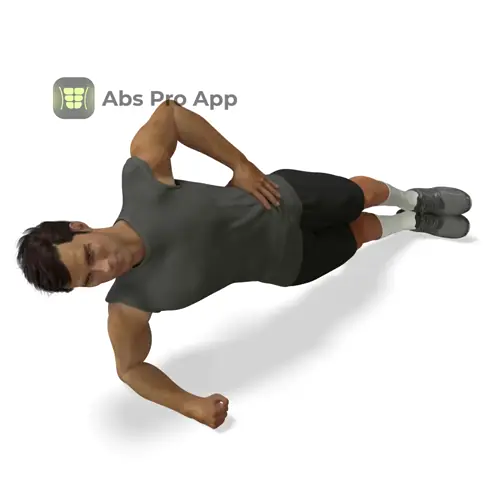
Form Cues
- Elbow under shoulder
- Body in one straight line
- Hips high and stacked
- Neck long and relaxed
- Glutes and abs engaged
- Do not rotate forward or back
Breathing & Bracing
Proper breathing makes the low side plank more effective and safer. Before lifting your hips, take a calm inhale through your nose. As you press into the forearm and lift, gently exhale and engage your core.
Once in position, avoid holding your breath. Use a steady rhythm such as inhale for 3 seconds, exhale for 3 seconds. Think about expanding your ribcage sideways and backward as you inhale, then tightening your abs slightly as you exhale.
Bracing means creating tension without stiffness. Your abs should feel firm, but you should still be able to breathe and talk. Keep your ribs pulled down and your hips stacked to prevent arching or twisting.
Common Mistakes
- Elbow too far from shoulder, fix by stacking elbow directly underneath
- Hips sagging, fix by squeezing glutes and lifting hips higher
- Body twisting forward or backward, fix by stacking shoulders and hips
- Neck strained, fix by keeping head in line with spine
- Holding breath, fix by using slow steady breathing
- Pressing into hand instead of forearm, fix by grounding forearm fully
How It Should Feel
Good signs: You should feel strong tension along the side of your abs, especially the obliques. The shoulder on the bottom side should feel active but stable. Your hips and glutes should feel engaged, helping you stay lifted.
Warning signs: Sharp pain in the shoulder, elbow, or lower back is a sign to stop immediately. If your lower back feels compressed or pinched, your hips may be sagging.
If you feel the exercise mostly in your neck, relax your shoulders and lengthen the neck. If you feel it in your lower back, reset by tightening your abs and glutes and shortening the hold time.
Alternative Names
Side plank on forearm, Forearm side plank
Variations
Easier
- Low side plank with knees bent: Bend both knees and keep them on the floor while lifting hips
- Short hold low side plank: Perform the same position but hold for 10 to 15 seconds
Harder
- Low side plank with hip abduction: Lift the top leg while holding the plank
- Low side plank with reach-through: Rotate torso slightly and reach top arm under body, then open back up
Sample Workout
Core Stability Workout
- Low side plank, 3 sets of 20 to 40 seconds per side
- Dead bug, 3 sets of 8 reps per side
- Glute bridge, 3 sets of 12 reps
- Bird dog, 3 sets of 6 reps per side
Rest 45 to 60 seconds between sets. Focus on control rather than speed.
Progression Plan
Week 1: Perform low side plank holds for 20 to 25 seconds per side. Complete 2 to 3 sets. Rest 45 seconds between sets. Focus on perfect alignment and steady breathing.
Week 2: Increase hold time to 30 to 40 seconds per side. Keep the same number of sets but reduce rest slightly if form stays strong.
Week 3: Add a slower entry and exit. Take 3 seconds to lift into the plank and 3 seconds to lower down. Maintain 30 to 45 second holds.
Week 4: Progress to an advanced variation such as the low side plank with hip abduction if you can hold 45 seconds with no form breakdown. If not, repeat the previous week until control improves.
FAQ
How long should I hold a low side plank?
Most people aim for 20 to 45 seconds per side with good form.
Should my feet be stacked or staggered?
Stacked feet are standard, staggered feet make balance slightly easier.
Is forearm pressure normal?
Yes, mild pressure is normal, but pain means your elbow or shoulder alignment needs adjustment.
Can I train this exercise every day?
You can perform it often, but allow rest if your core or shoulders feel overly fatigued.
Summary
The low side plank is a simple yet demanding core exercise that builds strength where it matters most. By training your obliques, hips, and shoulders together, you improve stability that carries over into daily movement and other workouts.
Stay patient, focus on quality holds, and progress gradually. With consistent practice and good technique, this exercise can become a cornerstone of your abs and core training routine.
Get Defined Abs in 30 Days
This exercise is part of our complete 30-day ab program. Download the app for structured daily workouts and track your progress.