
Low Plank Step Outs Tutorial
Low plank step outs are a bodyweight core exercise performed from a forearm plank position while stepping one foot out to the side and back. This move challenges your abs to resist rotation and sagging while your hips and shoulders stay square to the floor.
It is an intermediate-level exercise that builds deep core strength, improves plank control, and adds a lateral stability challenge without equipment. Focus on slow, controlled steps, steady breathing, and keeping your body in a straight line from head to heels.
Benefits
- Builds deep core and oblique strength
- Improves plank stability and control
- Trains anti-rotation and hip control
- Strengthens shoulders in a supported position
- Challenges coordination and balance
- Raises core tension without equipment
Setup & Starting Position
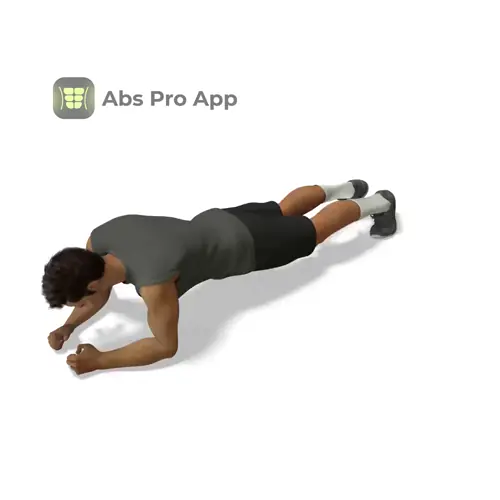
Begin by setting up in a low plank position on the floor. Place your forearms flat on the ground, elbows directly under your shoulders, and hands relaxed or lightly clasped. Your forearms should be parallel, not angled inward.
Extend both legs straight back with your toes on the floor. Your feet should start about hip-width apart, giving you a stable base before the first step. Engage your glutes and gently tuck your pelvis so your lower back stays neutral, not arched.
Look down between your forearms to keep your neck long. Your body should form a straight line from the back of your head to your heels.
Quick setup tip: Before moving, lightly press your forearms into the floor and tighten your abs as if preparing for a cough.
How To Do Low plank step outs (Step-by-step)
- Set up in a strong low plank on your forearms and toes.
- Shift a small amount of weight into your supporting leg.
- Step your right foot out to the side while keeping hips level.
- Tap the floor lightly with your toes.
- Bring the right foot back to the starting position.
- Repeat the step out with the left foot.
- Continue alternating sides with slow, controlled steps.
- Finish the set by lowering your knees to the floor with control.
Form Cues
- Elbows under shoulders
- Body in one straight line
- Hips stay level
- Slow, quiet steps
- Brace the abs before moving
- Neck long, eyes down
Breathing & Bracing
Proper breathing makes low plank step outs much more effective and safer for your lower back. Before each step, gently brace your core by tightening your abs as if zipping up tight pants. This creates tension without holding your breath.
Inhale through your nose while holding the plank position. As you step one foot out to the side, exhale slowly through your mouth. The exhale helps you maintain control and prevents your ribs from flaring.
As the foot returns to center, begin your next inhale. Each step out and back can follow one steady breath cycle. Keep the breathing smooth and repeatable.
If you notice yourself holding your breath, slow down the movement and reset your brace. The goal is steady tension, not maximum strain.
Common Mistakes
- Hips lifting too high, fix by tightening glutes and abs.
- Lower back sagging, fix by reducing step width.
- Rushing the steps, fix by slowing the tempo.
- Elbows too far forward, fix by stacking them under shoulders.
- Head dropping or craning, fix by looking between forearms.
- Feet stepping too wide, fix by keeping controlled range.
How It Should Feel
Quick self-check: You should feel steady tension through your abs and obliques as you step each foot out and back. Your shoulders should feel active but supported, not strained.
Good signs:
- Abs working harder as the foot moves
- Hips staying mostly level
- Controlled breathing throughout the set
Warning signs:
- Sharp pain in shoulders, lower back, or hips, stop immediately.
- Shaking so intense that form breaks down.
If you feel it mainly in your lower back, shorten the step and re-brace your abs. If your neck feels tense, reset your head position and press your forearms into the floor.
Alternative Names
forearm plank step outs, plank lateral step outs
Variations
Easier
- Low plank knee step outs: Perform the same movement with knees on the floor.
- Static low plank hold: Hold the forearm plank without stepping to build base strength.
Harder
- Slow tempo plank step outs: Take 3 to 4 seconds to step out and return.
- Low plank step outs with pause: Pause briefly when the foot is stepped out.
Sample Workout
Core Stability Workout
- Low plank step outs
3 sets of 10 to 16 reps, one rep equals stepping out and back on one side - Dead bug
3 sets of 8 to 10 reps per side - Side plank
2 sets of 20 to 30 seconds per side - Glute bridge
3 sets of 12 to 15 reps
Rest 45 to 60 seconds between sets and focus on quality over speed.
Progression Plan
Week 1: Perform 3 sets of 8 to 10 reps per side. Use a slow, controlled pace and rest as needed to keep perfect plank alignment.
Week 2: Increase to 3 sets of 12 to 14 reps per side. Reduce rest slightly and focus on quieter foot placement.
Week 3: Add a slower tempo, taking about 3 seconds to step out and return. Keep reps at 10 to 12 per side.
Week 4: Introduce a brief pause when the foot is stepped out, about 1 second, then return. Perform 3 sets of 10 reps per side.
Progress when you can maintain level hips and steady breathing. Repeat a week if form breaks down or fatigue causes sagging.
FAQ
How wide should I step my foot?
Step only as wide as you can without your hips shifting or twisting.
Is one rep both sides or one side?
One rep is stepping out and back on one side. Both sides together equal two reps.
Can I do this every day?
Yes, if volume is moderate and form stays solid, but rest if your core feels overly fatigued.
Why do my hips move side to side?
This usually means the step is too wide or the core brace is lost.
Summary
Low plank step outs are a powerful way to upgrade your plank training by adding controlled movement and lateral stability. They teach your core to stay strong while your legs move, which carries over to sports and daily activities.
Keep the steps slow, the hips steady, and the breathing calm. With consistent practice, this exercise builds a resilient core that supports better posture and stronger full-body movement.
Get Defined Abs in 30 Days
This exercise is part of our complete 30-day ab program. Download the app for structured daily workouts and track your progress.