
Low Plank Single Leg Tutorial
Benefits
- Increases core stability with minimal equipment
- Challenges anti-rotation strength
- Improves plank endurance
- Engages glutes for better hip control
- Builds shoulder and upper body stability
- Prepares you for harder plank variations
Setup & Starting Position
Begin by kneeling on the floor and placing your forearms directly under your shoulders. Your elbows should be about shoulder width apart, with forearms parallel and palms resting on the floor.
Step your legs back one at a time into a standard low plank, forming a straight line from head to heels. Now carefully place one foot on top of the other, stacking them so only the bottom foot is in contact with the floor.
Keep both legs straight, thighs tight, and glutes lightly squeezed. Your hips should face the floor, not rotated to either side. Before you start the hold, gently tuck your ribs down and brace your abs as if preparing for a cough.
Quick setup tip: If you feel unstable, widen your elbows slightly, but keep them under your shoulders.
How To Do Low plank single leg (Step-by-step)
- Lower onto your forearms with elbows under shoulders
- Extend both legs back into a low plank
- Stack one foot directly on top of the other
- Squeeze glutes and brace your abs
- Keep your body in a straight line
- Hold the position for the planned time
- Breathe steadily without losing tension
- Step down and switch foot position if needed
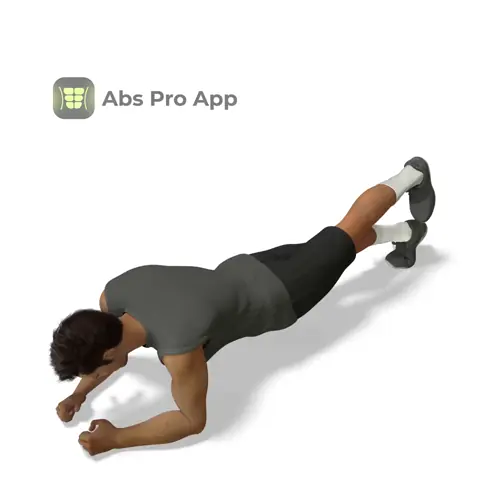
Form Cues
- Elbows under shoulders
- Feet stacked, legs straight
- Hips level to the floor
- Brace like a plank, not a crunch
- Push the floor away with forearms
- Neck long, eyes down
Breathing & Bracing
Proper breathing is key to holding the low plank single leg with control. Start by taking a calm breath in through your nose before stacking your feet. Once set, brace your core by gently tightening your abs and glutes, as if you are preparing to be lightly poked in the stomach.
Breathe slowly and rhythmically during the hold. A simple pattern is to inhale through the nose for three seconds and exhale through the mouth for three seconds. Keep breathing without letting your ribs flare up or your lower back sag.
Avoid holding your breath. If you notice tension building in your neck or shoulders, return focus to your breath and re-engage your brace. Controlled breathing helps maintain alignment and allows you to hold the position longer with better technique.
Common Mistakes
- Letting hips rotate, fix by squeezing glutes and slowing down
- Elbows too far forward, fix by stacking them under shoulders
- Lower back sagging, fix by bracing abs harder
- Feet slipping apart, fix by firmly stacking them
- Holding breath, fix by using a steady breathing rhythm
- Neck craned up, fix by looking at the floor
How It Should Feel
Quick self-check: This exercise should feel challenging but controlled.
Good signs: You feel steady tension in your abs, especially the deep core, your glutes are engaged, and your shoulders feel strong but not strained. Your body feels like one solid line, and breathing stays smooth.
Warning signs: Sharp pain in the lower back, elbows, or shoulders means you should stop immediately. Excessive hip twisting or shaking you cannot control is a sign to regress the exercise.
If you feel it mostly in your lower back, reset your brace and squeeze your glutes harder. If it builds up in your neck, relax your shoulders, lengthen your neck, and focus on pushing the floor away with your forearms.
Alternative Names
Feet-stacked low plank
Variations
Easier
- Low Plank with Feet Apart, perform a standard low plank with feet hip-width apart
- Low Plank Knees Down, keep knees on the floor while maintaining a straight line from head to knees
Harder
- Low Plank Single Leg with Shoulder Taps, stack feet and lightly tap one shoulder while resisting rotation
- Low Plank Single Leg with Hip Lift Hold, stack feet and add a brief pause while lifting hips slightly then returning to neutral
Sample Workout
- Low Plank Single Leg, 30 to 45 seconds
- Dead Bug, 8 reps per side
- Glute Bridge Hold, 40 seconds
- Bird Dog, 6 slow reps per side
Rest 60 seconds and repeat the circuit 2 to 3 times. Switch which foot is on top each round for balanced core work.
Progression Plan
Week 1: Practice holding the low plank single leg for 20 to 30 seconds. Do 2 to 3 sets, switching which foot is on top each set. Rest 45 to 60 seconds between sets. Focus on clean setup and steady breathing.
Week 2: Increase hold time to 30 to 45 seconds per set. Aim for 3 sets total. If stability improves, shorten rest to 30 to 45 seconds.
Week 3: Add control by slowing your breathing and tightening your brace without increasing tension in the neck. Optionally include a brief 2 second pause where you actively squeeze glutes harder.
Move to an advanced variation once you can hold 45 seconds on each side without hip rotation. Repeat a week if form breaks down or fatigue is too high.
FAQ
Should I switch which foot is on top?
Yes, switch sides to train both sides of your core evenly.
How long should I hold this plank?
Most people benefit from 20 to 45 second holds with perfect form.
Why does stacking my feet make it harder?
Stacking reduces stability, forcing your core and hips to resist rotation.
Can I do this every day?
You can, as long as recovery is good and form stays solid.
Summary
The low plank single leg is a simple but powerful way to increase core difficulty without adding equipment. By stacking your feet and holding steady, you train your abs and hips to resist unwanted movement.
Stay patient, prioritize form, and use controlled breathing to get the most out of each hold. Rotate in easier or harder versions as needed, and this plank variation will quickly become a reliable tool for building a strong, stable core.
Get Defined Abs in 30 Days
This exercise is part of our complete 30-day ab program. Download the app for structured daily workouts and track your progress.