
Low Plank Buzz Saw Tutorial
Low plank buzz saw is a core-focused bodyweight exercise performed in a forearm plank while gently rocking your body forward and back on your toes. This movement turns a static plank into a dynamic challenge that trains deep abdominal strength, shoulder stability, and full-body tension.
It is ideal for people who already know how to do a low plank and want a stronger core without equipment. Focus on slow control, steady breathing, and keeping your ribs stacked over your hips throughout the motion.
Benefits
- Builds deep core strength
- Improves plank endurance
- Trains shoulder stability
- Enhances body control and tension
- Protects the lower back when done correctly
- Boosts anti-extension core strength
- Requires no equipment
Setup & Starting Position
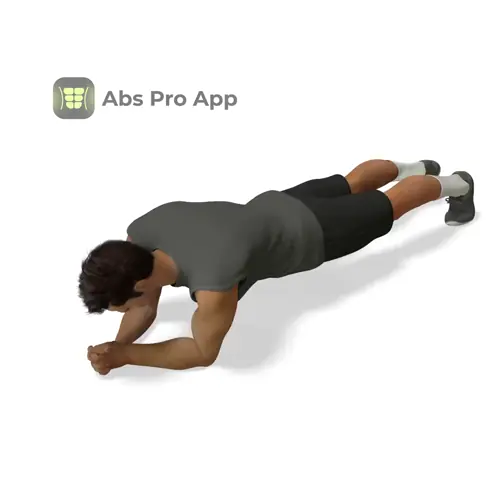
Begin by placing your forearms on the floor directly under your shoulders. Your elbows should be bent at about 90 degrees, forearms parallel, palms resting flat or lightly clasped.
Extend your legs straight back and place your toes on the floor. Your body should form a straight line from head to heels. Gently tuck your pelvis so your lower back is neutral, not arched and not rounded.
Engage your abs by pulling your ribs down toward your hips and lightly squeeze your glutes. Keep your neck long and gaze slightly ahead of your hands, not straight down.
Quick setup tip: Before moving, hold the plank for a few seconds and check that your shoulders, hips, and heels are aligned.
How To Do Low plank buzz saw (Step-by-step)
- Set up in a strong low plank on your forearms and toes
- Brace your core and squeeze your glutes
- Slowly rock your body forward, shifting weight toward your forearms
- Let your shoulders move slightly past your elbows
- Keep hips level and abs tight
- Rock backward by pushing through your toes
- Return to the starting plank position
- Move smoothly without pausing or bouncing
- Continue for time or controlled reps
- Finish by gently lowering knees to the floor
Form Cues
- Forearms press into the floor
- Ribs down, abs tight
- Squeeze glutes
- Move slow and controlled
- Hips stay level
- Neck long and relaxed
Breathing & Bracing
Proper breathing is key to getting the most out of the low plank buzz saw. Start by taking a calm inhale through your nose before the first rep. As you rock forward, lightly exhale through your mouth while maintaining abdominal tension.
When rocking back, take another small inhale without letting your ribs flare or belly relax. Think of breathing around your brace, not into it. Your abs should stay engaged the entire time.
A simple rhythm to follow is inhale as you move back, exhale as you move forward. Avoid holding your breath, as this can increase neck tension and reduce control.
Imagine gently tightening a wide belt around your waist. This keeps your spine stable and protects your lower back during the rocking motion.
Common Mistakes
- Hips sagging, fix by tightening abs and glutes
- Rocking too fast, slow down and control each rep
- Holding breath, breathe steadily throughout
- Shoulders shrugging, press forearms down and away
- Over-arching lower back, tuck pelvis slightly
- Moving only shoulders, shift the whole body together
How It Should Feel
Quick self-check: You should feel strong tension in your abs, especially the front and sides, with steady work in the shoulders.
Good signs:
- Abs feel tight and active
- Movement feels smooth and controlled
- No pressure in the lower back
Warning signs:
- Sharp pain in shoulders or back, stop immediately
- Lower back discomfort, reset your plank position
If you feel it mostly in your neck, relax your head and lengthen your spine. If your lower back takes over, reduce range of motion and brace harder.
Alternative Names
Plank buzz saw, Buzzsaw plank, Forearm plank buzz saw
Variations
Easier
- Low plank hold: Hold a static forearm plank and focus on perfect alignment
- Short-range buzz saw: Rock only a few inches forward and back
- Knees-down buzz saw: Perform the movement with knees on the floor
Harder
- Long-range buzz saw: Increase the forward and backward distance
- Slow tempo buzz saw: Take 3 to 4 seconds each direction
- Single-leg buzz saw: Lift one foot slightly while rocking
Sample Workout
Core Stability Workout
- Low plank buzz saw, 3 sets of 30 to 45 seconds
- Dead bug, 3 sets of 8 reps per side
- Side plank, 2 sets of 30 seconds per side
- Glute bridge, 3 sets of 12 reps
Rest 45 to 60 seconds between sets. Focus on control, not speed.
Progression Plan
Week 1: Perform 3 sets of 20 to 30 seconds. Use a short range of motion and focus on perfect form. Rest 60 seconds between sets.
Week 2: Increase to 30 to 40 seconds per set. Smooth out your rocking motion and reduce rest to 45 seconds.
Week 3: Extend each set to 45 to 60 seconds or slow the tempo. Move forward and back over 3 seconds each direction.
Week 4: Add an advanced variation such as long-range or single-leg buzz saws. Keep total time similar but increase control.
If form breaks down, repeat the previous week until you can maintain steady tension.
FAQ
FAQ
How to do a low plank buzz saw correctly?
Stay on your forearms, brace your core, and rock your entire body forward and back using your toes.
Is this better than a regular plank?
It is harder and adds movement, making it great for building more core strength.
How long should I do it?
Start with 20 to 30 seconds and build up to 60 seconds.
Can beginners do this exercise?
Yes, with short ranges or knees down variations.
Summary
The low plank buzz saw is a powerful way to upgrade your core training using only bodyweight. By adding controlled movement to a forearm plank, you challenge your abs, shoulders, and stability in a highly effective way.
Focus on slow tempo, strong bracing, and steady breathing. Progress gradually and prioritize quality over time. When done correctly, this exercise builds a resilient core that carries over to daily life and other workouts.
Get Defined Abs in 30 Days
This exercise is part of our complete 30-day ab program. Download the app for structured daily workouts and track your progress.