
Low Plank Body Saw Tutorial
Low plank body saw is a challenging bodyweight core exercise performed on your forearms and toes. From a stable low plank, you step and shift your body forward and backward like a saw. This movement increases the demand on your abs compared to a static plank and teaches you how to control your core while your center of gravity changes.
It is great for people who want stronger abs, better plank endurance, and improved full body tension without equipment. Focus on slow control, tight glutes, and steady breathing to get the most out of this exercise.
Benefits
- Builds stronger and deeper abdominal muscles
- Improves plank strength and endurance
- Teaches core control during movement
- Strengthens shoulders and upper body stability
- Enhances body awareness and posture
- Requires no equipment and little space
Setup & Starting Position
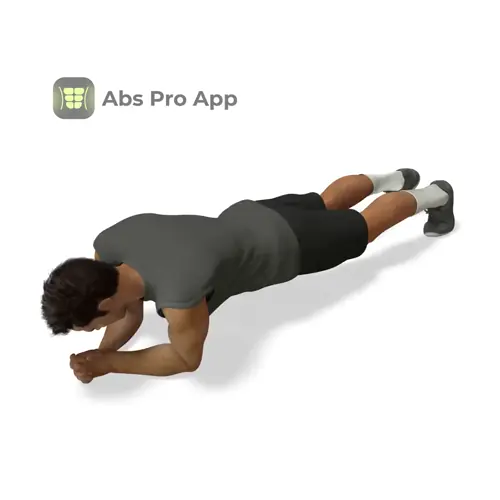
Begin by lowering yourself into a low plank position on the floor. Place your forearms flat on the ground, elbows directly under your shoulders. Your forearms should be parallel, with hands relaxed or lightly clasped.
Extend your legs straight behind you and tuck your toes under so your feet are supporting your lower body. Your body should form a straight line from the top of your head down to your heels. Gently squeeze your glutes and tighten your abs as if preparing for a light cough.
Keep your neck neutral by looking down at the floor between your forearms. Before starting the first rep, check that your hips are not sagging or lifting too high.
Setup tip: Push the floor away with your forearms to create shoulder stability before you begin moving.
How To Do Low plank body saw (Step-by-step)
- Get into a low plank on your forearms and toes
- Brace your core and squeeze your glutes
- Slowly step your toes backward
- Keep your body in one straight line as you move
- Pause briefly at the backward position
- Step your toes forward to return to the starting plank
- Move slowly and with control, not momentum
- Continue for the desired number of reps or time
Form Cues
- Elbows under shoulders
- Body in one straight line
- Squeeze glutes
- Ribs down, abs tight
- Slow forward and back
- Neck relaxed and neutral
Breathing & Bracing
Proper breathing is key to getting the most out of the low plank body saw. Before you start moving, take a deep breath in through your nose and gently brace your core. Think about tightening your abs as if you were preparing to lift something moderately heavy.
As you step your toes forward and shift your body ahead, exhale slowly through your mouth. This helps keep your ribs down and prevents your lower back from arching. When you step back to the starting position, inhale again through your nose while maintaining core tension.
A simple rhythm to follow is inhale as you move back, exhale as you move forward. Keep breathing smoothly and avoid holding your breath. Your abs should stay tight the entire time, but your breathing should feel controlled and steady.
Common Mistakes
- Letting the hips sag, fix by tightening your abs and glutes
- Lifting the hips too high, fix by keeping shoulders, hips, and heels aligned
- Moving too fast, fix by slowing down each step
- Shifting only the shoulders, fix by moving the whole body together
- Neck craning forward, fix by looking down at the floor
- Holding the breath, fix by using steady inhales and exhales
How It Should Feel
Quick self check: You should feel a strong, steady contraction in your abs throughout the movement. Your shoulders and upper arms will also work to stabilize your body, and your glutes should stay lightly engaged.
Good signs:
- Abs feel tight and warm
- Movement feels slow and controlled
- No shifting or wobbling in the hips
Warning signs:
- Sharp pain in the lower back, stop immediately
- Pinching in the shoulders
- Neck strain or tension
If you feel it mostly in your lower back, shorten the range of motion and focus on bracing your abs harder. If your neck feels tight, reset your head position and look straight down.
Alternative Names
body saw plank, forearm plank body saw
Variations
Easier
- Static low plank: Hold a forearm plank without stepping to build base strength
- Short range body saw: Step your toes only a few inches forward and back
Harder
- Extended range body saw: Step farther forward while keeping perfect alignment
- Slow tempo body saw: Take 3 to 5 seconds forward and back
Sample Workout
Core Stability Workout
- Low plank body saw, 3 sets of 8 to 12 reps
- Dead bug, 3 sets of 10 reps per side
- Side plank, 3 sets of 20 to 30 seconds per side
- Glute bridge, 3 sets of 12 reps
Rest 45 to 60 seconds between exercises. Focus on quality movement rather than rushing through the workout.
Progression Plan
Week 1: Start with 2 to 3 sets of 6 to 8 reps using a short stepping range. Rest 60 seconds between sets. Focus on learning the movement and maintaining a straight body line.
Week 2: Increase to 3 sets of 8 to 10 reps. Step slightly farther forward and slow the movement down. Rest 45 to 60 seconds.
Week 3: Progress to 3 to 4 sets of 10 to 12 reps. Add a brief pause in the forward position to increase core tension.
If you lose form or feel your lower back taking over, repeat the previous week. Move to advanced variations only when you can complete all reps with full control and steady breathing.
FAQ
How to do a low plank body saw correctly?
Start in a forearm plank, brace your core, and slowly step your toes forward and backward while keeping your body in a straight line.
Is the low plank body saw safe for beginners?
It can be challenging for beginners, but using a shorter range of motion makes it more accessible.
How many reps should I do?
Aim for 8 to 12 controlled reps or 20 to 40 seconds depending on your level.
Why do I feel it in my shoulders?
Your shoulders work to stabilize your body. This is normal, but keep your elbows under your shoulders to reduce strain.
Summary
The low plank body saw is an excellent way to take your core training beyond basic planks. By adding controlled forward and backward movement, you challenge your abs to stabilize your body under changing leverage.
Focus on quality reps, steady breathing, and strong bracing. Whether you are building toward harder plank variations or simply want stronger abs at home, this exercise fits perfectly into a balanced core routine.
Get Defined Abs in 30 Days
This exercise is part of our complete 30-day ab program. Download the app for structured daily workouts and track your progress.