
In-out-open-close Tutorial
In-out-open-close is a fast, no-equipment core exercise done in a high plank on your hands. You jump your knees toward your chest and back, then jump your feet wide and close again, all while keeping your core braced. This movement challenges your abs, shoulders, and hips, and quickly raises your heart rate.
It is best suited for intermediate exercisers who already have a solid plank. Focus on hand pressure, steady shoulders, and quiet, controlled jumps to get the most out of this exercise.
Benefits
- Builds dynamic core strength
- Improves plank stability
- Raises heart rate for conditioning
- Trains hip control during jumps
- Enhances coordination and rhythm
- Strengthens shoulders and arms
Setup & Starting Position
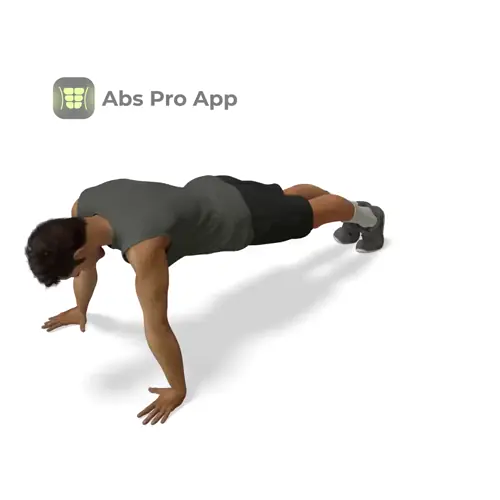
Begin on the floor in a high plank position. Place your hands flat on the ground directly under your shoulders, fingers spread for stability. Your arms are straight but not locked. Extend your legs straight behind you with your feet together and toes tucked under.
Align your body in one long line from head to heels. Gently tuck your pelvis so your lower back stays neutral, not arched. Brace your core as if preparing for a light punch. Your gaze stays slightly in front of your hands to keep your neck long.
Before starting the first rep, lightly press the floor away with your hands and shift weight evenly between both palms and toes.
Setup tip: If your shoulders feel unstable, slow the movement and focus on pushing the ground away throughout the set.
How To Do In-out-open-close (Step-by-step)
- Start in a stable high plank with feet together.
- Brace your core and keep shoulders stacked over hands.
- Jump both knees toward your chest under your hips.
- Immediately jump your feet back to the plank position.
- From plank, jump your feet out wide.
- Jump your feet back together to the starting plank.
- This full in, out, open, close sequence equals one rep.
- Continue for the planned reps or time with smooth rhythm.
- Finish by lowering knees to the floor with control.
Form Cues
- Hands under shoulders
- Core tight at all times
- Quiet, light jumps
- Hips level
- Neck long, eyes down
- Push the floor away
Breathing & Bracing
Use steady breathing to stay controlled during this fast movement. Before starting, take a calm inhale through your nose and lightly brace your core by tightening your abs and glutes.
As you jump your knees in and back, exhale softly through your mouth. Take another short exhale as you jump the feet wide and close. Think of breathing out on effort without fully emptying your lungs.
Keep your ribs down and hips slightly tucked so your lower back does not arch when you move. Avoid holding your breath, which can cause tension in your shoulders and neck.
A simple rhythm to repeat is: exhale on knee jump, exhale on wide jump, small inhale as you reset. This keeps your core engaged and your movement efficient.
Common Mistakes
- Letting hips sag, fix by tightening abs and glutes more.
- Jumping too wide, keep feet just wider than hips.
- Shoulders drifting past hands, reset shoulders over wrists.
- Landing loudly, aim for soft and controlled feet.
- Holding breath, practice steady exhales.
- Bending arms, keep arms straight and strong.
How It Should Feel
Quick self-check: You should feel strong engagement in your abs and shoulders, with your heart rate climbing. Your core should feel firm, not loose, and your shoulders should feel active but stable. Breathing should be challenging but controlled.
Good signs: steady plank line, quiet foot landings, even pressure through both hands. You can keep the same tempo without losing form.
Warning signs: sharp pain in wrists, shoulders, or lower back, or a feeling of collapsing through the core. Stop immediately if sharp pain occurs.
If you feel it mostly in your lower back, slow down and brace harder before each jump. If your neck gets tense, shift your gaze slightly forward and push the floor away.
Alternative Names
Plank in-out jacks
Variations
Easier
- Step-back in-out-open-close: Step knees in and out and step feet wide and close instead of jumping.
- Short-range in-out-open-close: Use smaller jumps to reduce impact while keeping plank control.
Harder
- Tempo in-out-open-close: Add a 2 second pause in the knee-in position to increase core tension.
- Explosive in-out-open-close: Jump faster while maintaining perfect plank alignment.
Sample Workout
Core and conditioning circuit
- In-out-open-close, 30 seconds
- Forearm plank, 40 seconds
- Bodyweight squats, 15 reps
- Mountain climbers, 30 seconds
Rest 60 seconds. Complete 3 to 4 rounds. Focus on clean reps and consistent breathing.
Progression Plan
Week 1: Perform 3 sets of 6 to 8 controlled reps. Rest 60 to 90 seconds between sets. Focus on quiet landings and perfect plank alignment. If form breaks, slow the tempo or shorten the set.
Week 2: Increase to 3 to 4 sets of 10 to 12 reps. Reduce rest to 45 to 60 seconds. Aim for smoother transitions between each jump while keeping shoulders stable.
Week 3: Add a brief pause when knees are tucked in, or move to the tempo variation. Keep reps at 10 to 12 and prioritize control.
Progress when you can complete all reps without hip sag or shoulder shifting. If fatigue causes form loss, repeat the previous week until movement quality improves.
FAQ
How many reps should I do?
Start with 6 to 10 reps, where one rep includes the full in, out, open, close sequence.
Can I do this on my elbows?
No, this exercise is specifically performed in a high plank on the hands.
Is this more for abs or cardio?
It trains both, but the core works continuously to stabilize the plank.
What if jumping hurts my wrists?
Use a stepping variation and focus on hand pressure and alignment.
Summary
In-out-open-close is a challenging plank-based exercise that builds strong, responsive abs while also improving conditioning. When done with control, it teaches your core to stay braced during fast leg movement.
Focus on quality over speed, steady breathing, and solid hand support. Use the easier versions when needed and progress only when your plank stays strong. Add this move to your core or HIIT workouts to boost intensity without equipment.
Get Defined Abs in 30 Days
This exercise is part of our complete 30-day ab program. Download the app for structured daily workouts and track your progress.