
Hollow Hold Tutorial
The Hollow Hold is a classic bodyweight core exercise used in gymnastics and strength training. It teaches you how to brace your abs and keep your spine stable while your arms and legs are extended off the ground.
This exercise helps build deep core strength, improve posture, and protect your lower back. It is ideal for beginner to intermediates learning proper core control and for advanced athletes who want a strong midsection. The main focus is keeping your lower back pressed into the floor while maintaining steady breathing.
Benefits
- Builds strong and stable abs
- Improves core control and awareness
- Supports better posture
- Protects the lower back during movement
- Transfers to many sports and lifts
- Requires no equipment
- Easy to scale up or down
Setup & Starting Position
Start by lying flat on your back on a comfortable surface like a mat or carpet. Extend your legs straight out and rest your arms overhead with your biceps close to your ears. Your palms can face each other or face upward, whichever feels more natural.
Before lifting anything, gently tuck your pelvis so your lower back presses into the floor. This is critical. There should be no gap between your lower back and the ground. Your neck stays long and relaxed.
Take a calm breath in through your nose, then lightly tighten your abs as if preparing for a cough. This is your starting brace.
Quick setup tip: If your lower back lifts off the floor at any time, bend your knees or raise your legs higher until you regain control.
How To Do Hollow hold (Step-by-step)
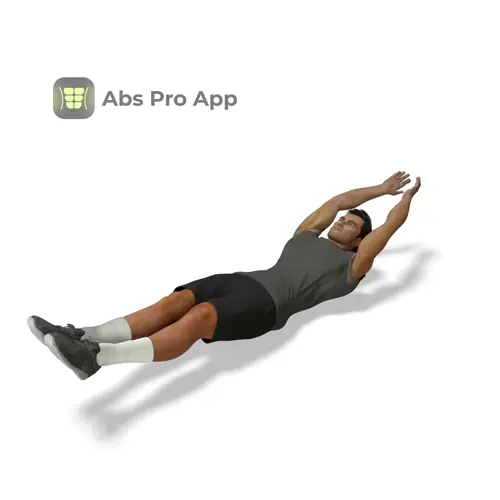
- Lie on your back with arms overhead and legs extended
- Press your lower back firmly into the floor
- Lift your shoulders and upper back slightly off the ground
- Lift both legs off the ground while keeping them straight
- Keep arms and legs extended and still
- Hold this position for the planned time
- Breathe slowly and stay tight
- Lower arms, legs, and shoulders with control to finish
Form Cues
- Lower back glued to the floor
- Ribs down, abs tight
- Long neck, relaxed jaw
- Legs straight and together
- Arms reaching overhead
- Slow and steady breathing
Breathing & Bracing
Proper breathing is key to getting the most out of the Hollow Hold. Start by inhaling through your nose before you lift your arms and legs. As you move into the hold, gently exhale through your mouth and tighten your abs.
Think about pulling your ribcage down toward your hips. This keeps your core engaged without holding your breath. Avoid locking your breath, as this can cause tension in the neck and shoulders.
A simple rhythm to use is inhale for 3 seconds, exhale for 4 seconds. Repeat this cycle throughout the hold. Your stomach should stay firm, but you should still be able to breathe calmly.
If your breathing becomes shaky, shorten the hold or adjust the leg height. Quality tension always matters more than time.
Common Mistakes
- Lower back arching off the floor, fix by raising legs or bending knees
- Holding breath, fix by slowing the exhale
- Neck straining forward, fix by keeping gaze upward
- Arms dropping too low, fix by reaching overhead
- Legs lowering too far, fix by lifting them higher
- Rushing into long holds, fix by starting with short holds
How It Should Feel
Quick Self-Check: A correct Hollow Hold should create steady tension across your abs without pain.
Good signs:
- Strong burn in the abs
- Lower back stays pressed down
- Controlled breathing
- Whole body feels connected
Warning signs:
- Sharp pain in the lower back, stop immediately
- Neck pain or headaches
- Shaking that causes loss of form
If you feel it mostly in your neck, relax your shoulders and look up. If you feel it in your lower back, raise your legs higher or bend your knees until you regain control.
Alternative Names
hollow body hold
Variations
Easier
- Tucked Hollow Hold: Bend knees toward chest while keeping arms extended
- One-Leg Hollow Hold: Keep one leg down while holding the other up
Harder
- Hollow Rocks: Gently rock back and forth while holding hollow position
- Extended Hollow Hold: Lower legs closer to the floor while maintaining control
Sample Workout
Core Stability Workout
- Hollow Hold, 3 sets of 20 to 40 seconds
- Dead Bug, 3 sets of 8 reps per side
- Side Plank, 2 sets of 20 seconds per side
- Glute Bridge, 3 sets of 12 reps
Rest 30 to 45 seconds between sets. Focus on quality form rather than long hold times.
Progression Plan
Week 1: Practice 3 sets of 15 to 20 second holds using a tucked or one-leg variation. Rest 45 seconds between sets. Focus on breathing and lower back contact.
Week 2: Move to full Hollow Hold with legs higher. Perform 3 to 4 sets of 20 to 30 seconds. Reduce rest to 30 seconds.
Week 3: Increase hold time to 30 to 40 seconds. Maintain calm breathing and steady tension.
Week 4: Begin lowering legs slightly closer to the floor or add Hollow Rocks for short sets.
Only progress when you can complete all sets without losing lower back contact. Repeat a week if form breaks down.
FAQ
How long should I hold a Hollow Hold?
Start with 15 to 20 seconds and build up to 40 to 60 seconds with perfect form.
Is Hollow Hold good for beginners?
Yes, as long as you use easier variations and keep your lower back pressed down.
Why does my lower back hurt?
This usually means your back is arching. Adjust by lifting legs higher or bending knees.
Can I do Hollow Holds every day?
Yes, if volume is low and form stays solid.
Summary
The Hollow Hold is a powerful way to learn true core control using just your body. When done correctly, it builds strength that carries over to many exercises and daily movements.
Focus on quality tension, steady breathing, and gradual progress. Small improvements in control will make a big difference over time. Stay patient, stay tight, and enjoy building a stronger core.
Get Defined Abs in 30 Days
This exercise is part of our complete 30-day ab program. Download the app for structured daily workouts and track your progress.