
Hip Escape Tutorial
This exercise is best suited for intermediate trainees who want to improve core control, coordination, and strength through movement. Focus on staying low, moving with control, and keeping tension through your trunk rather than rushing through reps.
Benefits
- Builds rotational core strength
- Improves shoulder and hip stability
- Trains coordination between upper and lower body
- Enhances core control under movement
- Strengthens abs without spinal flexion
- Improves body awareness and balance
- Transfers well to athletic movements
Setup & Starting Position
Keep your spine neutral from head to tailbone. Imagine a straight line from the back of your head through your hips. Your gaze should be down toward the floor, slightly ahead of your hands, keeping the neck long. Brace your core gently so your ribs stay pulled down and your lower back does not sag.
Before the first rep, shift a small amount of weight into your hands and feet to feel stable.
Setup tip: Think about pushing the floor away with your hands, this activates the shoulders and makes the hip rotation smoother and more controlled.
How To Do Hip escape (Step-by-step)
- Start in a stable bear plank with knees hovering low.
- Brace your core and shift weight into your left hand and right foot.
- Lift your left leg and keep it straight.
- Sweep the left leg across your body toward the right side.
- Rotate your hips so they turn toward the left grounded hand.
- Lower the sweeping leg as close to the floor as possible without touching.
- Keep shoulders stacked and chest open during the rotation.
- Pause briefly in the rotated position with control.
- Reverse the motion and return to bear plank.
- Repeat on the opposite side.
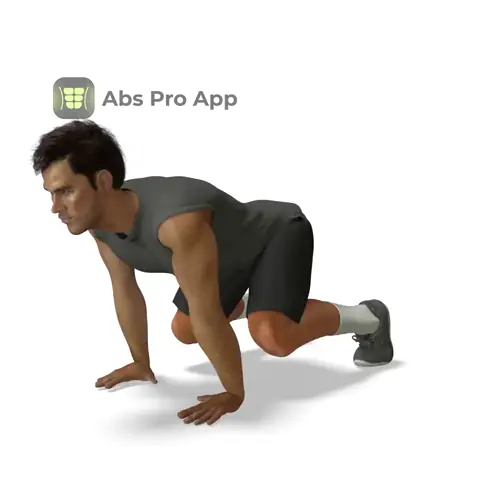
Form Cues
- Knees hover low at all times
- Leg stays straight during the sweep
- Rotate hips, do not twist the shoulders first
- Press strongly through the grounded hand
- Move slow and controlled
- Keep neck long and relaxed
Breathing & Bracing
Think about gently tightening your abs as if you are preparing for a cough, firm but not rigid. This brace should stay consistent throughout the movement. Avoid holding your breath, as this often leads to rushing or losing balance.
A simple rhythm you can repeat is: inhale in bear plank, exhale during the leg sweep and rotation, then inhale again as you return to the center. If the movement feels shaky, slow the breathing down and reduce the range slightly until you can maintain control.
Common Mistakes
- Letting the knees drift too high, fix it by keeping them close to the floor.
- Bending the sweeping leg, fix it by focusing on reaching long through the heel.
- Rushing the rotation, fix it by slowing the tempo and adding control.
- Collapsing into the shoulder, fix it by pushing the floor away.
- Over-rotating the lower back, fix it by bracing the abs before moving.
- Lifting the head to look forward, fix it by keeping your gaze down.
How It Should Feel
You should feel strong engagement through the abs and obliques as you rotate, with the shoulders working to stabilize your body. The hips should feel active and mobile, not jammed or pinched. Breathing should feel controlled, not strained.
Good signs:
- Steady balance on the grounded hand and foot
- Controlled rotation without dropping the hips
- Strong core tension throughout the rep
Warning signs:
- Sharp pain in the shoulder or lower back, stop immediately
- Loss of balance causing foot or knee to slam down
If you feel it mostly in your neck, reset your head position and slow down. If the lower back takes over, reduce the range of motion and focus on bracing before rotating.
Alternative Names
Bear plank hip escape, Sit-through from bear plank
Variations
Easier
- Bear Plank Hold: Hold the bear plank with knees hovering to build base strength.
- Assisted Hip Escape: Perform the sweep with the toes lightly brushing the floor for support.
- Partial Range Hip Escape: Rotate only halfway and return to center.
Harder
- Paused Hip Escape: Pause for 2 to 3 seconds in the fully rotated position.
- Slow Tempo Hip Escape: Take 4 seconds to sweep and rotate, then 4 seconds back.
- Continuous Hip Escape: Flow side to side without resetting in bear plank.
Sample Workout
- Hip Escape, 6 to 8 reps per side
- Dead Bug, 10 reps per side
- High Plank Shoulder Taps, 12 reps per side
- Glute Bridge Hold, 30 seconds
Rest 60 seconds and repeat for 3 rounds. Focus on quality over speed, especially during the Hip Escapes.
Progression Plan
Week 1: Perform 3 sets of 5 reps per side. Focus on clean setup, low knees, and smooth rotation. Rest 60 to 90 seconds between sets.
Week 2: Increase to 3 sets of 7 to 8 reps per side. Slightly slow the tempo, especially on the sweep. Keep rests the same.
Week 3: Add a 1 to 2 second pause in the rotated position. Perform 6 reps per side with maximum control.
Week 4: Progress to an advanced variation such as slow tempo or continuous Hip Escapes. Reduce rest to 45 to 60 seconds.
If form breaks down, repeat the previous week. Progress only when balance and control stay consistent on both sides.
FAQ
How many reps should I do per side?
Start with 5 to 8 controlled reps per side. One rep equals a full sweep and return on one side.
Should my foot touch the floor during the sweep?
No, the sweeping leg should stay just above the floor to maintain tension.
Is this exercise hard on the shoulders?
It challenges shoulder stability, but proper hand pressure and control should prevent strain.
Can I do Hip Escapes every day?
Yes, if volume is moderate and recovery feels good, but rotate intensity.
Why do my hips feel stuck?
Reduce range and slow down, focusing on smooth rotation rather than depth.
Summary
Use beginner variations to build confidence, then progress by adding pauses and slower tempo. When performed with intention, the Hip Escape can significantly improve your stability, coordination, and overall core performance.
Get Defined Abs in 30 Days
This exercise is part of our complete 30-day ab program. Download the app for structured daily workouts and track your progress.