
High Side Plank Tutorial
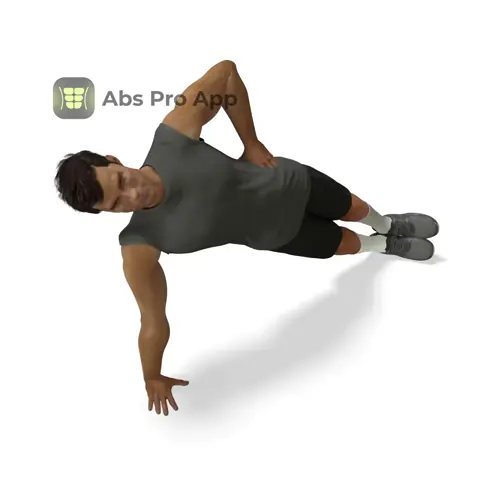
The High Side Plank is a bodyweight core exercise performed on one hand with your body turned sideways. It builds strong obliques, shoulders, and hips while teaching you how to stabilize your spine against gravity. This move is great for anyone looking for a clear side plank tutorial that improves posture, balance, and core control.
It is suitable for beginners who can hold a basic plank and for advanced athletes who want a simple but challenging anti-rotation exercise. Focus on stacking your body in a straight line, pressing the hand into the floor, and keeping your hips lifted.
Benefits
- Strengthens side abs and deep core muscles
- Improves shoulder stability on one arm
- Builds hip and glute endurance
- Helps improve balance and body awareness
- Supports better posture and spine control
- Requires no equipment and little space
- Transfers well to sports and daily movement
Setup & Starting Position
Start by lying on your side with your legs straight and your body in a long line. Place your bottom hand flat on the floor directly under your shoulder, fingers spread for stability. Your shoulder, elbow, and wrist should line up vertically when viewed from the front.
Stack your feet on top of each other for a harder version, or stagger them so the top foot is slightly in front of the bottom foot for more balance. Your free arm can rest on your hip or extend straight up toward the ceiling.
Before lifting, gently brace your core as if preparing for a cough. Press your hand into the floor and engage your shoulder. This is your ready position.
Quick setup tip: Think about pushing the floor away with your hand to create space in the shoulder.
How To Do High side plank (Step-by-step)
- Lie on your side with legs straight and feet stacked or staggered
- Place your bottom hand under your shoulder
- Brace your core and squeeze your glutes
- Press through your hand and lift your hips
- Align head, ribs, hips, and ankles in one line
- Keep your neck neutral and eyes forward
- Breathe steadily while holding the position
- Maintain tension for the desired time
- Lower hips with control to finish the set
Form Cues
- Hand under shoulder, push the floor away
- Hips high and stacked
- Body in one straight line
- Ribs down, core tight
- Neck long and relaxed
- Feet stacked or staggered with control
Breathing & Bracing
Good breathing is key to holding a strong high side plank. Before you lift your hips, take a calm inhale through your nose. As you push into the floor and come up, gently brace your core. This means tightening your abs as if you are preparing to be lightly poked, not sucking in or holding your breath.
Once you are in position, breathe slowly and evenly. A simple rhythm is to inhale for three seconds and exhale for three seconds. With each exhale, think about tightening your obliques slightly more while keeping your ribs stacked over your hips.
Avoid holding your breath, as this can cause tension in the neck and raise blood pressure. If you feel shaky, slow the breath down rather than cutting the set short. Controlled breathing helps you stay stable and makes this exercise more effective.
Common Mistakes
- Letting the hips sag, fix by squeezing glutes and lifting hips higher
- Hand placed too far from the shoulder, fix by stacking wrist under shoulder
- Shoulder collapsing toward the ear, fix by pressing the floor away
- Twisting the chest forward or backward, fix by stacking shoulders vertically
- Holding the breath, fix by using slow nose breathing
- Neck craned forward, fix by keeping head in line with spine
How It Should Feel
Quick Self-Check: During a correct high side plank, you should feel steady tension along the side of your waist, a firm contraction in the shoulder of the support arm, and engagement in the hips and glutes. These are good signs that you are using the right muscles.
You should be able to breathe calmly and maintain a straight line without shaking excessively. Mild shaking is normal, especially for beginners.
Warning signs: Sharp pain in the shoulder, elbow, or lower back means you should stop immediately. Pinching in the shoulder or pressure in the neck is also a sign to reset.
If you feel it mostly in your neck, relax your head and push the floor away more. If you feel it in the lower back, slightly tuck your pelvis and tighten your abs.
Alternative Names
Side plank on hand, High side bridge
Variations
Easier
- Staggered Feet High Side Plank, place the top foot slightly in front for more balance
- Bent Knee High Side Plank, bend the bottom knee and keep it on the floor
Harder
- High Side Plank with Hip Abduction, lift the top leg while holding the plank
- High Side Plank Reach Through, rotate the free arm under the torso and back up
Sample Workout
Core Stability Workout
- High Plank, 30 seconds
- High Side Plank (right), 20 to 40 seconds
- High Side Plank (left), 20 to 40 seconds
- Dead Bug, 8 reps per side
- Glute Bridge, 12 reps
Rest 60 seconds and repeat for 2 to 3 rounds. Focus on control rather than speed.
Progression Plan
Week 1: Practice proper setup and alignment. Hold the high side plank for 15 to 25 seconds per side, 2 to 3 sets. Rest 45 to 60 seconds between sets. Use staggered feet if needed and focus on calm breathing.
Week 2: Increase hold time to 25 to 40 seconds per side. Aim for cleaner form and less shifting. Shorten rest to about 45 seconds if possible.
Week 3: Move toward stacked feet and hold for 40 to 60 seconds per side. Add a slow three second exhale to increase core control.
Week 4 and beyond: Introduce advanced variations like leg lifts or reach throughs. Progress by slowing movement, increasing time under tension, or reducing rest. If form breaks, repeat the previous week until stable.
FAQ
How long should I hold a high side plank?
Most people start with 15 to 30 seconds per side and build up to 45 to 60 seconds.
Is high side plank better than low side plank?
High side plank challenges shoulder stability more, while low side plank reduces wrist load. Both are useful.
Can beginners do this exercise?
Yes, use staggered feet or bent knees to make it easier.
Should my feet be stacked or staggered?
Stacked feet are harder. Staggered feet give more balance.
Why does my shoulder get tired fast?
This is normal at first. Focus on pushing the floor away and keep practicing.
Summary
The high side plank is a simple but powerful way to train your core, shoulders, and hips using only your bodyweight. By paying attention to hand placement, foot position, and steady breathing, you can make this exercise both safe and effective.
Use it as part of a core workout, a warm-up, or a finisher. Progress slowly, stay consistent, and focus on quality holds. Over time, you will notice better stability, stronger obliques, and improved control in everyday movement and training.
Get Defined Abs in 30 Days
This exercise is part of our complete 30-day ab program. Download the app for structured daily workouts and track your progress.