
High Plank Single Leg Tutorial
The High Plank Single Leg is a challenging core stability exercise performed on your hands with your legs straight and one foot stacked on top of the other. This variation increases the balance demand compared to a regular plank, forcing your abs, hips, and shoulders to work harder to keep you steady.
It is ideal for intermediate trainees who already have good plank technique and want to build deeper core control, anti-rotation strength, and full-body tension. Focus on slow breathing, tight glutes, and keeping your hips level from start to finish.
Benefits
- Builds strong anti-rotation core control
- Improves balance and body awareness
- Strengthens shoulders and arms isometrically
- Engages glutes to stabilize the hips
- Reinforces proper plank alignment
- Transfers well to sports and lifting
Setup & Starting Position
Begin on the floor in a high plank position with your hands flat on the ground, placed slightly wider than shoulder-width. Your shoulders should be stacked directly over your wrists, fingers spread for better grip and stability.
Extend both legs straight behind you so your body forms a straight line from head to heels. Bring your feet together, then carefully place one foot directly on top of the other, stacking them so only the bottom foot is in contact with the floor.
Engage your core by gently drawing your ribs down and squeezing your glutes. Keep your neck neutral by looking at the floor a few inches in front of your hands.
Setup tip: Before starting the hold, lightly shift weight through both hands and tighten your abs to prevent hip sway once the feet are stacked.
How To Do High plank single leg (Step-by-step)
- Get into a high plank on your hands and toes
- Align shoulders over wrists and straighten your legs
- Bring your feet together behind you
- Place one foot directly on top of the other
- Tighten your abs and squeeze your glutes
- Hold the position while keeping hips level
- Breathe steadily and maintain tension
- After the set, switch which foot is on top
- Carefully lower knees to rest and reset
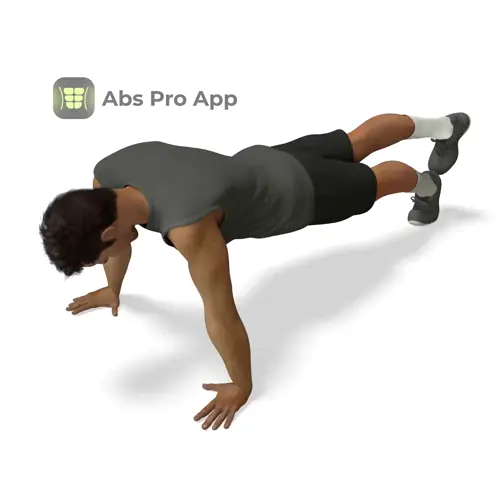
Form Cues
- Push the floor away with your hands
- Hips stay level, no twisting
- Legs long and active
- Glutes tight
- Neck relaxed, eyes down
- Ribs down, abs braced
Breathing & Bracing
Proper breathing is essential during the High Plank Single Leg because the position already challenges your balance and core control. Start by taking a calm breath in through your nose before stacking your feet.
Once in position, aim for slow, controlled breaths. Inhale gently through your nose, allowing your rib cage to expand slightly without letting your lower back arch. Exhale through your mouth as if fogging a mirror, and lightly tighten your abs during the exhale.
Think about bracing your core as if preparing for a light cough, not sucking your stomach in and not holding your breath. Your breathing rhythm can be simple, such as a 3-second inhale followed by a 4-second exhale.
If you feel shaky, slow your breathing even more. Steady breaths help calm the body and make it easier to keep your hips from rotating.
Common Mistakes
- Hips rotating to one side, fix it by tightening glutes and abs more.
- Hands too far forward, fix it by stacking shoulders over wrists.
- Holding the breath, fix it by using slow nose inhales and mouth exhales.
- Bending the knees, fix it by fully straightening the legs.
- Looking forward and straining the neck, fix it by keeping eyes down.
- Rushing the hold, fix it by focusing on steady tension instead of time.
How It Should Feel
Quick self-check: During the hold, you should feel steady tension in your abs, shoulders, and glutes. Your body should feel long and controlled, not shaky or collapsed.
Good signs:
- Your hips stay mostly level
- You feel your abs working more than your lower back
- Your shoulders feel strong and stable
Warning signs:
- Sharp pain in the shoulders, wrists, or lower back, stop immediately
- Strong lower back strain instead of core effort
- Neck tension or headache
If you feel it mostly in your lower back, reset and brace your abs harder while squeezing your glutes. If your neck feels tense, drop your gaze and lengthen the back of your neck.
Alternative Names
Single-Leg High Plank, Stacked Feet Plank
Variations
Easier
- High plank with feet apart, perform a standard high plank with a wider stance for more stability.
- High plank knee down, keep one or both knees on the floor to reduce load.
- Short hold high plank, hold for 10 to 15 seconds focusing on perfect form.
Harder
- High plank single leg with shoulder taps, tap one shoulder at a time while keeping feet stacked.
- High plank single leg slow weight shift, gently shift shoulders forward and back under control.
- High plank single leg hip lift pause, add a brief pause while slightly lifting the top leg.
Sample Workout
Core Stability Workout
- High Plank Single Leg, 3 sets of 20 to 30 seconds per side
- Dead Bug, 3 sets of 8 reps per side
- Side Plank, 3 sets of 20 seconds per side
- Glute Bridge Hold, 3 sets of 30 seconds
Rest 45 to 60 seconds between sets. Focus on control and breathing rather than rushing.
Progression Plan
Week 1: Practice 3 sets of 15 to 20 seconds per side. Focus on clean setup, level hips, and calm breathing. Rest 60 seconds between sets.
Week 2: Increase to 20 to 30 seconds per side. Keep the same form standards. If you lose alignment, shorten the hold and rebuild.
Week 3: Add a slower breathing tempo or reduce rest to 45 seconds. Aim for stronger control rather than longer time.
Week 4: Once you can hold 30 to 40 seconds per side with minimal hip movement, progress to an advanced variation such as shoulder taps.
If form breaks down early, repeat the current week until you can complete all sets with quality.
FAQ
Should I switch which foot is on top?
Yes, always perform equal time with each foot on top to avoid imbalances.
How long should I hold the position?
Most people benefit from 15 to 40 second holds per side with good form.
Is it normal to shake?
Light shaking is normal and means your stabilizing muscles are working.
Can I do this every day?
You can, as long as you manage volume and maintain good recovery.
Summary
The High Plank Single Leg is a powerful way to take your plank strength to the next level without any equipment. By stacking your feet and maintaining full-body tension, you challenge your core to resist rotation and build real-world stability.
Prioritize quality over duration, breathe steadily, and switch sides evenly. With consistent practice and smart progression, this exercise can significantly improve your core control, posture, and overall strength.
Get Defined Abs in 30 Days
This exercise is part of our complete 30-day ab program. Download the app for structured daily workouts and track your progress.