
High Plank Knee To Elbow Tutorial
High plank knee to elbow is a dynamic core exercise performed from a high plank on your hands. You draw one knee toward the same side elbow, then return to plank and switch sides.
This move builds strong abs, improves shoulder stability, and challenges your balance while keeping your body in a straight line. It is great for people who already have basic plank strength and want a harder abs workout.
Focus on slow control, steady breathing, and keeping your hips level. This guide shows how to do high plank knee to elbow with clean technique so you get core work, not lower back strain.
Benefits
- Strengthens the entire core.
- Targets the obliques with rotation control.
- Builds shoulder and arm stability.
- Improves balance and coordination.
- Raises core tension for better posture.
- Prepares you for harder plank variations.
Setup & Starting Position
Begin on the floor in a high plank position. Place your hands flat on the ground directly under your shoulders, fingers spread wide for better support. Your arms should be straight but not locked.
Extend your legs straight behind you with your feet about hip-width apart. Balance on the balls of your feet. Your body should form a straight line from your head to your heels.
Gently tuck your pelvis so your lower back stays neutral, not arched and not rounded. Keep your head in line with your spine and look slightly down at the floor.
Quick setup tip: Before the first rep, tighten your abs and squeeze your glutes as if preparing for a plank hold.
How To Do High plank knee to elbow (Step-by-step)
- Set up in a strong high plank on your hands.
- Brace your core and keep your hips level.
- Lift your right foot and bend the knee.
- Draw the right knee toward the right elbow.
- Pause briefly when the knee is close to the elbow.
- Return the right foot back to plank with control.
- Repeat the movement with the left knee and left elbow.
- Continue alternating sides for the desired reps.
- Finish by holding a steady plank, then lower down.
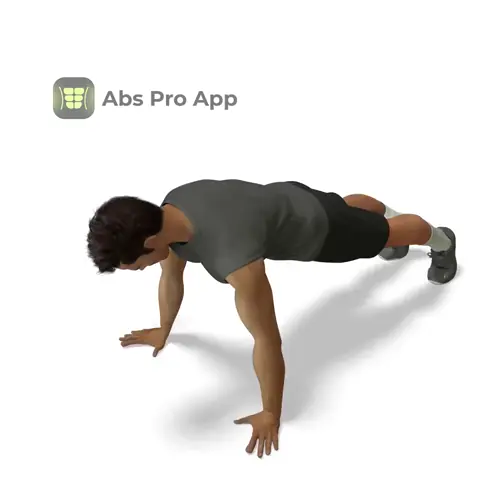
Form Cues
- Hands under shoulders.
- Core tight the whole time.
- Hips stay level.
- Slow and controlled knee drive.
- Neck long, eyes down.
- Press the floor away.
Breathing & Bracing
Proper breathing makes a big difference in this exercise. Start by taking a calm breath in before you begin your first knee drive. As you bring your knee toward your elbow, gently exhale through your mouth.
Think about tightening your abs as if you are preparing for a light cough. This creates core tension without holding your breath. Your ribs should stay down and your hips should not twist or lift.
A simple rhythm you can repeat is inhale in plank, exhale as the knee comes forward. When the foot returns to the floor, take a small inhale before switching sides.
If your breathing becomes rushed, slow the movement down. Controlled breathing helps keep your lower back safe and keeps the work focused on your abs.
Common Mistakes
- Letting the hips sag, fix by tightening your core and glutes.
- Rushing the movement, fix by slowing each rep.
- Shifting weight too far forward, fix by keeping shoulders stacked over hands.
- Twisting the hips, fix by keeping your belt line level.
- Looking forward, fix by keeping your neck neutral.
How It Should Feel
Quick self-check: You should feel strong tension across your abs and obliques, with your shoulders working to stabilize your body. The movement should feel controlled, not jerky.
Good signs: Your lower back feels supported, your hips stay steady, and you can move the knee without losing plank alignment. You may feel your abs shake slightly as they fatigue.
Warning signs: Sharp pain in the shoulders, wrists, or lower back means stop. If your hips swing side to side, the set is too hard.
Adjustments: If you feel it in your neck, look down and lengthen the back of your neck. If you feel strain in your lower back, shorten the knee range or rest, then resume with more core tension.
Alternative Names
plank knee to elbow, high plank knee drive
Variations
Easier
- High plank knee lift: Bring the knee forward only a few inches, then return.
- Elevated hands plank knee to elbow: Place hands on a low bench or step to reduce load.
Harder
- Slow tempo plank knee to elbow: Take 3 to 4 seconds to drive the knee forward and back.
- Cross-body plank knee to elbow: Bring the knee toward the opposite elbow for more oblique work.
Sample Workout
Core and stability workout:
- High plank knee to elbow, 10 reps per side
- Glute bridge, 15 reps
- Dead bug, 10 reps per side
- Side plank, 20 to 30 seconds per side
Rest 60 seconds and repeat the circuit 2 to 3 times. One rep of knee to elbow equals one knee drive on each side.
Progression Plan
Week 1: Perform 2 to 3 sets of 6 to 8 reps per side. Move slowly and pause briefly when the knee comes forward. Rest 60 to 90 seconds between sets.
Week 2: Increase to 8 to 12 reps per side and reduce rest to about 60 seconds. Focus on keeping your hips perfectly level.
Week 3: Add a slower tempo, taking 3 seconds to bring the knee forward and 3 seconds to return. Keep reps the same.
Week 4: Progress to an advanced variation like cross-body knee to elbow. If form breaks down, repeat the previous week.
Only progress when you can complete all reps with steady breathing and no lower back discomfort.
FAQ
FAQ
How many reps should I do?
Most people start with 8 to 12 reps per side, focusing on clean form.
Should my knee touch my elbow?
Touching is not required. Bring the knee as close as you can without losing plank position.
Why do my wrists get tired?
This exercise loads the wrists. Spread your fingers, press through your palms, and take breaks if needed.
Is one rep both sides?
Yes, one rep includes a knee drive on the right and one on the left.
Summary
High plank knee to elbow is a powerful way to build core strength while improving shoulder and hip stability. When done with control, it teaches your body to stay strong during movement, not just during static holds.
Take your time, breathe with each rep, and focus on quality over speed. As your strength improves, you can slow the tempo or explore harder variations to keep progressing.
Use this exercise as part of a balanced core routine and enjoy the challenge it brings to your plank training.
Get Defined Abs in 30 Days
This exercise is part of our complete 30-day ab program. Download the app for structured daily workouts and track your progress.