
High Plank Arm Raise Hold Tutorial
Benefits
- Builds strong anti-rotation core control
- Improves shoulder stability on the supporting arm
- Trains full body tension without equipment
- Enhances plank technique and alignment
- Challenges balance and coordination
- Strengthens deep abdominal muscles
- Transfers well to athletic movements
Setup & Starting Position
How To Do High plank arm raise hold (Step-by-step)
- Set up in a stable high plank on straight arms
- Brace your abs and squeeze your glutes
- Shift weight slightly into one hand and both feet
- Lift the opposite arm straight forward at shoulder height
- Keep shoulders, hips, and heels aligned
- Hold the raised arm steady for the planned time
- Breathe calmly while staying tight
- Lower the hand back under the shoulder with control
- Reset your balance
- Repeat the hold on the other side
- Finish by returning to a stable plank
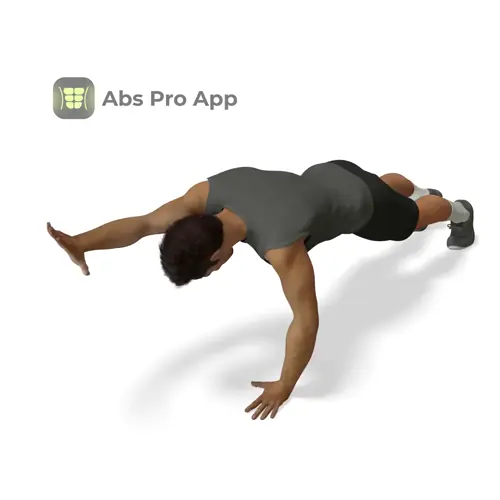
Form Cues
- Push the floor away
- Reach long with the lifted arm
- Keep hips square
- No sagging or piking
- Squeeze glutes gently
- Neck long and relaxed
- Slow and controlled
Breathing & Bracing
Common Mistakes
- Hips rotating to one side, fix by widening your feet and bracing harder
- Lower back sagging, fix by squeezing glutes and shortening the hold
- Shoulders shrugging toward ears, fix by pushing the floor away
- Rushing into the arm lift, fix by pausing to stabilize first
- Holding breath, fix by counting slow breaths
- Arm lifting too high, fix by keeping it at shoulder height
- Neck craning forward, fix by keeping head in line with spine
How It Should Feel
- Your body stays mostly still during the hold
- You feel deep abdominal engagement, not just surface muscles
- You can breathe calmly without losing alignment
- Sharp pain in the shoulder or wrist, stop immediately
- Lower back discomfort that increases during the hold
- Neck strain or jaw clenching
Alternative Names
plank arm raise hold, high plank reach hold
Variations
Easier
- High plank arm raise tap: Lift the arm briefly and tap the floor in front, then return, reducing hold time
- Wide stance plank arm raise: Perform the same hold with feet wider for more stability
- Short hold plank arm raise: Hold each arm lift for 3 to 5 seconds only
Harder
- Feet together plank arm raise hold: Bring feet together to increase balance demand
- Long lever plank arm reach: Reach the lifted arm farther forward while holding
- Extended hold plank arm raise: Increase hold time to 20 to 30 seconds per side
Sample Workout
Core Stability Workout
- High plank arm raise hold, 3 rounds of 20 seconds per side
- Dead bug, 3 x 8 reps per side
- Side plank, 3 x 20 seconds per side
- Glute bridge, 3 x 12 reps
Rest 45 to 60 seconds between exercises. Focus on quality and control rather than speed.
Progression Plan
Week 1: Practice building consistency and control. Perform 3 sets of 10 to 15 second holds per side. Use a slightly wider foot stance and focus on keeping hips level. Rest 45 to 60 seconds between sets.
Week 2: Increase the challenge by extending hold time to 20 seconds per side. Keep the same number of sets but aim for smoother arm lifts and calmer breathing.
Week 3: Narrow your foot stance slightly or reach the lifted arm farther forward. Maintain 20 to 25 second holds with perfect alignment.
Week 4: Progress to 30 second holds per side or add an extra set. If form breaks down, repeat the previous week until you can hold steady without hip movement.
Move to advanced variations once you can hold 30 seconds per side with minimal shaking and controlled breathing.
FAQ
How long should I hold each arm?
Most people start with 10 to 20 seconds per side. A rep consists of one hold on one side.
Should my feet be wide or narrow?
Wider feet make the exercise more stable, narrower feet make it harder.
Is it normal to shake?
Light shaking is normal and shows your stabilizing muscles are working.
Can I do this every day?
Yes, as long as you recover well and maintain good form.
What if my wrists hurt?
Try spreading fingers more, pushing through the palm, or reducing hold time.
Summary
Get Defined Abs in 30 Days
This exercise is part of our complete 30-day ab program. Download the app for structured daily workouts and track your progress.