
High Plank Tutorial
The high plank is a classic bodyweight core exercise performed on your hands with your arms straight. It looks simple, but it challenges your abs, shoulders, and full-body stability when done correctly.
This exercise is ideal for people who already have basic core awareness and want to build stronger abs, better posture, and full-body tension. Because the difficulty is moderate, it suits intermediate trainees or beginners who use easier variations.
Focus on hands under shoulders, a tight core, and a straight line from head to heels. Quality tension matters more than how long you hold it.
Benefits
- Builds strong and stable abs
- Improves shoulder stability and strength
- Teaches full-body tension and control
- Supports better posture
- Protects the lower back when done correctly
- Transfers well to push-ups and other exercises
- Requires no equipment and little space
Setup & Starting Position
Start on the floor in an all-fours position. Place your hands flat on the ground directly under your shoulders, fingers spread slightly for better grip and balance. Your arms should be straight but not locked.
Step your feet back one at a time until your legs are fully extended and your knees are off the floor. Feet should be about hip-width apart for stability. Press the floor away with your hands so your upper back stays slightly rounded, not sagging.
Align your body so your head, shoulders, hips, and heels form one straight line. Gently tuck your pelvis and squeeze your glutes to prevent your lower back from arching.
Before starting the hold, take a breath, brace your core as if preparing for a cough, and lock in your position.
Setup tip: If you feel pressure in your wrists, actively push the floor away and grip with your fingers.
How To Do High plank (Step-by-step)
- Start on hands and knees with hands under shoulders.
- Extend one leg back, then the other, lifting knees off the floor.
- Press the floor away to engage shoulders.
- Tighten your abs and squeeze your glutes.
- Keep your neck neutral and eyes on the floor.
- Breathe slowly while maintaining tension.
- Hold the position for the planned time.
- Lower knees to the floor to finish.
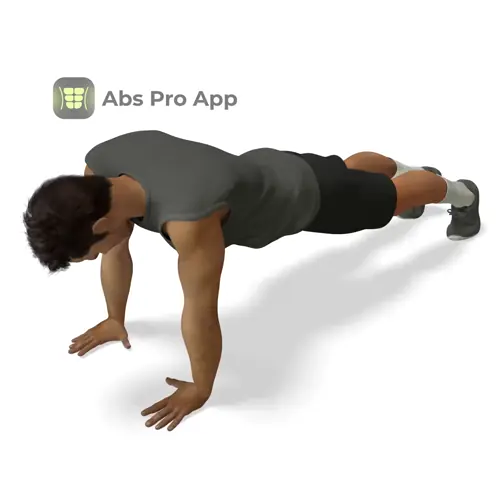
Form Cues
- Hands under shoulders
- Push the floor away
- Squeeze glutes
- Ribs down, core tight
- Head in line with spine
- Heels reaching back
Breathing & Bracing
Breathing correctly during a high plank helps you maintain tension without fatiguing too fast. Avoid holding your breath. Instead, aim for slow, controlled breaths while keeping your core engaged.
Before lifting into the plank, inhale through your nose. As you set your position, gently brace your core as if you are tightening a wide belt around your waist. Your ribs should stay down and stacked over your hips.
During the hold, breathe in through your nose for about 3 to 4 seconds, then exhale slowly through your mouth for 3 to 4 seconds. Each breath should happen without letting your hips drop or your shoulders shrug.
If you notice shaking, keep breathing and focus on tension rather than relaxing. If your breathing becomes rushed or shallow, it is a sign the set may be ending.
Common Mistakes
- Hips sagging, fix by squeezing glutes and tightening abs.
- Hands too far forward, fix by stacking shoulders over wrists.
- Holding breath, fix by using slow nasal breathing.
- Neck craned up, fix by looking at the floor.
- Locked elbows, fix by keeping arms straight but soft.
- Feet too close together, fix by widening stance slightly.
How It Should Feel
Quick Self-Check: A proper high plank should feel challenging but controlled.
Good signs:
- Strong tension in the abs
- Shoulders working but stable
- Glutes lightly engaged
- Even pressure through both hands
Warning signs:
- Sharp pain in shoulders or wrists, stop immediately.
- Lower back discomfort, reset core and glutes.
If you feel it mostly in your neck, relax your head and lengthen the spine. If your lower back takes over, slightly tuck your pelvis and shorten the hold time.
Alternative Names
front plank on hands, straight arm plank
Variations
Easier
- Knee High Plank: Keep knees on the floor while maintaining straight line from head to knees.
- Elevated High Plank: Place hands on a bench or box to reduce load.
Harder
- High Plank Shoulder Taps: From plank, slowly tap opposite shoulder without shifting hips.
- High Plank with Leg Lift: Lift one foot slightly while keeping hips level.
Sample Workout
Core Stability Workout
- High Plank: 3 sets of 30 to 45 seconds
- Dead Bug: 3 sets of 8 reps per side
- Glute Bridge: 3 sets of 12 reps
- Side Plank: 2 sets of 20 to 30 seconds per side
Rest 45 to 60 seconds between sets. Focus on control rather than rushing.
Progression Plan
Week 1: Perform high planks 3 times per week. Hold for 20 to 30 seconds per set, 3 to 4 sets. Focus on perfect alignment and breathing.
Week 2: Increase hold time to 30 to 45 seconds. Reduce rest slightly and aim for smoother breathing.
Week 3: Add tension by narrowing foot stance or lightly squeezing a towel between hands. Holds stay at 40 to 60 seconds.
Week 4: Introduce advanced variations like shoulder taps for short sets. If form breaks, return to standard plank.
Repeat a week if you lose alignment or breath control. Progress only when you can hold strong tension without pain.
FAQ
How long should I hold a high plank?
Most people benefit from holds between 20 and 60 seconds with perfect form.
Is high plank harder than low plank?
High plank places more load on the shoulders and wrists, while low plank often challenges the abs more directly.
Why do my wrists hurt during high planks?
This is often due to poor hand pressure or limited wrist mobility. Spread fingers and push the floor away.
Can I do high planks every day?
Yes, as long as volume is controlled and form stays solid.
Summary
The high plank is a simple but powerful core exercise when done with intention. By focusing on hand placement, full-body tension, and steady breathing, you turn a basic hold into a full-strength builder.
Do not rush progress. Short, high-quality holds beat long sloppy ones. Use easier or harder variations to match your level and stay consistent.
Mastering the high plank builds a foundation that carries over to many other exercises and everyday movement.
Get Defined Abs in 30 Days
This exercise is part of our complete 30-day ab program. Download the app for structured daily workouts and track your progress.