
Good Morning Tutorial
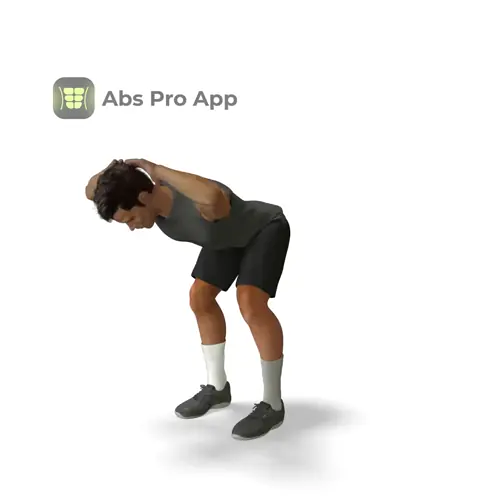
Good mornings are a classic hip hinge exercise done with bodyweight only in this version. You bend forward at the hips while keeping your back straight, then return to standing using your glutes and core. This move helps strengthen your abs, lower back, and hips, and improves posture and movement control.
It is best suited for intermediate-level exercisers who already understand basic bracing and hinge technique. Focus on slow, controlled movement, a neutral spine, and feeling tension in your core and hamstrings rather than your lower back.
Benefits
- Builds strong core bracing
- Improves hip hinge technique
- Strengthens posterior chain without equipment
- Supports better posture
- Reduces risk of back rounding in daily movement
- Improves body awareness and control
Setup & Starting Position
Stand upright with your feet about hip-width apart and toes pointing mostly forward. Your weight should be evenly distributed across your feet, not shifted to your toes or heels. Keep your knees soft but not deeply bent.
Place your hands lightly on your hips or cross your arms over your chest. Pull your shoulders gently back and down so your chest is open, but avoid flaring your ribs. Your head should stay in line with your spine, eyes looking slightly forward or down.
Before starting the first rep, take a breath in and lightly brace your core as if preparing to cough. This creates tension around your midsection and protects your lower back.
Setup tip: Imagine a straight line from your head to your tailbone and commit to keeping that line unchanged during the movement.
How To Do Good morning (Step-by-step)
- Stand tall in the starting position and brace your core.
- Begin the movement by pushing your hips straight back.
- Keep your back straight as your torso leans forward.
- Allow a slight bend in the knees, but do not squat.
- Lower until your torso is close to parallel with the floor or you feel a strong hamstring stretch.
- Pause briefly while maintaining tension.
- Drive your hips forward by squeezing your glutes.
- Return to a fully upright standing position.
- Reset your brace and repeat for the next rep.
Form Cues
- Hips move back, not down
- Spine stays long and neutral
- Brace abs before moving
- Neck stays in line with spine
- Feel stretch in hamstrings
- Squeeze glutes to stand
Breathing & Bracing
Breathing correctly during good mornings helps protect your spine and improve core engagement. Before each rep, inhale through your nose and lightly brace your abs. Think about tightening your midsection as if you were about to absorb a light punch, without sucking in or pushing your belly out excessively.
As you hinge forward, keep that brace and breathe shallowly if needed. Avoid fully relaxing your abs at the bottom position. When returning to standing, exhale slowly through your mouth as your hips drive forward.
A simple rhythm to follow is inhale and brace at the top, hinge while holding tension, then exhale as you stand tall. Never hold your breath for long periods, and keep your ribs stacked over your hips throughout the movement.
Common Mistakes
- Rounding the lower back, fix by reducing range and bracing harder.
- Bending the knees too much, fix by focusing on pushing hips back.
- Moving too fast, fix by slowing the lowering phase.
- Looking up or tucking the chin, fix by keeping neck neutral.
- Feeling pain in the lower back, fix by shortening the range and resetting form.
How It Should Feel
Quick Self-Check:
Good mornings should feel controlled and strong. You should notice tension in your hamstrings, glutes, and abs throughout each rep. Your lower back should feel supported, not strained.
Good signs:
- Stretch in the back of the legs
- Strong abdominal engagement
- Smooth, balanced movement
Warning signs:
- Sharp pain in the lower back, stop immediately
- Loss of balance or wobbling
If you feel it mostly in your neck or lower back, reduce depth, slow down, and focus on bracing before you hinge.
Alternative Names
bodyweight good morning, hip hinge good morning
Variations
Easier
- Partial Range Good Morning, hinge only halfway down while maintaining perfect posture.
- Wall Good Morning, stand a few inches from a wall and hinge until hips touch it.
Harder
- Tempo Good Morning, lower for 4 seconds and rise for 2 seconds.
- Paused Good Morning, pause for 2 seconds at the deepest hinge position.
Sample Workout
Posterior Chain and Core Session
- Good Morning, 3 sets of 10 to 12 reps
- Glute Bridge, 3 sets of 15 reps
- Dead Bug, 3 sets of 8 reps per side
- Plank, 3 sets of 30 to 45 seconds
Rest 45 to 60 seconds between sets and focus on slow, controlled movement.
Progression Plan
Week 1: Perform 3 sets of 8 to 10 controlled reps. Focus on learning proper bracing and keeping a neutral spine. Rest 60 seconds between sets.
Week 2: Increase to 3 sets of 12 reps. Add a slower lowering phase of about 3 seconds to increase time under tension.
Week 3: Maintain reps but add a 1 to 2 second pause at the bottom of each rep. Rest 45 to 60 seconds.
Week 4: Progress to a tempo or paused good morning variation. If form breaks down, repeat the previous week until control improves.
FAQ
How far down should I hinge?
Go down until your back stays neutral and you feel a strong hamstring stretch, depth varies per person.
Should my knees be locked?
No, keep a slight bend in the knees to protect your joints.
Why do I feel it more in one leg?
This often indicates a strength or mobility imbalance, slow down and focus on even weight distribution.
Can I do good mornings every day?
They can be done often, but allow rest if your lower back or hamstrings feel overly fatigued.
Summary
Bodyweight good mornings are a powerful way to train your core and posterior chain using precise technique rather than equipment. When done with control, they teach proper hip hinging that carries over to daily life and other exercises.
Prioritize posture, bracing, and slow movement, and you will build strength while protecting your lower back. Stay patient with progress and focus on quality reps for long-term results.
Get Defined Abs in 30 Days
This exercise is part of our complete 30-day ab program. Download the app for structured daily workouts and track your progress.