
Front Leaning Low Plank Tutorial
The Front Leaning Low Plank is an intermediate core exercise that builds strong abs, deep core control, and shoulder stability using only bodyweight. You perform it on your forearms with elbows crossed, rocking your body forward so the shoulders pass the elbows, then shifting back while slightly lifting the hips.
This move is great for people who already know how to hold a standard forearm plank and want more challenge without equipment. Focus on slow control, strong bracing, and keeping your body aligned from head to heels.
Benefits
- Builds strong and visible abs
- Improves deep core stability
- Strengthens shoulders without equipment
- Teaches body control and tension
- Enhances plank endurance
- Trains anti-extension core strength
Setup & Starting Position
Begin by getting down on the floor and placing your forearms on the ground with elbows crossed, one forearm resting over the other. Your elbows should be directly under your chest, not flared outward.
Extend both legs straight back and place your toes on the floor, feet about hip-width apart for balance. Lift your knees so your body forms a straight line from head to heels. This is a low plank position on forearms, not on hands.
Before starting the movement, lightly tuck your pelvis, squeeze your glutes, and brace your abs as if preparing for a punch. Keep your neck neutral, eyes looking slightly down at the floor.
Setup tip: If your shoulders already feel loaded, slide your elbows slightly forward before starting to create space and stability.
How To Do Front leaning low plank (Step-by-step)
- Set up in a low plank on crossed forearms and toes.
- Brace your core and squeeze your glutes.
- Slowly lean your body forward, moving shoulders ahead of elbows.
- Keep hips low and body straight as you lean.
- Pause briefly at the forward position.
- Push through forearms and toes to move back.
- As you move back, lift your butt slightly.
- Return to the starting plank position.
- Repeat with slow, controlled tempo.
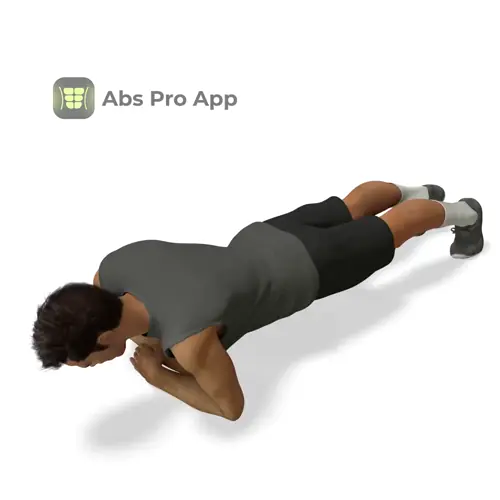
Form Cues
- Forearms stay planted
- Shoulders glide forward and back
- Core tight the whole time
- No sagging lower back
- Neck stays neutral
- Move slow and controlled
Breathing & Bracing
Proper breathing is key to getting the most out of the front leaning low plank. Before you begin each rep, take a calm inhale through your nose and gently expand your rib cage.
As you lean forward, exhale slowly through your mouth while tightening your abs. Think about pulling your ribs down toward your hips. This keeps your lower back protected and prevents arching.
When rocking back and lifting your hips slightly, take a small controlled inhale, then reset your brace before the next rep. Avoid holding your breath for long periods.
A simple rhythm you can repeat is: inhale to prepare, exhale as you lean forward, inhale as you rock back. Your core should stay firm, but breathing should remain smooth and controlled.
Common Mistakes
- Letting the lower back sag, fix by tightening abs and glutes.
- Moving too fast, fix by slowing down each rep.
- Shoulders not passing elbows, fix by leaning farther forward.
- Bending the knees, fix by keeping legs straight and active.
- Neck craning forward, fix by looking down and keeping neutral.
How It Should Feel
Quick self-check: You should feel strong tension across your abs and shoulders throughout the movement.
Good signs:
- Deep abdominal burn without back pain
- Shoulders working but stable
- Glutes engaged during the whole set
Warning signs:
- Sharp pain in shoulders or lower back, stop immediately
- Pressure in the neck, reset head position
If you feel it mostly in your lower back, shorten the range of motion and focus on bracing harder. If your neck feels tense, look slightly down and lengthen the back of your neck.
Alternative Names
Forearm plank rock, plank lean forward
Variations
Easier
- Low Plank Hold: Hold a standard forearm plank without rocking.
- Short Range Plank Rock: Lean forward only a few centimeters, then back.
Harder
- Slow Tempo Front Leaning Plank: Take 5 seconds forward and 5 seconds back.
- Extended Forward Hold: Pause 3 to 5 seconds with shoulders past elbows.
Sample Workout
Core Stability Workout
- Front Leaning Low Plank, 3 sets of 8 to 12 reps
- Dead Bug, 3 sets of 10 reps per side
- Side Plank, 3 sets of 20 to 30 seconds per side
- Glute Bridge Hold, 2 sets of 30 seconds
Rest 45 to 60 seconds between sets. Focus on control, not speed.
Progression Plan
Week 1: Perform 3 sets of 6 to 8 controlled reps. Keep the range moderate and rest 60 seconds between sets. Focus on learning the correct plank lean technique and maintaining a strong brace.
Week 2: Increase to 3 sets of 10 to 12 reps. Slow down the forward lean to about 3 seconds and add a short pause before rocking back.
Week 3: Reduce rest to 45 seconds and aim for cleaner reps. If you can keep perfect form, try the slow tempo advanced variation.
Progress when you can complete all reps without lower back strain. Repeat a week if form breaks down or tension is lost.
FAQ
How far should I lean forward?
Lean until your shoulders clearly move past your elbows while maintaining control.
Is one rep one forward and back motion?
Yes, one full lean forward and return back counts as one rep.
Should my hips lift a lot when rocking back?
No, only a slight lift, not a full pike.
Can I do this every day?
It is best done 2 to 4 times per week to allow recovery.
Summary
The front leaning low plank is a powerful way to upgrade your core training without adding equipment. By shifting your weight forward and back on crossed forearms, you challenge your abs, shoulders, and glutes in a unique and effective way.
Stay patient, move slowly, and prioritize control over reps. When done with proper technique, this exercise builds strength that carries over to many other bodyweight movements and daily activities.
Get Defined Abs in 30 Days
This exercise is part of our complete 30-day ab program. Download the app for structured daily workouts and track your progress.