
Elbow-knee Crunches Tutorial
Benefits
- Builds rotational core strength
- Targets both abs and obliques
- Improves coordination between upper and lower body
- Challenges core stability with legs lifted
- No equipment needed, bodyweight only
- Helps improve posture control
Setup & Starting Position
Quick setup tip: If your lower back arches off the floor, lower the legs slightly or bend them until you can maintain control.
How To Do Elbow-knee crunches (Step-by-step)
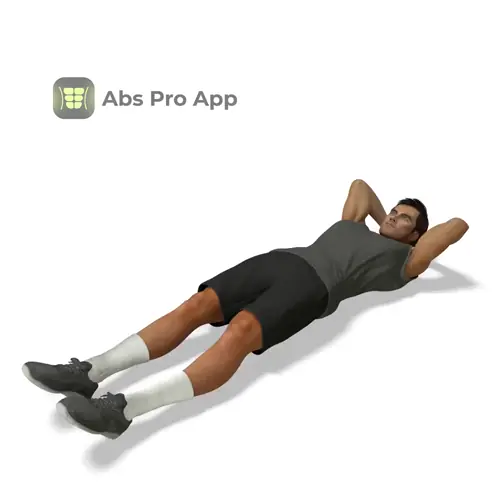
- Lie on your back with legs straight and hands behind your head
- Lift both legs off the floor and brace your core
- Rotate your torso and bring one elbow toward the opposite knee
- Let that knee bend as it comes in, keep the other leg lifted and straight
- Pause briefly at the top with abs tight
- Lower your shoulders and straighten the bent leg
- Switch sides and repeat on the other elbow and knee
- Move in a slow, controlled rhythm
- Complete all reps, where one rep equals both sides
Form Cues
- Elbows wide, neck relaxed
- Rotate from the ribs, not the arms
- Lower back gently pressed into floor
- Legs stay lifted the whole set
- Slow and controlled movement
Breathing & Bracing
As you lower back to the center position, inhale through the nose while maintaining tension in your core. Keep breathing smoothly from rep to rep. A simple rhythm to repeat is exhale on the crunch, inhale on the return. If you notice your breath becoming rushed or held, slow down the movement and reset your brace before continuing.
Common Mistakes
- Pulling on the head with the hands, fix by keeping elbows wide and hands light
- Letting the legs drop to the floor, fix by lifting them higher or reducing reps
- Rushing through the movement, fix by slowing the rotation
- Arching the lower back, fix by tightening abs and lowering legs slightly
- Leading with the elbow instead of the torso, fix by focusing on rib rotation
How It Should Feel
Good signs:
- Burning sensation in abs and obliques
- Core feels tight and controlled
- Legs stay lifted without swinging
- Sharp pain in the neck or lower back, stop immediately
- Hip flexors doing all the work
Alternative Names
Alternating elbow-to-knee crunch, cross-body crunch
Variations
Easier
- Bent-knee elbow crunch, keep both knees bent and feet lifted to reduce lever length
- Feet-on-floor cross crunch, keep one foot on the floor while rotating to the opposite knee
Harder
- Slow tempo elbow-knee crunch, take 3 seconds up and 3 seconds down
- Paused elbow-knee crunch, hold the elbow to knee position for 2 to 3 seconds
Sample Workout
- Elbow-knee crunches, 3 sets of 10 to 16 reps
- Front plank hold, 3 x 30 to 45 seconds
- Dead bug, 3 x 8 reps per side
- Glute bridge, 3 x 12 reps
Rest 45 to 60 seconds between sets. One rep of elbow-knee crunches includes both left and right sides.
Progression Plan
Week 1: Perform 3 sets of 8 to 10 controlled reps. Focus on learning the rotation and keeping the legs lifted without arching the back. Rest 60 seconds between sets.
Week 2: Increase to 10 to 14 reps per set and shorten rest to 45 seconds. Slow the movement slightly and add a brief pause at the top.
Week 3: Progress to 14 to 18 reps per set or switch to a slow tempo variation. Maintain perfect form and breathing.
Move to advanced variations once you can complete all sets without neck or back strain. If form breaks down, repeat the previous week until control improves.
FAQ
Do I need to keep both legs straight the whole time?
You start with both legs straight and lifted. As you rotate, the knee coming toward the elbow bends while the other leg stays straight.
How many reps should I do?
Most people do 10 to 16 reps per set, where one rep includes both sides.
Why do my hip flexors get tired first?
This usually means the legs are too low. Lift them slightly higher or slow down the movement.
Can I do this exercise every day?
Yes, if volume is controlled and form stays clean, but rest days help recovery.
Summary
Get Defined Abs in 30 Days
This exercise is part of our complete 30-day ab program. Download the app for structured daily workouts and track your progress.