
Diagonal Side Crunch Tutorial
Diagonal Side Crunch is a challenging side-lying core exercise that targets the obliques with constant tension. You lie on your side, lift both legs off the floor, and crunch the torso diagonally to bring the ribs toward the hips. Because your legs stay elevated and one leg is straight, this move demands strong core control and body awareness.
This exercise is best suited for intermediate trainees who already have basic core strength. Focus on slow, controlled movement, steady breathing, and keeping tension in the side of the waist rather than pulling with the neck.
Benefits
- Builds strong and defined obliques
- Improves side-to-side core stability
- Challenges core endurance with constant tension
- Enhances body control and coordination
- Strengthens diagonal movement patterns
- No equipment needed
Setup & Starting Position
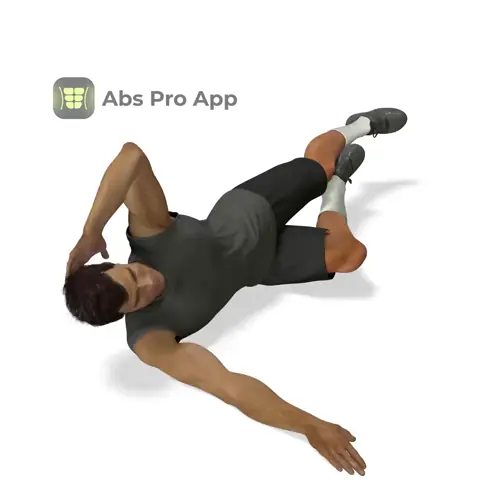
Lie on your side on the floor or mat. Bend the bottom knee for stability and keep the top leg straight. Stack your hips and shoulders so your body stays in one straight line from head to hips.
Extend your bottom arm fully on the floor in line with your body, palm relaxed. Place your top hand lightly behind your head, keeping the elbow open. This hand is only for guidance, not pulling.
Before starting the first rep, lift both legs off the floor. The bottom knee stays bent and elevated, and the top leg remains straight and hovering. Brace your core gently and keep your neck long.
Setup tip: Imagine squeezing the space between your ribs and hip on the working side before you begin the first crunch.
How To Do Diagonal side crunch (Step-by-step)
- Lie on your side with bottom knee bent and top leg straight.
- Extend the bottom arm on the floor, top hand behind your head.
- Lift both legs off the floor and hold them steady.
- Inhale to prepare and brace your core.
- Exhale and crunch your torso diagonally, bringing ribs toward hips.
- Keep the elbow wide and neck relaxed.
- Pause briefly at the top while maintaining tension.
- Lower slowly with control back to the start.
- Complete all reps on one side, then switch sides.
Form Cues
- Lift through the side of your waist
- Legs stay off the floor
- Top leg long and active
- Neck relaxed, elbow open
- Slow and controlled tempo
- No swinging or jerking
Breathing & Bracing
Start each rep with a calm inhale through your nose as you hold the starting position. Brace your core by gently tightening your abs as if preparing for a cough, without flattening your breath.
As you crunch diagonally upward, exhale slowly through your mouth. This helps deepen core engagement and prevents neck tension. Think about pulling the ribs toward the hip using your side abs, not your arm.
At the top of the crunch, maintain a brief, controlled breath hold without straining. Then inhale again as you lower with control.
A simple rhythm to follow is: inhale to prepare, exhale up for two seconds, inhale down for two to three seconds. Keep breathing smooth and never hold your breath completely.
Common Mistakes
- Pulling the head forward, fix by keeping the elbow open and neck long.
- Letting the legs touch the floor, fix by lifting them before each rep.
- Using momentum, fix by slowing down the lowering phase.
- Collapsing the torso forward, fix by stacking shoulders and hips.
- Holding breath, fix by timing the exhale with the crunch.
How It Should Feel
Good signs:
- Strong burn along the side of the waist
- Constant tension in the obliques
- Legs feel challenged but controlled
Warning signs:
- Sharp pain in the neck or spine, stop immediately
- Lower back discomfort from poor alignment
If you feel it mostly in your neck, reduce the range of motion and focus on moving the ribs. If the lower back feels strained, re-stack your hips and slightly bend the top leg until control improves.
Alternative Names
Side-lying diagonal crunch
Variations
Easier
- Diagonal Side Crunch with Legs Down, keep both legs on the floor to reduce load.
- Bent-Leg Side Crunch, bend both knees while keeping them lifted.
Harder
- Slow Tempo Diagonal Side Crunch, take 3 seconds up and 4 seconds down.
- Isometric Hold Side Crunch, pause 5 to 10 seconds at the top of each rep.
Sample Workout
Core Focused Side Stability Workout
- Diagonal Side Crunch 3 sets of 8 to 12 reps per side
- Side Plank 3 sets of 20 to 40 seconds per side
- Dead Bug 3 sets of 10 reps per side
- Glute Bridge 3 sets of 12 to 15 reps
Rest 45 to 60 seconds between sets. Perform all reps on one side before switching.
Progression Plan
Week 1: Perform 2 to 3 sets of 6 to 8 reps per side. Focus on learning the technique, keeping legs lifted, and maintaining slow control. Rest 60 seconds between sets.
Week 2: Increase to 8 to 12 reps per side. Start adding a brief pause of 1 second at the top of each crunch while keeping tension in the obliques.
Week 3: Slow the tempo to 3 seconds up and 3 seconds down. Keep reps at 10 to 12 per side and reduce rest to 45 seconds.
Week 4: Progress to an advanced variation such as longer top holds or extended sets. If form breaks down, repeat the previous week until control improves.
FAQ
Should I count one rep per side or both sides?
One rep is counted on one side only. Complete all reps on one side, then switch.
Why do my legs shake during this exercise?
This is normal and means your core and hip stabilizers are working hard to keep the legs elevated.
Can I bend the top leg if it feels too hard?
Yes, bending the top leg slightly reduces leverage and makes the exercise easier.
How high should I crunch up?
Only lift until you feel maximum tension in the obliques without losing control or pulling the neck.
Summary
The Diagonal Side Crunch is a powerful bodyweight move for building strong, functional obliques. By lifting the legs and crunching diagonally, you place the core under constant tension, which improves both strength and control.
Prioritize clean form, steady breathing, and slow tempo over high reps. When performed correctly, this exercise can significantly improve side core stability and help support better posture and movement in daily life and training.
Get Defined Abs in 30 Days
This exercise is part of our complete 30-day ab program. Download the app for structured daily workouts and track your progress.