
Crunches Tutorial
Crunches are a classic bodyweight abs exercise done on the floor with bent knees and feet planted. They focus on lifting the shoulder blades off the mat using your core, not pulling with the neck. This move helps build basic abdominal strength, improve mind muscle connection, and teach proper spinal flexion control.
Crunches are ideal for beginners or anyone learning how to train the abs with good technique. The key focus is slow, controlled movement, keeping the neck neutral, and feeling the abs shorten as you lift.
Benefits
- Builds basic abdominal strength
- Improves core control and awareness
- Requires no equipment
- Easy to scale and learn
- Supports better posture when done correctly
- Low impact on joints
- Good foundation for harder ab exercises
Setup & Starting Position
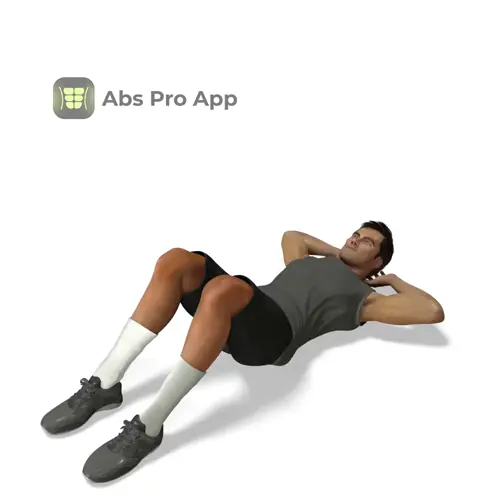
Start by lying flat on your back on an exercise mat or comfortable floor. Bend your knees so your feet are planted firmly on the ground about hip width apart. Your heels should stay down throughout the movement.
Place your fingertips lightly on the back of your head, just behind the ears. Keep your elbows open and wide, not pulled forward. Your neck stays long and neutral, imagine holding a tennis ball between your chin and chest.
Before you begin the first rep, gently tighten your core as if preparing for a light cough. Your lower back should stay in its natural position against the floor without excessive arching or pressing.
Quick setup tip: If your neck feels tense, move your fingertips slightly lighter and focus on lifting the chest, not the head.
How To Do Crunches (Step-by-step)
- Lie on your back with knees bent and feet flat on the floor
- Place fingertips behind the head with elbows open
- Inhale to prepare and brace your core
- Exhale and lift your shoulder blades off the mat
- Keep your lower back on the floor
- Pause briefly at the top while squeezing the abs
- Lower down slowly and with control
- Fully relax the shoulders before the next rep
Form Cues
- Lift the chest, not the chin
- Elbows stay wide
- Neck stays neutral
- Slow and controlled tempo
- Abs initiate the movement
- Feet stay planted
Breathing & Bracing
Breathing correctly during crunches helps you activate the abs without straining the neck or holding your breath. Begin each rep with a calm inhale through your nose while lying on the floor.
As you lift your shoulders, gently exhale through your mouth and tighten your abs. Think about pulling your ribs slightly toward your hips. This creates abdominal tension without flattening your breath completely.
At the top, keep breathing relaxed, not forced. Then inhale again as you lower down under control. Avoid holding your breath or pushing the belly outward.
Simple rhythm: inhale at the bottom, exhale as you crunch up, inhale as you return.
Common Mistakes
- Pulling on the head, fix by relaxing the hands and lifting the chest
- Elbows collapsing forward, fix by keeping them wide
- Jerking the movement, fix by slowing the tempo
- Lifting too high, fix by stopping once shoulders leave the floor
- Holding breath, fix by exhaling on the lift
- Feet lifting off the floor, fix by pressing them down lightly
How It Should Feel
Quick self check: Crunches should create a clear burning or tightening feeling in the front of your abs. You should feel control through the movement, not momentum.
Good signs:
- Abs engage as soon as you lift
- Neck feels relaxed and supported
- You can control the lowering phase
Warning signs:
- Sharp pain in the neck or back, stop immediately
- Strain in the neck more than the abs
If you feel it mostly in your neck, reduce range of motion and focus on lifting the chest. If your lower back feels uncomfortable, tighten your core more and keep the movement smaller.
Alternative Names
ab crunch, floor crunch
Variations
Easier
- Partial Crunch: Lift only a few centimeters off the floor and return
- Arms Crossed on Chest Crunch: Cross arms over chest to reduce neck involvement
Harder
- Slow Tempo Crunch: Take 3 seconds up and 3 seconds down
- Pause Crunch: Hold the top position for 2 to 3 seconds
Sample Workout
Beginner Abs Workout:
- Crunches, 3 sets of 12 to 15 reps
- Dead Bug, 3 sets of 8 reps per side
- Glute Bridge, 3 sets of 12 reps
Rest 45 to 60 seconds between sets. Focus on control and breathing rather than speed.
Progression Plan
Week 1: Perform 3 sets of 10 to 12 reps. Focus on learning the movement, breathing correctly, and keeping the neck relaxed. Rest about 60 seconds between sets.
Week 2: Increase to 3 sets of 15 reps. Begin slowing the lowering phase to 2 seconds to increase control.
Week 3: Keep reps the same but add a 1 second pause at the top of each crunch. Rest 45 seconds.
Week 4: Progress to slow tempo crunches or pause crunches. If form breaks down, repeat the previous week.
Move to advanced variations once you can complete all reps with no neck strain and full control.
FAQ
Should my lower back stay on the floor?
Yes, it should stay in a natural position without lifting or arching excessively.
Can I do crunches every day?
Yes, if volume is moderate and you are not feeling pain or excessive soreness.
Why do my elbows move forward?
This usually happens when the neck takes over, focus on opening the chest.
Are crunches safe for beginners?
Yes, when performed slowly with good control and limited range.
Summary
Crunches remain one of the most effective ways to learn how to train your abs with control and awareness. By focusing on clean technique, proper breathing, and slow movement, you can build a strong foundation for more advanced core exercises.
Keep your reps controlled, listen to your body, and prioritize quality over quantity. Mastering this simple move can greatly improve your overall core strength and confidence.
Get Defined Abs in 30 Days
This exercise is part of our complete 30-day ab program. Download the app for structured daily workouts and track your progress.