
Crunch Pulses Hands Up Tutorial
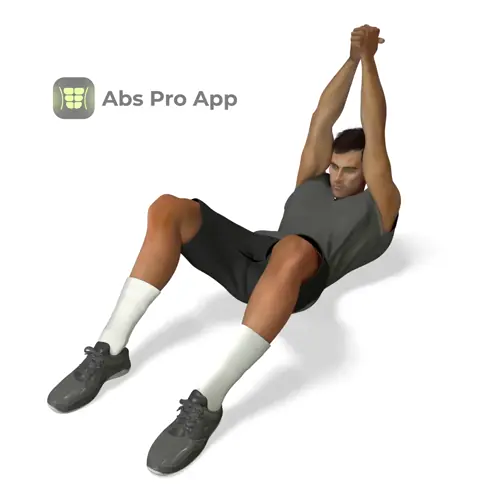
Crunch pulses hands up is a bodyweight ab exercise where you stay slightly lifted off the floor and perform small pulsing crunches with your arms extended overhead.
It helps build endurance and control in the upper abs while also challenging shoulder stability and core coordination.
This move is well suited for beginners who already understand basic crunch technique and want to feel more time under tension without adding equipment.
Focus on slow pulses, keeping your ribs down, neck relaxed, and abs doing the work instead of momentum.
Benefits
- Builds upper ab endurance
- Improves mind muscle connection in the core
- Increases time under tension without heavy strain
- Teaches controlled crunch technique
- Engages shoulders for added stability
- No equipment needed
- Easy to scale up or down
Setup & Starting Position
Start by lying flat on your back on a mat or comfortable floor.
Bend your knees and place your feet flat on the ground, about hip width apart and close enough that your heels stay grounded throughout the set.
Extend both arms straight overhead so your biceps are near your ears and your hands are hovering just above the floor. Keep the arms straight but relaxed.
Gently tuck your chin so your neck stays long, and press your lower back lightly into the floor to set your core.
Before starting the pulses, lift your head and shoulders slightly off the floor into a shallow crunch position and hold that lift.
Setup tip: Think about pulling your ribs down toward your hips before the first pulse to lock in core control.
How To Do Crunch pulses hands up (Step-by-step)
- Lie on your back with knees bent and feet flat on the floor
- Extend arms overhead with biceps near your ears
- Engage your core and lightly press lower back into the floor
- Lift shoulders and upper back slightly into a crunch
- Hold this lifted position without dropping down
- Pulse upward by lifting your shoulders a few more inches
- Lower back to the lifted position, not all the way down
- Repeat controlled pulses for the desired reps
- Keep arms extended and steady overhead
- Finish the set by slowly lowering shoulders to the floor
Form Cues
- Small controlled pulses
- Stay lifted the whole set
- Ribs down, abs tight
- Neck long and relaxed
- Arms straight overhead
- No swinging or jerking
Breathing & Bracing
Proper breathing helps keep tension in your abs and reduces strain on your neck and lower back.
Before starting, take a deep inhale through your nose and gently brace your core by tightening your abs as if preparing for a cough.
As you perform each upward pulse, exhale slowly through your mouth. This helps the abs contract more strongly and keeps your ribs from flaring upward.
Inhale lightly as you return to the lifted position between pulses, without fully relaxing your core.
A simple rhythm to follow is: inhale to prepare, exhale on each pulse.
Avoid holding your breath or forcing air out aggressively. Your breathing should stay smooth and controlled while your core remains engaged the entire time.
Common Mistakes
- Pulling on the neck, fix it by keeping hands overhead and chin relaxed
- Dropping fully to the floor between pulses, stay lifted the whole set
- Using momentum instead of abs, slow down the pulses
- Arching the lower back, press it gently into the floor
- Letting arms bend or fall forward, keep them extended overhead
- Rushing reps, focus on control and tension
How It Should Feel
Quick self check:
You should feel a steady burn in the upper abs that builds as the set goes on. The movement should feel small but intense, with your abs doing most of the work.
Good signs:
- Shaking or burning in the abs
- Ability to keep shoulders lifted the entire set
- Neck stays relaxed without pulling
Warning signs:
- Sharp pain in the neck or back, stop immediately
- Lower back lifting hard off the floor
If you feel it mostly in your neck, lower the pulse height and think about lifting from your ribs instead of your head. If your lower back feels strained, reset your core and shorten the set.
Alternative Names
Overhead arm crunch pulses
Variations
Easier
- Crunch pulses arms forward: Extend arms toward knees instead of overhead to reduce leverage
- Short range crunch hold: Hold the lifted position without pulsing
Harder
- Crunch pulses with straight legs: Extend legs to increase core demand
- Slow tempo crunch pulses: Pulse up for 2 seconds and down for 2 seconds to increase time under tension
Sample Workout
Beginner Core Workout
- Crunch pulses hands up, 3 sets of 12 to 20 pulses
- Dead bug, 3 sets of 6 reps per side
- Glute bridge hold, 3 sets of 20 seconds
Rest 45 to 60 seconds between exercises. Use crunch pulses hands up early in the workout when your core is fresh so you can focus on clean technique.
Progression Plan
Week 1:
Perform 2 to 3 sets of 10 to 15 pulses. Focus on staying lifted the entire set and maintaining steady breathing. Rest 60 seconds between sets.
Week 2:
Increase to 3 sets of 15 to 20 pulses. Slow the pulse slightly and improve control. Rest 45 to 60 seconds.
Week 3:
Keep reps the same but reduce rest to 30 to 45 seconds. Focus on stronger exhale with each pulse.
Progressing further:
When you can complete 3 sets of 20 pulses with perfect form and no neck strain, move to an advanced variation like straight leg crunch pulses or slower tempo pulses. If form breaks down, repeat the previous week.
FAQ
How high should I pulse up?
Only a few inches. Think small movement with constant tension, not a full crunch.
Should my arms touch the floor?
No, keep them hovering overhead to maintain tension and shoulder engagement.
How many pulses equal one rep?
Each upward pulse counts as one rep.
Why do my shoulders get tired?
Holding arms overhead adds leverage and stability demand, which is normal.
Can I do this exercise every day?
Yes, as long as volume is moderate and you are not sore or fatigued.
Summary
Crunch pulses hands up is a simple but effective way to challenge your abs using control instead of speed.
By staying lifted and keeping your arms overhead, you increase time under tension and build stronger core awareness.
Focus on small pulses, smooth breathing, and relaxed neck positioning to get the most out of every rep.
Use this exercise as part of a balanced core routine and progress slowly for long term results.
Get Defined Abs in 30 Days
This exercise is part of our complete 30-day ab program. Download the app for structured daily workouts and track your progress.