
Crunch Pulses Tutorial
Crunch pulses are a focused ab exercise where you hold your shoulder blades lifted off the floor and perform small, controlled pulses. This keeps continuous tension on the abs, especially the upper core, making it more challenging than regular crunches.
This exercise is great for people who already understand basic core control and want to improve muscle endurance, mind to muscle connection, and ab definition. The key focus is staying lifted, keeping the elbows wide, and moving slowly without pulling on the neck.
If you are looking for a how to crunch pulses guide or a clear tutorial to level up your ab workouts, this exercise fits perfectly into intermediate core training.
Benefits
- Builds constant tension in the abs
- Improves core endurance and control
- Enhances mind to muscle connection
- Strengthens upper abdominal muscles
- Helps improve crunch technique
- Requires no equipment or space
- Easy to add intensity without weights
Setup & Starting Position
Lie flat on your back on a comfortable surface such as a mat. Bend your knees and place your feet flat on the floor about hip width apart. Your heels should be close enough that you can touch them with your fingertips if needed.
Place your fingers lightly against the back of your head with your elbows opened wide to the sides. Do not interlock your fingers tightly or pull your head forward. Your neck should stay long and relaxed.
Before starting, gently tilt your pelvis so your lower back presses lightly into the floor. Brace your abs as if preparing for a cough.
Setup tip: Think about lifting your chest toward the ceiling rather than curling your chin toward your chest.
How To Do Crunch pulses (Step-by-step)
- Lie down and set your feet flat with knees bent.
- Place fingers behind your head, elbows wide.
- Brace your core and press your lower back gently into the floor.
- Lift your head, neck, and shoulder blades off the ground.
- Hold this lifted position without relaxing.
- Perform a small upward pulse by contracting the abs.
- Lower slightly but do not let shoulders touch the floor.
- Continue pulsing in a short, controlled range.
- Maintain steady breathing and tension.
- Finish the set by slowly lowering back down.
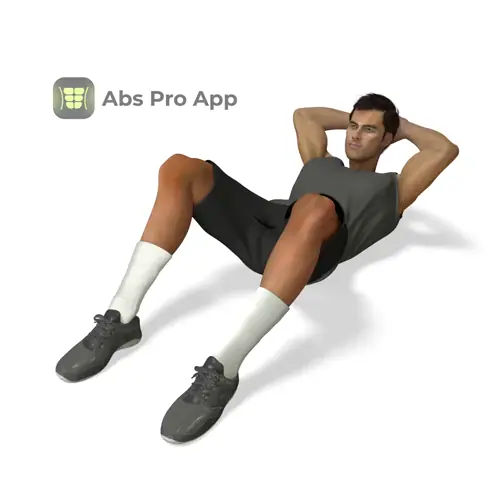
Form Cues
- Elbows stay wide
- Shoulders never touch the floor
- Small controlled pulses
- Neck stays relaxed
- Lower back gently pressed down
- Abs tight the whole time
Breathing & Bracing
Breathing correctly during crunch pulses helps maintain control and prevents neck or lower back strain. Before lifting, take a calm inhale through your nose and gently brace your core as if tightening a belt around your waist.
As you pulse upward, exhale slowly through your mouth. The exhale should be controlled, not forced, and match the effort of each pulse. During the small lowering phase, take a short inhale without fully relaxing your abs.
Focus on keeping your ribs down and stacked over your hips. Avoid flaring the ribs upward as this reduces ab engagement. Your breathing rhythm can follow a simple pattern such as exhale on each pulse or exhale for two pulses, inhale for one.
Do not hold your breath. Think of breathing behind the brace, keeping your core tight while air moves in and out.
Common Mistakes
- Pulling on the head with the hands, fix by loosening your grip and widening elbows.
- Letting shoulders touch the floor, fix by reducing range and staying lifted.
- Using large crunch movements, fix by making pulses smaller.
- Neck strain from chin tucking, fix by keeping gaze up and neck long.
- Lower back arching, fix by pressing it gently into the floor.
- Holding breath, fix by using steady exhales.
How It Should Feel
Quick self check: Crunch pulses should create a strong, burning sensation in the upper abs within the first few reps. You should feel constant tension rather than momentum.
Good signs:
- Deep abdominal fatigue and warmth
- Controlled shaking as muscles tire
- Stable lower back against the floor
Warning signs:
- Sharp pain in the neck or spine, stop immediately
- Lower back lifting excessively
- Head being pulled forward by the hands
If you feel it mostly in your neck, reduce range, relax your grip, and focus on lifting the chest. If your lower back feels strained, bring your feet closer and re brace your core.
Alternative Names
Pulse crunches, Crunch hold pulses
Variations
Easier
- Crunch Hold: Lift shoulders and hold without pulsing to reduce movement demand.
- Feet Elevated Crunch Pulses Short Set: Keep pulses but reduce reps and rest more.
- Hands Across Chest Crunch Pulses: Remove head support to encourage lighter tension.
Harder
- Extended Time Crunch Pulses: Increase time under tension with longer sets.
- Slow Tempo Crunch Pulses: Add a 2 second pause at the top of each pulse.
- Legs Raised Crunch Pulses: Lift feet off the floor with knees bent to increase load.
Sample Workout
Core Burn Workout
- Crunch Pulses: 3 sets of 20 to 30 pulses
- Dead Bug: 3 sets of 8 reps per side
- Forearm Plank: 3 sets of 30 to 45 seconds
- Reverse Crunch: 3 sets of 12 reps
Rest 30 to 45 seconds between exercises. Focus on quality reps and controlled breathing.
Progression Plan
Week 1: Perform 3 sets of 15 to 20 pulses. Rest 45 seconds between sets. Focus on perfect form, wide elbows, and keeping shoulders lifted.
Week 2: Increase to 3 to 4 sets of 25 pulses. Shorten rest to 30 seconds and slow the pulse slightly for more control.
Week 3: Add a brief 1 second pause at the top of each pulse or raise your feet off the floor. Keep reps around 20 to 25.
If form breaks or neck strain appears, repeat the previous week. Progress only when you can maintain constant tension without discomfort.
FAQ
How many pulses should I do per set?
Most people start with 15 to 30 pulses per set, depending on control.
Should my shoulders touch the floor between pulses?
No, keeping them lifted maintains continuous tension.
Can I do crunch pulses every day?
Yes, as long as volume is moderate and recovery feels good.
Are crunch pulses better than regular crunches?
They increase time under tension, which can be more challenging for the abs.
What if my neck gets tired first?
Reduce range and focus on chest lift, not head pull.
Summary
Crunch pulses are a powerful way to increase ab intensity without adding equipment. By staying lifted and pulsing in a small range, you challenge your core with nonstop tension.
Focus on clean setup, controlled breathing, and quality reps rather than speed. When performed correctly, this exercise can significantly improve ab endurance and definition.
Add crunch pulses to your core workouts when you want a deeper burn and better control, and progress slowly to keep results steady and safe.
Get Defined Abs in 30 Days
This exercise is part of our complete 30-day ab program. Download the app for structured daily workouts and track your progress.