
Crunch Hold Tutorial
Crunch Hold is an isometric abs exercise where you lift and hold your upper back off the floor to keep constant tension in your core.
It strengthens the rectus abdominis while teaching proper bracing and posture control. This move is ideal for beginners and anyone learning how to feel their abs work without fast reps.
Focus on slow setup, steady breathing, and keeping your neck relaxed while your abs do the work.
Benefits
- Builds core strength without equipment
- Improves mind to muscle connection in the abs
- Low impact and joint friendly
- Teaches proper crunch posture
- Great for beginners learning bracing
- Enhances core endurance
- Easy to adjust intensity
Setup & Starting Position
Start by lying flat on your back on a mat or comfortable floor surface. Bend your knees so your feet are planted firmly on the ground about hip width apart. Your lower back should rest naturally against the floor without excessive arching.
Place your fingertips gently behind your head with thumbs near the ears. Do not interlock your fingers. Keep your elbows open and wide so your chest stays open. Your neck should remain neutral, as if holding a small apple between your chin and chest.
Before lifting, lightly brace your core by tightening your abs as if preparing for a cough. This sets tension before the hold begins.
Quick setup tip: Press your feet into the floor to help stabilize your hips.
How To Do Crunch hold (Step-by-step)
- Lie on your back with knees bent and feet flat.
- Place fingertips behind your head, elbows open.
- Engage your core before moving.
- Lift your head and shoulder blades off the floor.
- Keep your lower back lightly pressed down.
- Hold this position with steady tension.
- Breathe slowly while maintaining the hold.
- Lower down with control to finish.
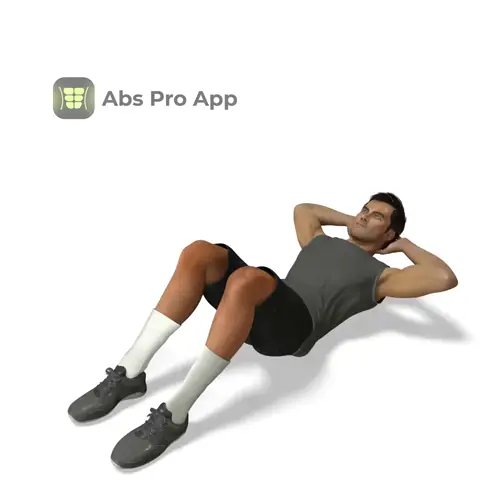
Form Cues
- Elbows wide, not pulling the head
- Neck relaxed and neutral
- Ribs down, abs tight
- Shoulder blades off the floor
- Feet planted and steady
- Slow, calm breathing
Breathing & Bracing
Breathing correctly during the crunch hold helps you maintain tension without straining your neck or holding your breath. Before lifting, take a gentle inhale through your nose. As you raise your shoulder blades, lightly exhale and tighten your abs.
During the hold, continue breathing slowly. Use short, controlled breaths, inhaling through the nose and exhaling through the mouth. Each exhale should reinforce abdominal tension, as if gently tightening a belt around your waist.
Keep your ribs pulled down and avoid flaring them upward. Your hips should stay still, and your lower back should not arch. A simple rhythm to repeat is inhale for three seconds, exhale for three seconds, while maintaining the hold.
If you feel shaky breathing, reduce the hold time and rebuild control.
Common Mistakes
- Pulling the head forward, fix by keeping elbows wide and hands light.
- Holding the breath, fix by using slow nasal breathing.
- Arching the lower back, fix by tightening the abs harder.
- Lifting too high, fix by focusing on shoulder blades off the floor only.
- Neck pain, fix by relaxing the jaw and neck muscles.
- Feet lifting off the floor, fix by pressing them down.
How It Should Feel
Quick Self-Check: The crunch hold should create a steady burning sensation across the front of your abs. You should feel strong tension without sharp discomfort.
Good signs:
- Abs feel engaged and working continuously
- Neck stays relaxed with no pulling
- Breathing remains controlled
Warning signs:
- Sharp pain in the neck or lower back, stop immediately
- Cramping in the hip flexors
If you feel it mostly in your neck, open your elbows wider and lower slightly. If your lower back feels strained, shorten the hold and press your ribs down more firmly.
Alternative Names
Isometric crunch, Static crunch hold
Variations
Easier
- Short Crunch Hold: Hold for 5 to 10 seconds, rest, and repeat.
- Arms Reaching Forward Hold: Reach arms forward instead of behind the head to reduce neck strain.
Harder
- Feet Elevated Crunch Hold: Place feet on a chair to increase core demand.
- Weighted Crunch Hold: Hold a light object on the chest for added resistance.
Sample Workout
Beginner Core Workout:
- Crunch Hold, 3 sets of 15 to 30 seconds
- Dead Bug, 3 sets of 6 reps per side
- Glute Bridge Hold, 3 sets of 20 seconds
Rest 45 to 60 seconds between sets. Focus on quality tension rather than long holds.
Progression Plan
Week 1: Perform 3 sets of 10 to 20 second holds. Focus on perfect setup, calm breathing, and neck relaxation. Rest 60 seconds between sets.
Week 2: Increase hold time to 20 to 30 seconds. Reduce rest to 45 seconds if form stays solid.
Week 3: Add an extra set or extend holds to 40 seconds. Focus on slower breathing and stronger bracing.
Week 4: Introduce an advanced variation like feet elevated crunch holds. If form breaks, repeat the previous week.
Progress only when you can hold tension without neck or lower back discomfort.
FAQ
How long should I hold a crunch hold?
Most beginners benefit from 15 to 30 seconds per set.
Should my lower back touch the floor?
Yes, it should stay lightly pressed down without force.
Is it normal to feel shaking?
Yes, shaking means your core muscles are working.
Can I do crunch holds every day?
Yes, as long as volume is moderate and there is no pain.
Summary
The crunch hold is a simple yet powerful way to build abdominal strength and awareness. By slowing down and holding tension, you teach your core how to stay engaged and stable.
Keep your setup consistent, breathe steadily, and focus on quality over time. Whether used as a warm-up, finisher, or main core move, this exercise fits easily into any bodyweight routine.
Stay patient, stay controlled, and your abs will respond.
Get Defined Abs in 30 Days
This exercise is part of our complete 30-day ab program. Download the app for structured daily workouts and track your progress.