
Burpee No Jump Hands Down Tutorial
Burpee No Jump Hands Down is a full-body, no-equipment exercise that builds core strength, upper body pushing power, and conditioning without the impact of a jump. It follows a controlled burpee pattern with a plank and push-up, then returns to standing calmly.
This variation is ideal for intermediate trainees who want a strong abs and conditioning challenge while being easier on the joints. Focus on clean plank position, a solid push-up with the chest to the floor, and smooth transitions. This guide and tutorial explains how to do the burpee no jump hands down with proper technique.
Benefits
- Builds core stability through plank and push-up
- Strengthens chest, shoulders, and triceps
- Trains legs through squat and stand phases
- Improves full-body coordination
- Raises heart rate without high impact
- Reinforces strong plank alignment
- Can be done anywhere with no equipment
Setup & Starting Position
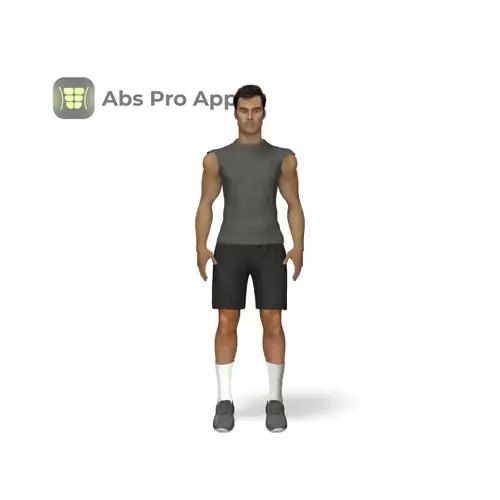
Begin standing upright with your feet about hip-width apart. Keep your arms relaxed by your sides and your chest tall. Your weight should be evenly distributed through the mid-foot, not leaning too far forward or back.
Before the first rep, gently brace your core by tightening your abs as if preparing for a plank. Keep your shoulders relaxed and your neck long. Look straight ahead or slightly down to avoid overextending the neck.
This exercise moves from standing to the floor and back up, so make sure you have enough space in front of you to place your hands and kick your feet back safely.
Setup tip: Think about moving smoothly and quietly, especially when placing your hands and feet, control matters more than speed.
How To Do Burpee no jump hands down (Step-by-step)
- Stand tall with arms by your sides and feet hip-width apart.
- Push hips back and bend knees into a squat.
- Place both hands flat on the floor in front of your feet.
- Kick or step both feet back into a high plank on hands.
- Lower your chest all the way to the floor with elbows bending.
- Briefly lift your hands a small amount off the floor.
- Place hands back down and press up to a strong plank.
- Jump or step both feet forward toward your hands.
- Stand back up fully without jumping, arms return to sides.
Form Cues
- Hands under shoulders in plank
- Body straight from head to heels
- Chest touches floor in push-up
- Light hand lift, no rushing
- Control the stand up
- Abs tight the whole time
Breathing & Bracing
Proper breathing helps you stay strong and controlled throughout the burpee no jump hands down. Start by taking a calm inhale while standing tall. As you squat down and place your hands on the floor, begin to exhale slowly.
In the plank and push-up phase, maintain gentle abdominal tension. Exhale as you lower your chest to the floor and lightly lift your hands. Inhale again as you press back up to plank, keeping your ribs pulled down and hips level.
As you bring your feet back toward your hands, start another exhale. Finish the rep by inhaling as you stand tall. Avoid holding your breath, instead use a steady rhythm that matches each phase of the movement.
Think of bracing your core like tightening a wide belt around your waist, firm but still able to breathe.
Common Mistakes
- Letting hips sag in plank, squeeze glutes and tighten abs.
- Skipping the full chest-to-floor push-up, lower with control.
- Hands too far forward, place them under shoulders.
- Rushing through reps, slow down for better form.
- Rounding the back in the squat, keep chest lifted.
- Holding breath too long, use steady breathing.
How It Should Feel
Quick Self-Check: When done correctly, you should feel your abs working to stabilize your body, especially during the plank and push-up. Your chest, shoulders, and arms should feel challenged, and your legs should engage as you squat down and stand back up.
Good signs:
- Strong tension in the core without lower back strain
- Even weight through both hands in plank
- Controlled, smooth transitions
Warning signs:
- Sharp pain in shoulders, wrists, or lower back, stop immediately
- Neck strain from looking up too much
If you feel it mostly in your neck, keep your gaze down and lengthen the back of your neck. If your lower back feels stressed, slow down and tighten your abs more before moving.
Alternative Names
Low-impact burpee with push-up, Burpee without jump
Variations
Easier
- Step-Back Burpee No Jump: Step one foot back at a time into plank instead of kicking both feet.
- Burpee No Push-Up: Hold plank briefly instead of lowering chest to floor.
- Incline Hands Burpee: Place hands on a sturdy elevated surface to reduce load.
Harder
- Tempo Burpee No Jump: Slow the push-up to 3 to 4 seconds down.
- Paused Push-Up Burpee: Pause for 2 seconds with chest just off the floor.
- One-Leg Step-In Burpee: Alternate stepping one foot forward at a time for more core demand.
Sample Workout
Full-Body Conditioning Circuit
- Burpee No Jump Hands Down, 8 to 12 reps
- Bodyweight Squats, 15 reps
- High Plank Hold, 30 seconds
- Alternating Reverse Lunges, 10 per side
Rest 60 to 90 seconds between rounds. Complete 3 to 4 rounds. Focus on quality reps and steady breathing.
Progression Plan
Week 1: Perform 3 sets of 6 to 8 reps. Focus on learning the sequence and maintaining a strong plank. Rest 90 seconds between sets. Move slowly and prioritize clean push-ups.
Week 2: Increase to 3 to 4 sets of 8 to 10 reps. Reduce rest to 60 to 75 seconds. Begin to smooth out transitions from squat to plank.
Week 3: Aim for 10 to 12 reps per set. Add a slight pause at the bottom of the push-up to increase time under tension.
If form breaks down, repeat the same week before progressing. Move to advanced variations once you can maintain perfect plank alignment and controlled breathing throughout all reps.
FAQ
Is this burpee easier on the joints?
Yes, removing the jump reduces impact on ankles, knees, and hips.
Do I have to jump my feet back?
No, you can step them back if you need more control.
Why lift the hands at the bottom?
It ensures full chest contact and removes momentum from the push-up.
How fast should I do the reps?
Use a controlled, steady pace, speed should never reduce form.
How many reps should I aim for?
Most people start with 6 to 12 reps per set depending on conditioning.
Summary
The burpee no jump hands down is a powerful way to train your abs and entire body using only your own weight. By removing the jump, you gain more control while still challenging strength and conditioning.
Stay focused on clean technique, steady breathing, and strong core engagement. Use the variations and progression plan to match your current fitness level. With consistent practice, this exercise can become a reliable tool in your bodyweight training routine.
Get Defined Abs in 30 Days
This exercise is part of our complete 30-day ab program. Download the app for structured daily workouts and track your progress.