
Boxer Sit-ups Tutorial
Boxer sit-ups are a classic abs exercise where you perform controlled sit-ups with your fists clenched under your chin, similar to a boxing guard. This hand position encourages better posture and reduces the urge to pull on your neck. The movement targets the front of your core and helps build basic abdominal strength and endurance.
This exercise is well suited for beginners or anyone looking for a simple, no-equipment core move. Focus on slow control, keeping your feet grounded, and lifting with your abs rather than momentum. If you are searching for a clear how to do boxer sit-ups guide, this tutorial breaks it down step by step.
Benefits
- Builds basic abdominal strength
- Improves core control and posture
- Teaches proper sit-up technique
- Requires no equipment
- Easy to add to home workouts
- Hand position reduces neck pulling
- Can be progressed or regressed easily
Setup & Starting Position
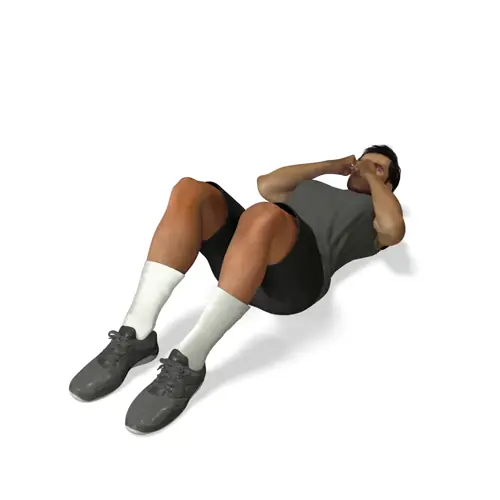
Lie flat on your back on a mat or comfortable floor surface. Bend your knees to about a right angle and place your feet flat on the ground, roughly hip-width apart. Your heels should stay in contact with the floor throughout the movement.
Clench your fists and place them gently under your chin, with your elbows pointing slightly forward. The fists should not push your head up, they simply act as a reminder to keep your neck neutral. Keep your head relaxed and your eyes looking up.
Before starting, gently flatten your lower back toward the floor by tightening your abs. This creates a stable base and protects your lower back. Setup tip, think about curling your ribs toward your hips before the first rep to engage your core.
How To Do Boxer sit-ups (Step-by-step)
- Start lying on your back with knees bent, feet flat, and fists under your chin
- Inhale gently to prepare and brace your core
- Begin the movement by curling your head and shoulders off the floor
- Continue rolling your upper body up until your torso is upright
- Keep your feet planted and elbows relaxed
- Pause briefly at the top while staying tall
- Exhale as you slowly lower your back down
- Lower one vertebra at a time until your shoulders touch the floor
- Reset your brace and repeat for the next rep
Form Cues
- Fists stay light under the chin
- Lift with your abs, not momentum
- Feet stay flat on the floor
- Neck stays long and relaxed
- Control the way down
- Ribs move toward hips
Breathing & Bracing
Good breathing makes boxer sit-ups safer and more effective. Before each rep, take a small inhale through your nose and gently tighten your abs as if preparing to cough. This brace should feel firm but not stiff.
As you curl your upper body up, exhale slowly through your mouth. This helps your abs contract and keeps pressure off your lower back. At the top, avoid holding your breath. Stay tall and controlled.
On the way down, either continue exhaling or take a light inhale as you lower with control. The key is to avoid breath holding. A simple rhythm you can repeat is inhale at the bottom, exhale as you sit up. Keep your ribs stacked over your hips and avoid letting your belly push outward.
Common Mistakes
- Pulling on the head with the fists, fix it by keeping hands light
- Feet lifting off the floor, fix it by slowing the tempo
- Using momentum to sit up, fix it by pausing at the bottom
- Straining the neck, fix it by keeping eyes up and chin neutral
- Arching the lower back, fix it by bracing before each rep
How It Should Feel
Good signs include a strong contraction in the front of your abs, steady control throughout the movement, and minimal tension in your neck. You should feel your core doing most of the work, especially during the first half of the sit-up.
You may also feel light effort in the hips, which is normal, but your lower back should feel supported. Breathing should stay smooth and repeatable from rep to rep.
Warning signs include sharp pain, especially in the lower back or neck, which means you should stop. If you feel it mostly in your neck, reduce the range of motion and focus on curling the chest up first. If your lower back feels strained, slow down and brace harder before lifting.
Alternative Names
Boxer crunch sit-ups
Variations
Easier
- Half boxer sit-up, sit up only until shoulder blades leave the floor
- Assisted boxer sit-up, anchor feet lightly under a couch for stability
- Paused top boxer sit-up, hold upright position for 2 seconds
Harder
- Slow tempo boxer sit-up, take 3 to 4 seconds to lower down
- Extended arm boxer sit-up, move fists slightly away from chin to increase lever length
- Continuous tension boxer sit-up, do not rest shoulders fully on the floor
Sample Workout
- Boxer sit-ups, 3 sets of 10 to 15 reps
- High plank, 3 sets of 20 to 30 seconds
- Glute bridge, 3 sets of 12 reps
Rest 45 to 60 seconds between sets. Focus on clean technique. This workout works well at home and can be done 2 to 3 times per week.
Progression Plan
Week 1, start with 2 to 3 sets of 8 to 12 boxer sit-ups. Rest about 60 seconds between sets. Focus on learning the technique, keeping feet flat, and controlling the lowering phase.
Week 2, increase to 3 sets of 12 to 15 reps. Begin slowing the descent to about 3 seconds down. Keep breathing consistent and stop each set with 1 to 2 reps left in reserve.
Week 3, either add another set or move to a slow tempo boxer sit-up. If form breaks down, repeat the previous week. Progress only when you can maintain control and feel the abs doing most of the work.
FAQ
No, keeping feet flat and unanchored helps your abs work harder and reduces hip flexor dominance.
Are boxer sit-ups bad for the lower back?When done with control and proper bracing, they are generally safe for healthy individuals.
Why keep fists under the chin?This hand position helps maintain neck alignment and discourages pulling on the head.
How many reps should I do?Most beginners do well with 8 to 15 controlled reps per set.
Summary
Boxer sit-ups are a simple and effective way to strengthen your abs using only your bodyweight. The clenched-fist guard position encourages better posture and helps you focus on proper technique rather than speed.
Start slow, stay consistent, and prioritize control over high reps. As your core gets stronger, you can progress the tempo or volume while keeping the same clean form. Used regularly, boxer sit-ups can be a solid foundation in any home core training routine.
Get Defined Abs in 30 Days
This exercise is part of our complete 30-day ab program. Download the app for structured daily workouts and track your progress.