
Bird-dog Hold Tutorial
Bird-dog hold is a classic core stability exercise performed on hands and knees, where you hold one arm and the opposite leg extended straight. It is widely used in core training guides and physical therapy programs because it teaches you how to control your spine while your limbs move.
This exercise is best suited for intermediate level trainees who want to improve core strength, balance, and coordination without using equipment. The main focus is not speed or reps, but holding perfect alignment, keeping hips and ribs steady, and maintaining tension through the abs and lower back.
Benefits
- Improves core stability and control
- Teaches spinal alignment under tension
- Strengthens abs without spinal flexion
- Builds balance and coordination
- Reinforces good posture habits
- Supports lower back health
- Enhances mind muscle connection
Setup & Starting Position
Begin on the floor in a quadruped position, with your hands placed directly under your shoulders and your knees directly under your hips. Your fingers should be spread for better support, pressing evenly through the palms.
Your spine should be in a neutral position, not rounded and not arched. Imagine a straight line from the back of your head through your upper back to your tailbone. Keep your neck long and your gaze down toward the floor between your hands.
Before lifting anything, gently tighten your abdominal muscles as if preparing to cough, without sucking your stomach in. Your weight should feel evenly distributed between both hands and both knees.
Setup tip: Think about pushing the floor away with your hands to activate the shoulders and stabilize the upper body.
How To Do Bird-dog hold (Step-by-step)
- Start on hands and knees with a neutral spine.
- Brace your core lightly without holding your breath.
- Slowly extend one arm straight forward.
- At the same time, extend the opposite leg straight back.
- Lift until both are aligned with your torso.
- Keep hips and shoulders square to the floor.
- Hold the position for the prescribed time.
- Breathe slowly while maintaining tension.
- Lower arm and leg with control.
- Switch sides and repeat.
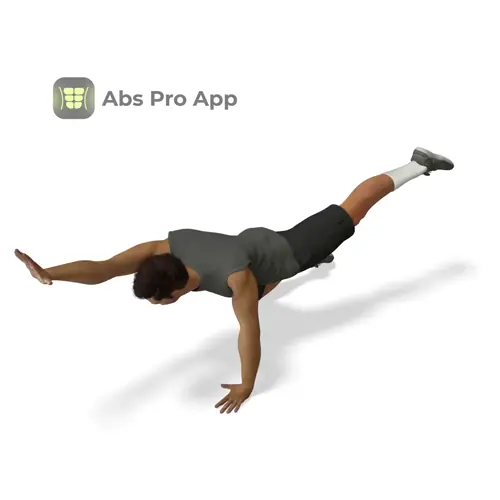
Form Cues
- Keep hips level
- Reach long, not high
- Brace the abs
- Neck in line with spine
- Press the floor away
- Move slowly and smoothly
Breathing & Bracing
Proper breathing is essential during the bird-dog hold to maintain stability without creating unnecessary tension. Before lifting your arm and leg, take a calm breath in through your nose. As you extend into the hold, gently tighten your core as if zipping up a snug jacket around your waist.
During the hold, continue breathing normally. Use slow nasal breaths if possible. A helpful rhythm is to inhale for about three seconds and exhale for about three seconds while holding the position. Your ribs should stay down and not flare upward as you breathe.
Avoid holding your breath, as this often leads to stiffness or loss of balance. The goal is to brace without locking up. If you feel your lower back arching or your hips shifting, slightly reduce the lift height and refocus on controlled breathing.
Common Mistakes
- Arching the lower back, fix by tightening the abs more.
- Lifting the arm or leg too high, fix by staying in line with the torso.
- Shifting weight to one side, fix by pressing evenly through both hands.
- Holding the breath, fix by using slow steady breathing.
- Rushing into the position, fix by moving slowly.
- Letting the head drop, fix by keeping the neck neutral.
How It Should Feel
Quick Self-Check: When done correctly, you should feel steady tension through your abs and lower back, with your glutes helping to support the extended leg. Your shoulders should feel active but not strained.
Good signs:
- You can hold the position without wobbling.
- Your breathing stays calm and controlled.
- You feel balanced from side to side.
Warning signs:
- Sharp pain in the lower back or shoulders, stop immediately.
- Strong neck tension.
- Loss of balance or shaking that you cannot control.
If you feel it mostly in your lower back, lower the leg slightly and increase abdominal bracing. If you feel neck strain, gently tuck your chin and look straight down.
Alternative Names
Quadruped opposite arm leg hold, Bird dog isometric hold
Variations
Easier
- Bird-dog arm only: Extend just one arm forward while keeping both knees down.
- Bird-dog leg only: Extend one leg straight back while hands stay planted.
- Short lever bird-dog: Lift arm and leg but keep them slightly bent.
Harder
- Bird-dog with knee to elbow: From the hold, slowly bring elbow and knee together, then re-extend.
- Bird-dog hold with pause: Add a longer hold while maintaining perfect alignment.
- Hover bird-dog: Slightly lift the supporting knee off the floor for more challenge.
Sample Workout
Core Stability Workout
- Dead bug, 8 reps per side
- Bird-dog hold, 20 to 30 seconds per side
- Side plank, 20 seconds per side
- Glute bridge hold, 30 seconds
Rest 60 seconds between rounds and repeat for 2 to 3 rounds. Focus on control and quality, not speed.
Progression Plan
Week 1: Perform bird-dog holds for 15 to 20 seconds per side, 2 to 3 sets. Rest about 30 to 45 seconds between sides. Focus on perfect alignment and smooth breathing.
Week 2: Increase hold time to 25 to 30 seconds per side. Reduce rest slightly and aim for less shifting in the hips and shoulders.
Week 3: Extend holds to 35 to 45 seconds per side, or add a brief 2 second pause at full extension to increase difficulty.
Once you can hold 40 plus seconds per side with full control and calm breathing, progress to advanced variations such as knee to elbow or hover bird-dog. If form breaks down, repeat the previous week instead of progressing.
FAQ
How long should I hold the bird-dog hold?
Most people benefit from holding 15 to 40 seconds per side, depending on control.
Is a rep counted per side or both sides?
One full set includes holding both the left and right side.
Should my lifted leg be completely straight?
Yes, the leg should be straight and in line with the torso, not bent.
Can I use this exercise for lower back support?
Yes, when done correctly it helps reinforce spinal stability.
Why do I feel shaky?
Shaking usually means your stabilizing muscles are working hard, reduce hold time if needed.
Summary
The bird-dog hold is a powerful yet simple tool for building real core stability. By focusing on control, balance, and breathing, you train your abs to support your spine the way they are meant to in daily life and sports.
Take your time with this exercise. Quality matters far more than duration. With consistent practice and smart progressions, the bird-dog hold can become a foundation movement in your core training routine.
Get Defined Abs in 30 Days
This exercise is part of our complete 30-day ab program. Download the app for structured daily workouts and track your progress.