
Bent Legs Hip Lift Tutorial
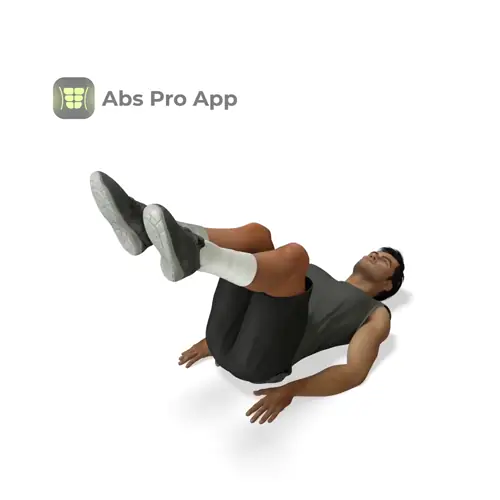
The Bent Legs Hip Lift is a beginner-friendly abs exercise performed on your back with your legs bent and lifted. It focuses on lifting the hips off the floor using your core, especially the lower abs. This move is ideal if you are learning how to do lower ab exercises without equipment or strain on the neck.
It works well for beginners, home workouts, and anyone following a step-by-step abs tutorial. The main focus is controlled movement, slow tempo, and using your abs to curl the hips upward rather than swinging the legs.
Benefits
- Strengthens the lower abdominal muscles
- Improves core control and awareness
- Low neck and spine strain when done correctly
- Great foundation for harder ab exercises
- No equipment needed, perfect for home workouts
- Helps learn posterior pelvic tilt control
- Can improve overall core stability
Setup & Starting Position
Lie flat on your back on a comfortable surface such as a mat or carpet. Bend your knees to about 90 degrees and lift your legs so your thighs are roughly vertical and your shins are parallel to the floor. Your feet should be relaxed, not touching the ground.
Place your arms down by your sides with your palms pressing gently into the floor. This gives you stability but should not be used to push your hips up. Keep your head, neck, and shoulders relaxed on the ground, eyes facing up.
Before starting the first rep, gently tighten your abs by pulling your belly button slightly inward and flattening your lower back toward the floor. This sets your core and protects your lower back.
Setup tip: If your lower back is arching, bring your knees slightly closer to your chest to regain control.
How To Do Bent legs hip lift (Step-by-step)
- Lie on your back with knees bent and legs lifted
- Arms stay on the floor, palms down for balance
- Brace your core and press your lower back gently into the floor
- Slowly curl your hips upward, lifting them a few inches
- Think about pulling your knees toward your chest without swinging
- Pause briefly at the top with hips off the ground
- Lower your hips back down slowly and with control
- Reset your core before starting the next rep
Form Cues
- Lift hips, not legs
- Move slow and controlled
- Neck and shoulders relaxed
- No swinging or momentum
- Small but strong movement
Breathing & Bracing
Proper breathing is key for getting the most out of this exercise. Start each rep by inhaling gently through your nose while your hips are on the floor. As you begin to lift your hips, exhale slowly through your mouth.
During the lift, lightly brace your core as if tightening a belt around your waist. This helps keep your ribs down and your pelvis tucked without holding your breath. Avoid pushing your stomach outward.
A simple breathing rhythm you can repeat is inhale at the bottom, exhale as you lift, brief pause, then inhale again as you lower. This keeps your movement controlled and prevents unnecessary tension.
If you feel yourself holding your breath, slow the reps down and focus on smoother exhales.
Common Mistakes
- Swinging the legs, fix by slowing down and lifting only the hips
- Pushing with arms, fix by using arms only for balance
- Arching the lower back, fix by bracing abs before lifting
- Lifting too high, fix by focusing on a small controlled curl
- Neck tension, fix by relaxing shoulders and jaw
- Rushing reps, fix by using a steady tempo
How It Should Feel
Quick Self-Check: You should feel strong tension in the lower abs during the lift and controlled effort as you lower back down.
Good signs:
- Burning or tightening in the lower abs
- Stable upper body with no neck strain
- Smooth, controlled movement
Warning signs:
- Sharp pain in the lower back, stop immediately
- Hip flexors doing all the work
- Neck or shoulder discomfort
If you feel it mostly in your neck or back, reduce the range of motion and slow the tempo. Focus on pressing your lower back into the floor before lifting.
Alternative Names
Bent knee hip lift, Bent leg reverse crunch
Variations
Easier
- Assisted bent legs hip lift, keep knees closer to chest and lift hips slightly
- Isometric hip lift hold, lift hips and hold for 5 to 10 seconds
Harder
- Slow tempo bent legs hip lift, take 3 to 4 seconds to lift and lower
- Extended hold hip lift, pause at the top for longer before lowering
Sample Workout
Core Stability Workout
- Bent Legs Hip Lift, 3 sets of 10 to 12 reps
- Dead Bug, 3 sets of 8 reps per side
- High Plank, 3 sets of 20 to 30 seconds
- Glute Bridge, 3 sets of 12 reps
Rest 30 to 45 seconds between exercises. Focus on control and breathing rather than speed.
Progression Plan
Week 1: Perform 2 to 3 sets of 8 to 10 reps. Focus on learning the technique, slow tempo, and breathing. Rest 45 seconds between sets.
Week 2: Increase to 10 to 12 reps per set. Add a brief 1 second pause at the top of each rep. Maintain control and avoid swinging.
Week 3: Move to 3 sets of 12 to 15 reps or slow the lowering phase to 3 seconds. Reduce rest to 30 seconds if form stays strong.
If you lose lower back control or start swinging, repeat the previous week. Once you can perform all reps with smooth control, you can try advanced variations like longer pauses or slower tempo.
FAQ
Is this exercise good for beginners?
Yes, it is a great beginner abs exercise because it uses a small range of motion and low neck strain.
How many reps should I do?
Start with 8 to 10 reps and build up to 12 to 15 with good form.
Is this the same as a reverse crunch?
It is similar, but the bent legs hip lift focuses more on controlled hip movement.
Can I do this every day?
Yes, if volume is moderate and form stays clean.
Why do my hip flexors feel tired?
This usually means you are lifting your legs instead of curling your hips.
Summary
The Bent Legs Hip Lift is a simple yet effective way to build lower ab strength and core control. By focusing on small, precise movements and proper breathing, you can make this exercise highly effective without equipment.
Keep your reps slow, your core engaged, and your lower back protected. With consistent practice, this move can become a solid foundation in your abs training routine and help prepare you for more advanced core exercises.
Get Defined Abs in 30 Days
This exercise is part of our complete 30-day ab program. Download the app for structured daily workouts and track your progress.