
Bear Plank To Cross Knee Tutorial
Bear Plank to Cross Knee is a dynamic core exercise performed from an extended bear plank position on your hands with your knees hovering just off the floor. From there, you drive one knee diagonally under your torso toward your chest, then return to the starting position and alternate sides.
This move builds deep core strength, shoulder stability, and hip control while also challenging coordination. It is best suited for intermediate trainees who already feel comfortable holding a bear plank and want a guide on how to progress it with controlled movement. Focus on slow, deliberate knee drives and keeping your torso steady.
Benefits
- Strengthens deep core muscles
- Improves shoulder stability under load
- Builds hip mobility and control
- Enhances coordination and balance
- Teaches core bracing during movement
- Raises heart rate without equipment
Setup & Starting Position
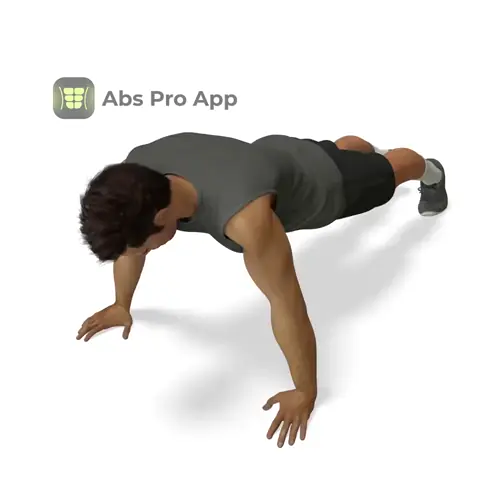
Begin on the floor on all fours and place your hands slightly forward of your shoulders, fingers spread wide for stability. Your knees should be bent and hovering a few inches off the ground, directly under or slightly behind your hips. This is the extended bear plank position.
Shift your weight evenly through both hands and toes. Your arms stay straight, elbows locked but not hyperextended. Set your spine in a neutral position with your head in line with your torso, eyes looking down at the floor.
Before starting the first rep, lightly tuck your pelvis and tighten your abs as if preparing to be poked in the stomach. Your back should be flat, not rounded or sagging. A helpful setup tip is to imagine balancing a glass of water on your lower back and not letting it spill.
How To Do Bear plank to cross knee (Step-by-step)
- Set up in an extended bear plank on your hands with knees hovering.
- Brace your core and shift slightly into your hands.
- Lift one foot and drive that knee diagonally under your torso toward your chest.
- Keep hips low and shoulders steady as the knee moves.
- Pause briefly at the end of the knee drive with control.
- Extend the leg back to the starting bear plank position.
- Repeat on the opposite side.
- Continue alternating sides for the desired reps, one rep equals both sides.
- Finish by gently lowering your knees to the floor.
Form Cues
- Hands press firmly into the floor
- Knees stay low and controlled
- Flat back from head to hips
- Move slow and deliberate
- Hips stay square to the floor
- Neck stays relaxed
Breathing & Bracing
Proper breathing is key to getting the most out of the Bear Plank to Cross Knee. Start each set by taking a calm inhale through your nose as you set your position. As you drive one knee under your torso, gently exhale through your mouth while keeping your abs tight.
Think about wrapping your abdominal muscles around your spine without holding your breath. Your rib cage should stay down and stacked over your hips, not flaring up as the leg moves. A steady breathing rhythm helps maintain control.
A simple pattern you can repeat is inhale in the bear plank, exhale as the knee moves in, then inhale again as the leg extends back. This keeps your core engaged and prevents unnecessary tension in your neck and shoulders.
Common Mistakes
- Letting the hips rise, fix by lowering them and slowing down.
- Rounding the upper back, fix by pressing the chest slightly forward.
- Rushing the knee drive, fix by using a controlled tempo.
- Shifting weight side to side, fix by bracing harder through the core.
- Bending the arms, fix by locking in straight arms.
- Holding the breath, fix by timing exhales with the knee drive.
How It Should Feel
Quick Self-Check:
You should feel strong tension through your abs and a steady burn in your shoulders as you hold yourself up. Your hips and core should feel challenged to stay stable as each knee crosses under your body. Breathing should feel controlled, not strained.
Good signs include shaking in the core and shoulders, steady balance, and the ability to move the knee without your torso twisting. You may also feel your hip flexors working as the knee drives in.
Warning signs include sharp pain in the shoulders, wrists, or lower back. If you feel pinching or pain, stop the set. If you feel it mostly in your neck, relax your shoulders and look slightly forward. If your lower back feels strained, slow down and focus on keeping your ribs down and abs tight.
Alternative Names
Bear plank knee cross, Diagonal bear plank knee drive
Variations
Easier
- Bear plank hold, hold the extended bear plank without moving the legs.
- Bear plank knee lift, lift one knee slightly without crossing under the torso.
- Short range cross knee, bring the knee only partway under the body.
Harder
- Slow tempo bear plank to cross knee, take 3 to 4 seconds to move the knee in and out.
- Paused cross knee, pause for 2 seconds when the knee is under the torso.
- Bear plank to cross knee push-back, add a small push back into the shoulders before alternating sides.
Sample Workout
You can use this exercise as a core-focused strength movement or in a conditioning circuit.
- Warm-up
Cat-cow x 6
Glute bridges x 12 - Main circuit
Bear Plank to Cross Knee x 8 reps (both sides count as one rep)
Bodyweight squats x 15
Push-ups x 10
Rest 60 seconds and repeat 3 rounds - Finisher
Bear plank hold 30 to 45 seconds
Progression Plan
Week 1
Practice the movement with perfect control. Perform 2 to 3 sets of 6 reps, counting one rep as both sides. Rest 60 to 90 seconds between sets. Focus on slow knee drives and keeping your hips level.
Week 2
Increase to 8 to 10 reps per set and reduce rest to about 60 seconds. Begin adding a brief pause when the knee is under your torso to increase tension.
Week 3
Move to a slower tempo, taking 3 seconds to bring the knee in and 3 seconds to extend it back. Keep reps at 8 per set. If form breaks down, repeat Week 2.
Week 4
Progress to an advanced variation such as paused or slow tempo reps. Use 3 to 4 sets with strong bracing. Repeat a week anytime your control or breathing starts to slip.
FAQ
How many reps should I do?
Start with 6 to 10 reps, where one rep includes both left and right knee drives.
Should my knees touch the floor?
No, the knees should stay hovering a few inches above the floor the entire set.
Is this more of a core or shoulder exercise?
It is primarily a core exercise, but your shoulders work hard to stabilize your body.
Can I do this every day?
You can, but allow rest if your shoulders or core feel overly fatigued.
Why do my hips twist?
Hip twisting usually means the movement is too fast or the core is not braced enough.
Summary
The Bear Plank to Cross Knee is a powerful bodyweight move that teaches your core to stay strong while your limbs move. When done with control, it builds real-world stability and strength without any equipment.
Take your time mastering the setup and breathing, and let quality lead the way instead of speed. As your control improves, this exercise can become a staple in your abs workouts or full-body routines. Stay patient, stay braced, and enjoy the challenge.
Get Defined Abs in 30 Days
This exercise is part of our complete 30-day ab program. Download the app for structured daily workouts and track your progress.