
Bear Plank Shoulder Tap Tutorial
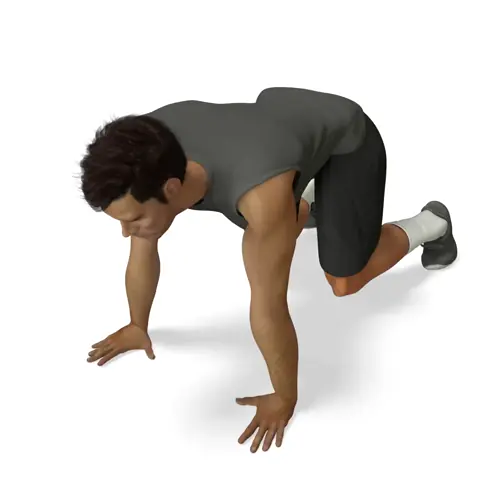
Bear plank shoulder tap is a challenging core stability exercise performed from a bear plank position with knees hovering just off the floor. From this position, you lift one hand at a time to tap the opposite shoulder. This move trains deep abs, shoulders, and hips to resist rotation while your body supports itself on fewer contact points.
It is ideal for intermediate to advanced trainees who want better core control, shoulder stability, and full-body tension. Focus on slow, controlled taps, quiet hips, and steady breathing to get the most benefit.
Benefits
- Builds deep core stability
- Improves anti-rotation strength
- Strengthens shoulders and arms
- Trains coordination and balance
- Improves hip control
- Reinforces proper plank alignment
- Challenges full-body tension
Setup & Starting Position
Begin on all fours on the floor. Place your hands directly under your shoulders with fingers spread wide for grip. Knees are bent and positioned under your hips, toes tucked into the floor.
From here, hover your knees about 2 to 5 cm off the ground. Your back should be flat, not rounded or sagging, with your head in line with your spine. Gaze down between your hands.
Distribute your weight evenly between both hands and both feet. Your hips should stay low, roughly level with your shoulders, creating a compact, strong base. Before starting the first tap, gently tighten your abs as if bracing for a cough.
Setup tip: Think about pushing the floor away with your hands to engage your shoulders and upper back before you move.
How To Do Bear plank shoulder tap (Step-by-step)
- Set up in a stable bear plank with knees hovering.
- Brace your core and shift weight slightly into your left hand and feet.
- Lift your right hand and tap your left shoulder.
- Place the right hand back under the shoulder with control.
- Shift weight to the right hand and feet.
- Lift your left hand and tap your right shoulder.
- Return the hand to the floor and regain balance.
- Continue alternating sides at a slow, steady tempo.
- Finish by lowering knees to the floor with control.
Form Cues
- Keep hips as still as possible
- Knees hover low, not high
- Back stays flat
- Tap softly, no slapping
- Push the floor away
- Neck stays neutral
Breathing & Bracing
Breathing correctly during bear plank shoulder taps helps maintain control and reduce unnecessary tension. Start by taking a calm inhale through your nose before the first tap. As you lift one hand to tap the opposite shoulder, slowly exhale through your mouth.
Between taps, take short controlled inhales without letting your ribs flare or your belly relax. Think about gently tightening your abs as if wrapping them around your spine, not sucking in.
A simple rhythm is inhale while stable on both hands, exhale during each shoulder tap. Avoid holding your breath, as this often leads to hip shifting and neck tension. Your goal is steady breathing while maintaining full-body stiffness.
Common Mistakes
- Hips swaying side to side, slow the tempo and widen your stance.
- Knees lifting too high, lower them closer to the floor.
- Rounding the back, reset and brace the abs.
- Rushing the taps, pause briefly to regain balance.
- Shoulders collapsing, actively push through the planted hand.
- Holding breath, switch to slow nasal breathing.
How It Should Feel
Quick Self-Check:
You should feel strong tension through your abs, especially deep in the core, along with steady work in the shoulders and hips. Your body should feel compact and controlled rather than loose or shaky.
Good signs:
- Hips stay mostly level
- Abs feel engaged throughout
- Shoulders feel stable and strong
Warning signs:
- Sharp pain in shoulders or wrists, stop the exercise
- Lower back discomfort, reset your brace or regress the movement
If you feel strain in the neck, lower your gaze and relax your jaw. If the lower back takes over, slow down and focus on tightening your abs before each tap.
Alternative Names
Bear plank taps, Bear crawl shoulder tap
Variations
Easier
- Static bear plank hold, hold the hover position without tapping.
- Wide stance bear plank shoulder tap, place feet wider to increase stability.
- Bear plank with alternating hand lift, lift hand without tapping the shoulder.
Harder
- Slow tempo bear plank shoulder tap, take 3 to 4 seconds per tap.
- Paused bear plank shoulder tap, pause for 2 seconds during the tap.
- Bear plank shoulder tap plus knee lift, slightly lift the opposite knee during the tap.
Sample Workout
Core Stability Workout
- Bear plank shoulder tap, 3 sets of 10 reps per side
- Dead bug, 3 sets of 8 reps per side
- Side plank, 3 sets of 30 seconds per side
- Glute bridge hold, 3 sets of 40 seconds
Rest 45 to 60 seconds between sets. Perform the bear plank shoulder taps slowly and early in the workout while fresh.
Progression Plan
Week 1: Practice static bear plank holds and wide stance shoulder taps. Perform 3 sets of 6 to 8 reps per side with full control and 60 seconds rest.
Week 2: Narrow the stance slightly and increase to 8 to 10 reps per side. Focus on quieter hips and smoother breathing.
Week 3: Slow the tempo to 2 to 3 seconds per tap. Keep reps the same but reduce rest to 45 seconds.
Week 4: Add a brief pause during each tap or progress to an advanced variation. If form breaks down, repeat the previous week.
Progress only when you can keep hips steady and breathing controlled throughout all sets.
FAQ
How many reps should I do?
Start with 6 to 10 taps per side. One tap to one shoulder counts as one rep.
Should my knees touch the floor?
No, knees should hover slightly above the floor for the bear plank position.
Can I do this every day?
Yes, if volume is low and form stays solid, but allow rest if shoulders feel fatigued.
Why do my hips keep moving?
This usually means the movement is too fast or your stance is too narrow.
Is this safe for wrists?
If wrists are sensitive, warm them up well and keep weight evenly distributed.
Summary
Bear plank shoulder taps are a powerful way to build real-world core strength and shoulder stability using only your bodyweight. When performed with control, they teach your body to resist unwanted movement while staying strong and balanced.
Stay patient with the progression, prioritize form over speed, and use easier variations when needed. With consistency, this exercise will carry over to better posture, stronger lifts, and improved athletic performance.
Get Defined Abs in 30 Days
This exercise is part of our complete 30-day ab program. Download the app for structured daily workouts and track your progress.