
Back Extension Side Reach Tutorial
Back Extension Side Reach is a gentle, no-equipment bodyweight exercise done lying face down on the floor. It combines a light back extension with controlled side-to-side rotation to train your core muscles, especially the lower back and obliques. This move is great for beginners or anyone learning how to improve spinal control, posture, and rotational stability.
Focus on slow, smooth movement, keeping your legs and hips stable while your upper body does the work. It works well in warm-ups, core circuits, or low-impact strength routines.
Benefits
- Improves lower back endurance
- Trains core rotation control
- Supports better posture
- Strengthens obliques without equipment
- Enhances mind muscle connection
- Low impact and joint friendly
- Balances front and back core work
Setup & Starting Position
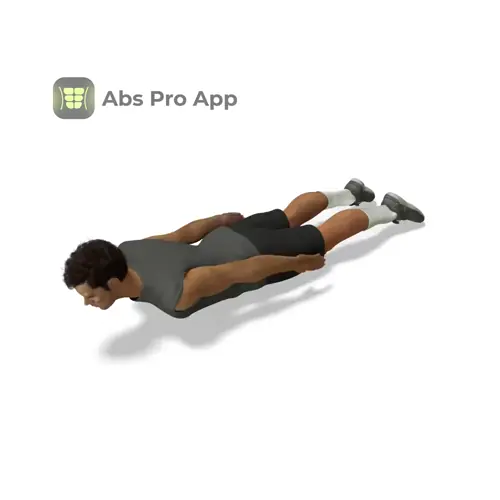
Lie flat on your stomach on a comfortable surface such as a mat or carpeted floor. Extend your legs straight behind you with your feet together and toes pointing back. Your hips and thighs stay in contact with the floor throughout the movement.
Place your arms long along the sides of your body, with palms facing your thighs. Gently draw your shoulders back and down so your chest opens slightly. From here, lift your chest just a few inches off the floor. Your neck stays long, with your gaze down toward the floor.
Before starting, lightly tighten your abs and glutes to create a stable base. This brace helps protect your lower back and keeps the movement controlled.
Setup tip: Think about lengthening through the crown of your head rather than lifting as high as possible.
How To Do Back extension side reach (Step-by-step)
- Lie face down with legs straight, together, and relaxed.
- Extend arms along your sides, palms facing inward.
- Gently lift your chest a few inches off the floor.
- Brace your abs and squeeze your glutes lightly.
- Rotate your upper body slowly to the right.
- Return through center with control.
- Rotate your upper body slowly to the left.
- That left and right rotation equals one rep.
- Move at a steady, slow tempo.
- Lower your chest back down after finishing all reps.
Form Cues
- Chest lifted, not cranked up
- Neck long and relaxed
- Rotate from the ribs
- Hips stay heavy on the floor
- Slow and controlled motion
- Abs gently braced
Breathing & Bracing
Start each rep with a calm inhale through your nose while holding the lifted chest position. As you rotate to one side, slowly exhale through your mouth, letting the breath help you stay relaxed and controlled.
As you return through the center and rotate to the other side, take another smooth exhale. Keep breathing continuously rather than holding your breath.
For bracing, gently tighten your abs as if preparing for a light cough. This should be about a 3 out of 10 effort. Your ribs should stay down and connected to your core, not flaring upward. Your hips remain stable against the floor.
A simple rhythm to repeat is: inhale to prepare, exhale during each rotation.
Common Mistakes
- Lifting the chest too high, fix by lowering the range.
- Pulling with the neck, fix by keeping eyes down.
- Rocking the hips, fix by squeezing glutes lightly.
- Moving too fast, fix by slowing each rotation.
- Holding breath, fix by exhaling during rotation.
- Letting arms drift away from sides, fix by keeping them close.
How It Should Feel
Good signs:
- Gentle work in the lower back and sides of the core
- Even tension on both sides during rotation
- Ability to control the movement smoothly
Warning signs:
- Sharp pain in the lower back, stop immediately
- Pinching in the spine, reduce range or stop
If you feel it mostly in your neck, lower your chest height and relax your shoulders. If your lower back feels strained, tighten your abs more and shorten the rotation range.
Alternative Names
Prone side rotation back extension
Variations
Easier
- Reduced Range Side Reach, lift chest very slightly and rotate only a few inches.
- Alternating Holds, rotate to one side and return to center before switching sides.
Harder
- Paused Side Reach, hold each side rotation for 2 to 3 seconds before switching.
- Slow Tempo Side Reach, take 4 seconds to rotate each direction.
Sample Workout
Core Stability Workout
- Dead Bug, 8 reps per side
- Glute Bridge Hold, 30 seconds
- Back Extension Side Reach, 8 to 12 reps
- Side Plank, 20 seconds per side
Rest 45 to 60 seconds and repeat the circuit 2 to 3 times. Use controlled tempo on all movements.
Progression Plan
Week 1: Perform 2 sets of 8 reps. Focus on learning the technique, keeping the chest lift low and the rotations smooth. Rest 60 seconds between sets.
Week 2: Increase to 2 or 3 sets of 10 to 12 reps. Maintain strict control and even tempo on both sides. Rest 45 to 60 seconds.
Week 3: Add a brief 2 second pause at each side rotation or slow the tempo to 3 to 4 seconds per rotation. Keep reps at 8 to 10.
Only move to advanced variations when you can complete all reps without losing hip stability or neck position. If control slips, repeat the previous week.
FAQ
How many reps should I do per set?
Most beginners do well with 8 to 12 reps, where one rep includes both left and right rotations.
Is this exercise safe for beginners with weak backs?
Yes, when done with a small chest lift and slow control, but stop if pain appears.
Should my legs lift off the floor?
No, your legs and hips stay grounded the entire time.
Can I add this to a warm-up?
Yes, use lower reps and smaller range to gently activate the back and core.
Summary
The Back Extension Side Reach is a simple but effective way to train your core and lower back with control and precision. By focusing on slow rotation, steady breathing, and proper bracing, you build strength that supports posture and daily movement.
Use it as part of a balanced core routine, progress gradually, and always prioritize quality over range. With consistency, this exercise can help improve both stability and confidence in your core training.
Get Defined Abs in 30 Days
This exercise is part of our complete 30-day ab program. Download the app for structured daily workouts and track your progress.