
Arm And Leg Raises Tutorial
Arm and Leg Raises are a classic bodyweight core exercise performed lying face down on the floor. This movement trains your abs, lower back, and glutes to work together, helping improve core stability, posture, and coordination.
It is a beginner-friendly exercise often used in core workouts, warm-ups, and rehab-style training. The focus is not speed or height, but control, keeping your body stable while lifting opposite arm and leg. If you are looking for a simple guide on how to build core control without equipment, this exercise is a great place to start.
Benefits
- Builds deep core stability
- Strengthens lower back muscles
- Improves coordination between sides of the body
- Helps support healthy posture
- Low impact and joint friendly
- Good for warm-ups and recovery days
- Requires no equipment
Setup & Starting Position
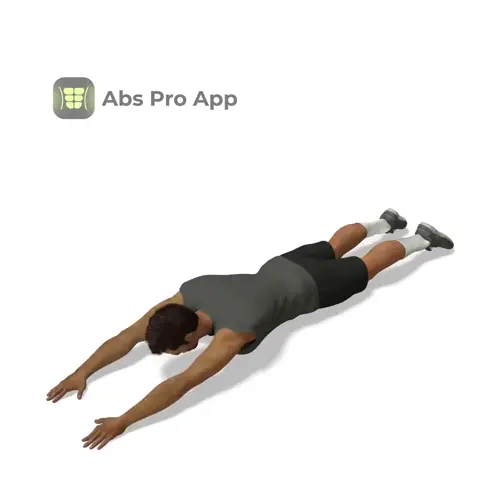
Start by lying face down on a flat, comfortable surface such as a mat or carpeted floor. Extend both arms straight overhead so your biceps are close to your ears and your palms face down toward the floor.
Keep your legs straight with your toes resting lightly on the ground. Your legs should be hip-width apart or slightly narrower, whichever feels more natural and stable. Let your forehead rest gently on the floor so your neck stays neutral, not cranked upward.
Before you begin, lightly tighten your abs as if preparing for a gentle cough. This helps keep your hips and lower back stable. Your body should form a long straight line from fingertips to toes.
Quick setup tip: Think about reaching long rather than lifting high. Length through the body helps protect your lower back.
How To Do Arm and leg raises (Step-by-step)
- Lie face down with arms extended overhead and legs straight.
- Brace your abs gently to stabilize your core.
- Lift your right arm and left leg a few inches off the floor.
- Keep hips and shoulders facing the ground.
- Pause briefly at the top with control.
- Lower the arm and leg slowly back to the floor.
- Lift your left arm and right leg.
- Continue alternating sides for the desired reps.
- Finish by relaxing fully on the floor.
Form Cues
- Reach long, not high
- Keep hips flat on the floor
- Neck stays neutral
- Slow and controlled movement
- Abs lightly engaged
- No swinging or jerking
Breathing & Bracing
Breathing correctly during Arm and Leg Raises helps you stay relaxed while maintaining core control. Before lifting, take a calm inhale through your nose. As you raise your arm and opposite leg, slowly exhale through your mouth while gently tightening your abs.
Think about drawing your belly button slightly away from the floor without flattening or arching your lower back. This creates a supportive brace around your spine.
A simple breathing rhythm you can repeat is inhale to prepare, exhale during the lift, then inhale again as you lower back down. Avoid holding your breath, since this often leads to unnecessary tension in the neck and lower back.
If you notice your breathing becoming rushed, slow down the movement and focus on smooth, steady breaths.
Common Mistakes
- Lifting too high, fix it by focusing on length instead of height.
- Arching the lower back, fix it by tightening the abs before lifting.
- Twisting the hips, fix it by moving slower and with control.
- Looking forward, fix it by keeping the forehead close to the floor.
- Rushing reps, fix it by pausing briefly at the top.
How It Should Feel
Quick Self-Check:
You should feel gentle but steady work in your abs, lower back, and glutes. The muscles should feel active, not strained. Each rep should feel controlled, with both sides of your body working evenly.
Good signs:
- Core feels engaged without holding breath
- No pressure in the lower back
- Movement feels smooth and balanced
Warning signs:
- Sharp pain in the lower back, stop immediately
- Neck strain or tension
If you feel it mostly in your lower back, reduce the lift height and tighten your abs more. If your neck feels tight, relax your shoulders and keep your gaze down.
Alternative Names
Prone opposite arm and leg raise, Swimmer exercise
Variations
Easier
- Single Limb Raise, lift only one arm or one leg at a time to reduce balance demands.
- Bent Knee Leg Raise, bend the lifting leg slightly to make it easier.
Harder
- Alternating Arm and Leg Raise with Hold, pause for 3 to 5 seconds at the top of each rep.
- Continuous Swimmers, smoothly switch sides without resting on the floor.
Sample Workout
Core Stability Workout
- Arm and Leg Raises, 3 sets of 10 reps per side
- Glute Bridge, 3 sets of 12 reps
- Dead Bug, 3 sets of 8 reps per side
- Front Plank, 3 sets of 20 to 30 seconds
Rest 45 to 60 seconds between exercises. Focus on slow, controlled technique rather than speed.
Progression Plan
Week 1: Perform 2 to 3 sets of 6 to 8 reps per side. Move slowly and focus on keeping hips and shoulders flat. Rest about 60 seconds between sets.
Week 2: Increase to 8 to 10 reps per side. Add a 2 second pause at the top of each rep to improve control. Keep rest periods the same.
Week 3: Progress to 10 to 12 reps per side or reduce rest to 45 seconds. Focus on smoother transitions between sides.
Move to advanced variations once you can complete all reps without hip movement or lower back discomfort. If form breaks down, repeat the previous week until control improves.
FAQ
FAQ
How high should I lift my arm and leg?
Only a few inches off the floor, just enough to feel your muscles engage.
Is one rep both sides or one side?
One rep usually refers to lifting one arm and the opposite leg. Make sure to perform equal reps on both sides.
Can I do this exercise every day?
Yes, as long as it feels comfortable and you maintain good form.
Why do my hips move during the lift?
This often means the movement is too fast or too high. Slow down and brace your abs.
Is this good for lower back health?
Yes, when done with control, it helps strengthen muscles that support the spine.
Summary
Arm and Leg Raises are a simple but powerful way to build core stability and body awareness. By focusing on slow, controlled movement and proper breathing, you can strengthen your abs and lower back without equipment.
Use this exercise as part of your warm-up, core training, or recovery routine. Mastering this basic technique lays the foundation for more advanced core exercises and healthier movement overall.
Get Defined Abs in 30 Days
This exercise is part of our complete 30-day ab program. Download the app for structured daily workouts and track your progress.