
Airplane With Leg Lift Tutorial
Airplane with leg lift is a beginner friendly, no-equipment core and back exercise done lying face down on the floor. It trains your deep abs, lower back, and glutes while improving coordination and posture.
This move is great if you are looking for a how to guide that teaches control rather than speed. By lifting one arm and the opposite leg at a time, you challenge anti-rotation strength and spinal stability. Focus on slow, clean technique, keeping your chest lifted and your limbs long. It fits well into warm-ups, rehab-style core work, or low-impact ab workouts.
Benefits
- Builds deep core stability
- Strengthens lower back muscles
- Improves left-right coordination
- Supports better posture
- Low impact on joints
- Enhances mind-muscle connection
- Helps balance strength between sides
Setup & Starting Position
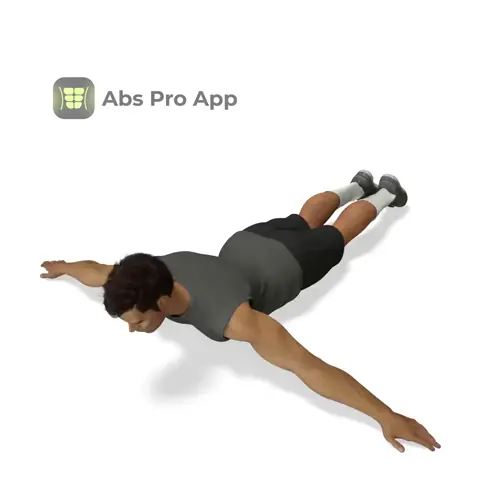
Lie face down on a mat or comfortable floor surface. Extend your legs straight behind you with your toes pointing lightly into the floor. Spread your arms out to the sides so your body forms a long T shape, palms facing down.
Before starting the first rep, gently lift your chest a few centimeters off the floor by engaging your lower back and squeezing your glutes lightly. Your head should stay in line with your spine, eyes looking down at the floor. Keep your legs straight and relaxed, but active.
Brace your core as if you are gently tightening a belt around your waist. This helps protect your lower back during the movement.
Setup tip: Think about reaching your fingers and toes away from your body to create length before you lift.
How To Do Airplane with leg lift (Step-by-step)
- Start lying face down with arms in a T and legs straight.
- Engage your core and lift your chest slightly off the floor.
- Slowly raise your right arm and left leg at the same time.
- Lift only as high as you can without twisting your hips.
- Pause briefly at the top under control.
- Lower the arm and leg back to the floor.
- Switch sides, lifting left arm and right leg.
- Continue alternating sides for the set.
- Move slowly and keep tension the whole time.
- Finish the set by lowering fully and relaxing.
Form Cues
- Keep hips pressed evenly into the floor
- Reach long, not high
- Neck neutral, eyes down
- Move slow and controlled
- Abs lightly braced
- Glutes engaged, not clenched
Breathing & Bracing
Proper breathing helps you control this movement and protect your lower back. Before lifting, take a gentle breath in through your nose and expand your ribs slightly. As you lift one arm and the opposite leg, slowly breathe out through your mouth.
Think about tightening your abs just enough to keep your ribs from flaring and your hips from rocking. You should not hold your breath. The brace should feel supportive, not stiff.
A simple rhythm you can repeat is inhale as you prepare, exhale as you lift, then inhale again as you lower. Keep the breath smooth and steady throughout the set.
If you feel your breathing getting rushed, slow the movement down and reset your brace before the next rep.
Common Mistakes
- Lifting too high and arching the lower back, fix by reducing range of motion.
- Twisting the hips, fix by pressing both hip bones into the floor.
- Rushing the reps, fix by slowing the tempo.
- Lifting the head and straining the neck, fix by keeping eyes down.
- Bending the raised leg, fix by keeping both legs straight.
- Holding the breath, fix by exhaling during the lift.
How It Should Feel
Quick Self-Check:
Good signs: You feel gentle tension in your abs, lower back, and glutes. Both sides feel equally challenged. The movement feels controlled and smooth. You can maintain steady breathing.
Warning signs: Sharp pain in the lower back means stop immediately. Neck strain or pinching sensations are signs your head position is off. Excessive hip rocking means the movement is too big.
If you feel it mostly in your neck, lower your chest slightly and lengthen the back of your neck. If you feel compression in your lower back, reduce how high you lift your arm and leg and focus more on core bracing.
Alternative Names
Alternating Superman T raise, Opposite arm and leg raise
Variations
Easier
- Arm-only airplane lift, lift just one arm at a time while keeping both legs on the floor.
- Leg-only prone lift, lift one leg at a time with both arms resting on the floor.
- Reduced range airplane, lift arm and leg only a few centimeters off the floor.
Harder
- Paused airplane with leg lift, hold the top position for 3 to 5 seconds each rep.
- Slow tempo airplane, take 3 seconds to lift and 3 seconds to lower.
Sample Workout
Core Stability Workout
- Airplane with leg lift, 3 sets of 8 to 10 reps per side
One rep equals lifting both sides once. - Dead bug, 3 sets of 10 reps
- Glute bridge hold, 3 sets of 20 to 30 seconds
- Bird dog, 2 sets of 8 reps per side
Rest 30 to 45 seconds between sets and focus on control.
Progression Plan
Week 1: Perform 2 to 3 sets of 6 to 8 reps per side. Focus on learning the technique, steady breathing, and keeping hips level. Rest 45 seconds between sets.
Week 2: Increase to 8 to 10 reps per side and add a brief 1 second pause at the top of each lift. Keep rest the same and prioritize control.
Week 3: Slow the tempo, taking 3 seconds to lift and 3 seconds to lower. Reduce reps slightly if needed to maintain form.
Progressing further: Move to the paused or slow tempo advanced variations once you can complete all reps without hip movement or back discomfort. Repeat a week if form breaks down or breathing becomes difficult.
FAQ
How many reps should I do per side?
Start with 6 to 10 controlled reps per side, counting one rep as both sides.
Can I do this exercise every day?
Yes, it is low impact and can be used daily if you keep volume moderate.
Why do my hips rock during the lift?
This usually means the lift is too high, reduce range and brace harder.
Is this safe for lower back sensitivity?
When done slowly with a small range, it is often well tolerated, but stop if pain appears.
Summary
The Airplane with leg lift is a simple but effective bodyweight move that builds core control and back strength without equipment. By focusing on slow movement, clean form, and steady breathing, you can get strong benefits even with low reps.
Use this exercise as part of a core workout, warm-up, or posture routine. Stay patient, keep your range controlled, and let quality guide your progress. Small, precise reps make a big difference over time.
Get Defined Abs in 30 Days
This exercise is part of our complete 30-day ab program. Download the app for structured daily workouts and track your progress.