
Ab Pulse Tutorial
Ab pulses are a simple, no-equipment core exercise performed from a seated, leaned-back position with bent knees and heels on the floor. They build abdominal endurance by keeping constant tension while you move in a very small range. This makes them great for beginners who want to learn how to brace the core without complex coordination.
This exercise works best when you focus on control, breathing, and keeping the ribs down instead of leaning too far back. If you are looking for a clear how to guide, tutorial-style instructions, and technique cues for safer core training at home, ab pulses are a strong place to start.
Benefits
- Builds core endurance without equipment
- Teaches constant abdominal tension
- Low impact and joint friendly
- Easy to scale up or down
- Improves posture awareness
- Great finisher for ab workouts
Setup & Starting Position
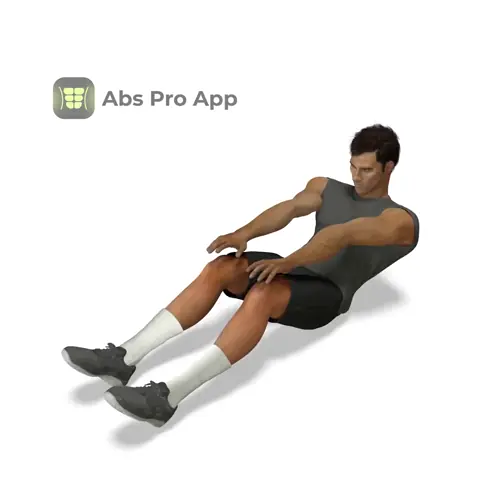
Sit on the floor with your knees bent and your heels planted lightly on the ground. Your toes can lift off the floor if that feels natural. Scoot your hips so you are balanced on your sit bones, not slouched on your tailbone.
Lean your torso back slightly, just enough that you feel your abs engage. Extend your arms straight forward toward your knees, with shoulders relaxed and down. Keep your chest open but ribs pulled in so your lower back stays long, not arched.
Your spine should be neutral, your head in line with your torso, and your gaze forward or slightly down toward your knees. Before starting, gently tighten your abs as if preparing for a cough.
Setup tip: If your lower back feels strained, sit taller and reduce the lean until you can hold tension comfortably.
How To Do Ab pulse (Step-by-step)
- Sit down and set your feet, knees bent and heels on the floor.
- Lean back slightly and extend your arms forward.
- Brace your core and keep your ribs down.
- Pulse your torso back an inch or two.
- Pulse forward to the starting lean without sitting upright.
- Keep the movement small and controlled.
- Continue pulsing while maintaining constant tension.
- Finish the set by sitting fully upright and relaxing.
Form Cues
- Small range, steady tension
- Ribs down, chest relaxed
- Long neck, no chin jut
- Abs tight, not hip thrusting
- Move slow and controlled
Breathing & Bracing
Breathing correctly during ab pulses helps you maintain tension without straining your neck or lower back. Before you begin pulsing, take a calm inhale through your nose. As you start the movement, gently tighten your abs as if you were zipping up tight pants.
Exhale lightly through your mouth during one or two pulses, then inhale again while keeping your core engaged. Avoid holding your breath, instead aim for smooth, quiet breaths that do not disturb your posture.
A simple rhythm is to inhale for two pulses and exhale for two pulses. Keep your ribs pulled down toward your hips as you breathe, so your stomach does not bulge outward. This teaches proper bracing and makes the exercise feel controlled rather than rushed.
Common Mistakes
- Leaning too far back, fix by sitting taller and reducing range.
- Rounding the lower back, fix by lifting the chest slightly.
- Using momentum, fix by slowing the pulses.
- Tensing the neck, fix by relaxing shoulders and gaze.
- Holding breath, fix by using a steady breathing rhythm.
How It Should Feel
Quick Self-Check: Done correctly, ab pulses should create a steady burn across the front of your abs.
Good signs: You feel tension in the abs the entire set, your breathing stays controlled, your torso moves only slightly, and your lower back feels supported.
Warning signs: Sharp pain in the lower back, strong pulling in the hip flexors, or neck strain. Stop if you feel sharp pain.
If you feel it mostly in your neck, lower the lean and relax your shoulders. If you feel it in your lower back, sit more upright and focus on pulling your ribs down. Small adjustments make a big difference.
Alternative Names
seated ab pulses
Variations
Easier
- Hands on thighs pulse: Place hands on thighs to reduce leverage and make control easier.
- Upright lean pulse: Reduce the backward lean and pulse closer to vertical.
Harder
- Feet lifted ab pulse: Lift heels off the floor while keeping knees bent.
- Straight leg ab pulse: Extend legs forward with heels lightly touching the floor.
- Long pause pulse: Pause for two seconds at the furthest lean back position.
Sample Workout
Beginner Core Workout
- Ab pulses: 3 sets of 20 to 30 pulses
- Glute bridge hold: 3 sets of 20 seconds
- Dead bug: 3 sets of 6 reps per side
- Rest 45 seconds between sets
Use ab pulses at the start to activate the core or at the end as a burn-out finisher.
Progression Plan
Week 1: Perform ab pulses 2 to 3 times per week. Do 3 sets of 20 pulses with a comfortable lean. Focus on learning proper bracing and breathing. Rest 45 to 60 seconds between sets.
Week 2: Increase to 25 to 35 pulses per set or slow the tempo slightly to increase time under tension. Keep the movement small and controlled.
Week 3: Add a brief one second pause at the furthest lean back position on each pulse. Reduce rest to 30 to 45 seconds.
Once you can complete 3 sets of 40 slow pulses with control and no back discomfort, move to advanced variations like feet lifted pulses. Repeat a week if form breaks down or tension is lost.
FAQ
How many pulses should I do per set?
Most beginners start with 20 to 30 controlled pulses.
Are ab pulses safe for lower backs?
Yes, if you keep a neutral spine and small range. Reduce the lean if discomfort appears.
Should my feet stay flat?
Heels should stay on the floor, toes can lift naturally.
Can I do ab pulses every day?
Yes, but keep volume moderate and focus on good technique.
Summary
Ab pulses are a simple but effective way to build core endurance using just your bodyweight. By keeping the range small and the tension constant, you train your abs to stay active and supportive.
Focus on posture, breathing, and control rather than speed. As your strength improves, small changes like lifting the feet or adding pauses can make the exercise more challenging without adding equipment. Stay consistent, listen to your body, and use ab pulses as a reliable tool in your core training routine.
Get Defined Abs in 30 Days
This exercise is part of our complete 30-day ab program. Download the app for structured daily workouts and track your progress.