

How Often Should You Train Abs? The Complete Guide for Real Results

Three-panel image of a man performing different ab exercises in a gym, illustrating how often should you train abs for core strength.

Should you train abs every day? Just once a week? Only at the end of workouts if you “have time”?

If you’ve ever wondered how often you should train your core to actually see results—and not just feel random soreness—this guide is for you.

We’ll walk through:

  • How many times per week to train abs

  • How much volume you really need

  • How to adjust your ab work based on your goal and experience level

  • Simple weekly plans you can follow

Quick Answer: How Many Times Per Week Should You Train Abs?

If you don’t read anything else, here’s the short version:

  • Beginners:
    2–3 ab sessions per week, 10–15 minutes each, with rest days in between.

  • Intermediate lifters:
    3–4 ab sessions per week, including some built into your main workouts.

  • Advanced trainees:
    3–5 focused core sessions per week, with smart variation and recovery.

You can do light core activation more often, but your hard ab workouts should have at least one day of rest between them for the same muscles.

Most people will see great results with:

10–20 total sets of direct ab work per week, spread over 2–4 days, plus big compound lifts.

Now let’s break down why.

What Actually Happens When You Train Abs

Your core muscles (rectus abdominis, obliques, deep stabilizers, etc.) work just like any other muscle group:

  1. You train them → They get challenged, slightly damaged, and fatigued.
  2. You recover → The body repairs them.
  3. You adapt → They come back stronger and more resilient.

If you never train abs:
They stay weak and underdeveloped, even if you’re lean.

If you overdo ab work with no recovery:
Your form falls apart, your lower back may complain, and progress stalls.

The sweet spot is enough stress to signal growth, plus enough rest to recover.

Factor #1 – Your Training Experience

How often you should train abs depends heavily on whether you’re a beginner, intermediate, or advanced.

Beginners

Group training in a gym with hanging leg raises, planks, and weighted moves, showing how often should you train your abs by experience level.If you’re new to core training or coming back after a long break:

  • Your muscles and connective tissues are still adapting.
  • Your technique needs repetition and focus.
  • You don’t need crazy volume to see progress.

Good starting point:

  • 2–3 sessions per week
  • 10–15 minutes each
  • 3–5 exercises per session (basic, safe moves)
Intermediates

If you’ve been training consistently for 6–18 months:

  • Your core can handle more work.
  • You can mix stability, anti-rotation, and more challenging exercises.

Good range:

  • 3–4 core sessions per week
  • Ab work attached to your main workouts (e.g., at the end of strength sessions)

Advanced

If you’ve been training seriously for a long time and want:

  • Visible, defined abs
  • Strong performance for sports or heavy lifting

You might do:

  • 3–5 ab-focused sessions per week
  • Possibly mixing heavy, high-tension core work with lighter activation sessions

But even advanced lifters don’t need brutal abs every single day. Smart training beats punishment.

Factor #2 – Training Intensity and Volume

It’s not just how often you train abs, it’s how hard you train them.

Volume basics

For most people, a good weekly target:

  • 10–20 sets of direct ab work per week
    • A “set” = 15–30 seconds of a plank or 8–15 controlled reps of a movement.

Examples:

  • 3 sessions × 4 sets = 12 total sets
  • 4 sessions × 4 sets = 16 total sets

Intensity basics

Your working sets should feel like:

  • You could do a few more reps or seconds, but not many.
  • You can maintain good form the whole time.

If every set is “to death” and your form collapses, you’re likely doing too much, too often.

Factor #3 – Your Overall Training Plan

Ab training doesn’t exist in a vacuum. Your weekly plan also includes:

  • Full-body strength or resistance training
  • Cardio or conditioning
  • Sports or other activities
  • Work, stress, sleep

If you’re already training hard 4–6 days per week, your abs are working a lot in:

  • Squats and deadlifts
  • Overhead presses
  • Rows, carries, push-ups

That means you can often:

  • Use shorter ab sessions, and

Sprinkle them throughout the week instead of adding huge extra workouts.

Recommended Ab Training Frequency by Level

Let’s turn this into specific recommendations you can follow.

Beginner: 2–3 Times Per Week

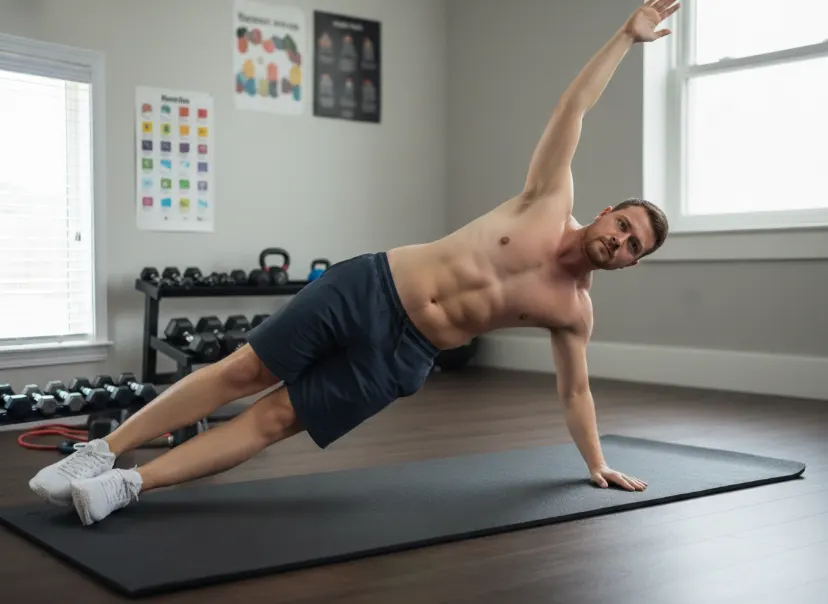
Man holding a side plank on a mat in a home gym, representing beginner guidance on how often should you train your abs.Best for: New to core training, rebuilding from scratch, or recovering from a long break.

  • Frequency: 2–3 ab sessions per week
  • Length: 10–15 minutes per session
  • Focus: Form, control, and breathing

Example exercises:

  • Dead Bug
  • Dead Bug March / Heel Taps
  • Glute Bridge
  • Bird Dog
  • Side Plank (knees)
  • Bent-Knee Plank

You don’t need to crush yourself. You just need consistent, quality reps.

Intermediate: 3–4 Times Per Week

Woman holding a forearm plank on a mat in a home gym, illustrating intermediate guidance on how often should you train your abs.Best for: You’ve been training regularly and know basic core movements.

  • Frequency: 3–4 ab sessions per week
  • Length: 10–20 minutes
  • Focus: Mix of stability, anti-rotation, and strength

Include variations like:

  • Full Plank
  • Longer Side Plank holds
  • Reverse Crunches
  • Dead Bugs with longer levers
  • Standing anti-rotation presses
  • Carries (farmer’s carry, suitcase carry)

You might:

  • Add 1–2 ab exercises at the end of 3–4 main workouts
  • Or have 2 slightly longer ab sessions + 1–2 shorter finishers

Advanced: 3–5 Focused Core Sessions Per Week

Man performing a hanging leg hold on a pull-up bar, demonstrating advanced core work tied to how often should you train your abs.Best for: Athletes, lifters, or people chasing serious core performance and aesthetics.

  • Frequency: 3–5 ab/core sessions per week
  • Length: 15–25 minutes (for focused sessions)
  • Focus:
    • Heavy and loaded core work
    • Advanced anti-rotation
    • Hanging or unstable exercises

Include options like (when you’re ready):

  • Hanging knee raises / leg raises
  • Weighted planks or cable crunches
  • Hard anti-rotation work
  • More advanced rotational drills (done safely)

Even at this level, you still need rest days. More volume is only better if you’re recovering and progressing.

Sample Ab Training Schedules

Here are some plug-and-play templates you can use or recreate in your app.

3-Day Full-Body Plan With Abs (Beginner–Intermediate)

Monday – Full Body + Core A

  • Main workout (full-body strength or circuits)
  • Core (10–12 minutes):
    • Dead Bug – 3 × 6–8/side
    • Glute Bridge – 3 × 10–12
    • Side Plank (knees) – 2 × 15–20 sec/side

Wednesday – Full Body + Core B

  • Main workout
  • Core:
    • Bird Dog – 3 × 6–8/side
    • Bent-Knee Plank – 2–3 × 20–30 sec
    • Heel Taps – 2–3 × 8–10/side

Friday – Full Body + Core A (Again)

Repeat Monday’s core plan or slightly progress:

  • Add a set
  • Add a few reps
  • Add a few seconds to holds

4–5 Day Plan With Short Ab Finishers (Intermediate)

Day 1 – Upper Body + Core

  • Main upper-body workout
  • Core finisher:
    • Plank – 2 × 30–40 sec
    • Reverse Crunch – 2–3 × 8–10

Day 2 – Lower Body

  • Main lower-body workout
  • (Optional small core: bird dogs between sets)

Day 3 – Conditioning + Core

  • Cardio, intervals, or sports
  • Core:
    • Dead Bug – 3 × 8/side
    • Side Plank – 2 × 20 sec/side

Day 4 – Upper/Full Body + Core

  • Main workout
  • Core:
    • Anti-Rotation Press – 2–3 × 8–10/side
    • Glute Bridge – 2–3 × 12–15

Day 5 – Optional Light Core / Mobility

  • Focus on:
    • Easier core moves
    • Mobility and stretching
  • No need to crush yourself, just maintain good activation and movement.

Should You Train Abs Every Day?

Muscular man in a home gym holding hands behind head, illustrating how often should you train your abs and recovery needs.Short answer: you don’t need to, and most people shouldn’t train them hard every day.

But let’s clarify.

When “every day” makes sense

Light, low-intensity core work can be done most days:

  • Easy dead bugs
  • Pelvic tilts
  • Glute bridges
  • Short posture/activation drills

These are more like movement hygiene than workouts.

When “every day” is too much

You’re doing too much if:

  • Your lower back is constantly tight or sore.
  • Your abs feel trashed and affect your main workouts.
  • Your form gets sloppy and painful.
  • You dread core day and keep skipping it.

For most people, the best combo is:

2–4 solid core sessions per week, with light activation as needed.

Signs You’re Training Abs Too Often (or Not Enough)

You might be doing too much if:

  • Your lower back hurts more than your abs.
  • Your form gets worse every set.
  • You’re constantly exhausted and don’t recover between sessions.
  • Your main lifts (squats, deadlifts, presses) are going down, not up.

You might be doing too little if:

  • You never feel your core working in squats, deadlifts, or daily life.
  • Your posture collapses easily when you get tired.
  • Your balance and stability feel shaky during basic moves.
  • You do “random” ab sets once in a while with no progression.

The sweet spot: You feel your abs working, you recover, and you’re able to slowly increase difficulty over time.

How Long Until You See Results From Ab Training?

There are two kinds of “results”:

  1. Stronger core (performance) – you’ll often notice this in weeks:
    • Better posture
    • Stronger lifts
    • Less wobble and more control
  2. Visible abs (aesthetics) – this depends on:
    • Starting body fat
    • Nutrition and overall activity
    • Genetics

For many people, with consistent training and a solid nutrition plan:

  • You’ll notice your waist getting tighter and more defined over a few months.
  • Deep, sharp six-pack lines may take longer and require lower body fat.

Remember: ab training alone doesn’t guarantee visible abs. You also need:

  • A calorie deficit (for fat loss)
  • Enough protein
  • Sleep, stress management, and patience

How Ab Training Fits With Fat Loss and Your Other Guides

Your ab frequency plan works best when it’s connected to the rest of your approach:

  • For overall roadmap and expectations, see your six-pack beginner guide.
  • For fat loss strategy, see your belly fat/science guide.
  • For what to eat, follow your nutrition for abs guide.
  • For actual exercises, use your best ab exercises for beginners routine.

Together, they cover:

  • What to do (exercises and frequency)
  • What to eat (nutrition and calories)
  • What to avoid (common myths and mistakes)

FAQs

Once a week is better than zero, but most people will progress faster and feel more stable with 2–3 sessions per week.

Yes, if:

  • You keep the intensity moderate.
  • You rotate exercises smartly.
  • You actually recover between harder sessions.

Just don’t turn every day into a “destroy your core” type workout.

Not necessarily. It can work, but for most people it’s more practical to:

  • Attach ab work to full-body, upper, or lower days.
  • Use 10–15 minute blocks at the end of sessions.

You can get a lot done in 10–15 minutes, especially if:

  • You choose 3–5 effective exercises.
  • You rest just enough to keep form sharp.
  • You don’t waste time between sets.

Final Checklist: Is Your Ab Training Frequency On Point?

I train abs 2–4 times per week, not just randomly.

I hit 10–20 total sets per week, spread over multiple days.

I give my core at least one day of real rest between hard sessions.

I progress over time (more reps, more time, or harder variations).

I combine ab training with good nutrition and full-body workouts.

I’m thinking in weeks and months, not quick fixes.

Dial in your frequency, stay consistent, and your core will absolutely respond, both in strength and in how your midsection looks as your overall body fat comes down.

Scroll to Top